LLVM Clang 22 compiler shows minimal performance differences compared to Clang 21 on AMD EPYC Zen 5 systems, with incremental gains in some workloads but no major breakthroughs in binary optimization.
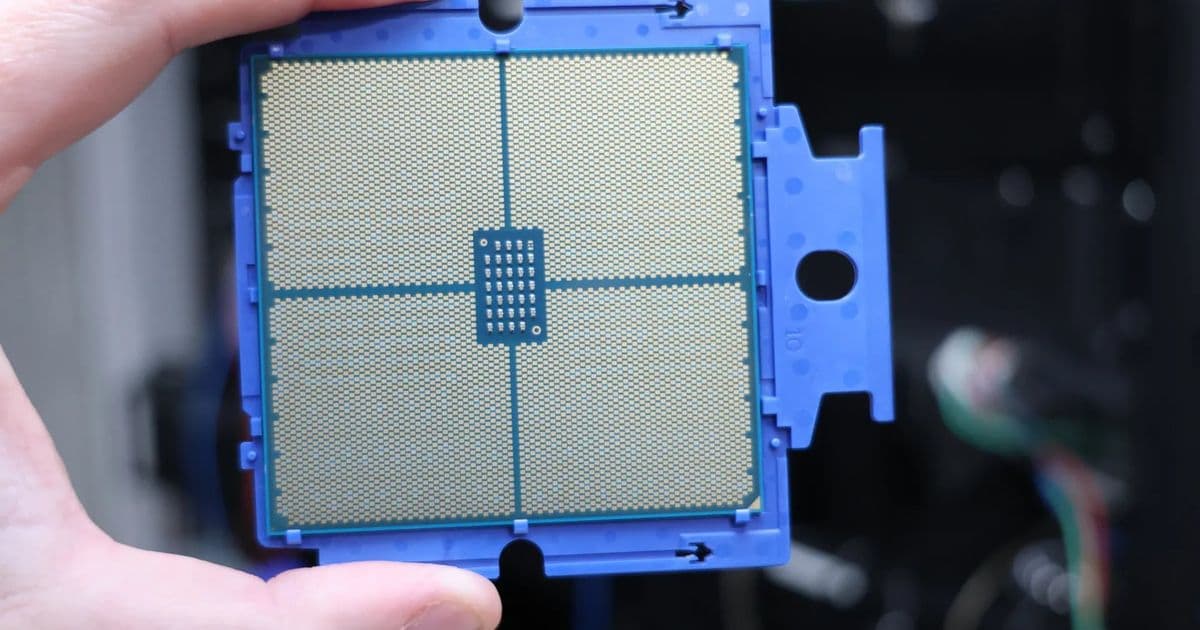
LLVM Clang 22 has been released as a stable compiler update, and initial benchmarking on AMD EPYC Zen 5 systems shows performance largely unchanged from Clang 21. Testing conducted on an AMD EPYC 9655P server with 96 Zen 5 cores and twelve channels of DDR5 memory reveals incremental improvements in some workloads but no significant breakthroughs in binary optimization.
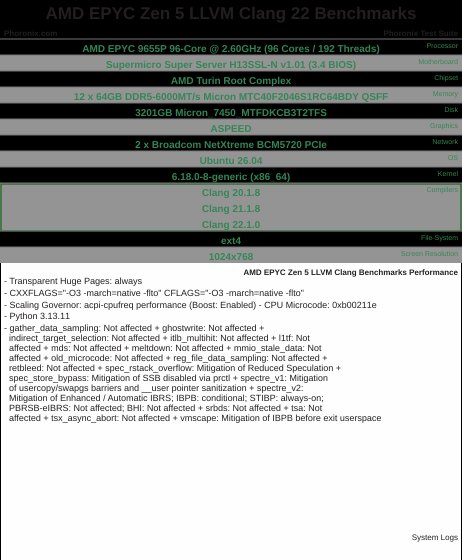
The benchmark comparison includes LLVM Clang 22.1.0, Clang 21.1.8, and Clang 20.1.8 across various open-source C/C++ workloads. The testing methodology involved building all software with CFLAGS/CXXFLAGS set to "-march=native -O3 -flto" to maximize performance optimization.
Performance Analysis
Initial results show that Clang 22 maintains the performance plateau that has characterized recent LLVM releases. While some workloads demonstrate small gains, the improvements are not dramatic compared to the significant leaps seen in earlier compiler versions. This stability in performance suggests that the LLVM/Clang compiler has reached a mature state where binary optimization is largely on par with GCC.
The neck-and-neck competition between LLVM/Clang and GCC continues, with both compilers delivering comparable performance for most workloads. Exceptions occur primarily when supporting new CPU instructions or implementing target-specific scheduling improvements, but these are becoming increasingly rare as both compilers mature.
Hardware Testing Platform
The primary testing platform was an AMD EPYC 9655P server, chosen for its high core count and memory bandwidth. This hardware configuration provides an excellent environment for compiler performance testing, as it can fully utilize the optimization capabilities of modern compilers. The twelve channels of DDR5 memory ensure that memory bandwidth is not a limiting factor in the benchmark results.
Build Configuration
All benchmarks were conducted with aggressive optimization flags: "-march=native -O3 -flto". This configuration enables:
- Native architecture optimization for maximum performance
- Level 3 optimization for aggressive code optimization
- Link-time optimization for whole-program optimization
These settings represent a common configuration for performance-critical applications and provide a realistic assessment of compiler capabilities in production environments.
Implications for Developers
The minimal performance differences between Clang 21 and Clang 22 suggest that developers can upgrade without expecting dramatic performance improvements. However, the stability and maturity of the LLVM/Clang toolchain make it a reliable choice for production builds. The compiler's ability to handle complex codebases like the Linux kernel continues to improve, making it a viable alternative to GCC for a wide range of projects.
Future Outlook
As compiler technology matures, we can expect fewer dramatic performance improvements and more incremental optimizations. The focus may shift toward better support for emerging hardware features, improved debugging capabilities, and enhanced developer experience rather than raw performance gains. The LLVM/Clang project has successfully established itself as a competitive alternative to GCC, and this stability is a positive sign for the open-source compiler ecosystem.
The benchmarking results confirm that LLVM/Clang has reached a level of maturity where it can reliably produce optimized binaries comparable to GCC, making it a solid choice for developers seeking a modern, well-supported compiler toolchain.
Comments
Please log in or register to join the discussion