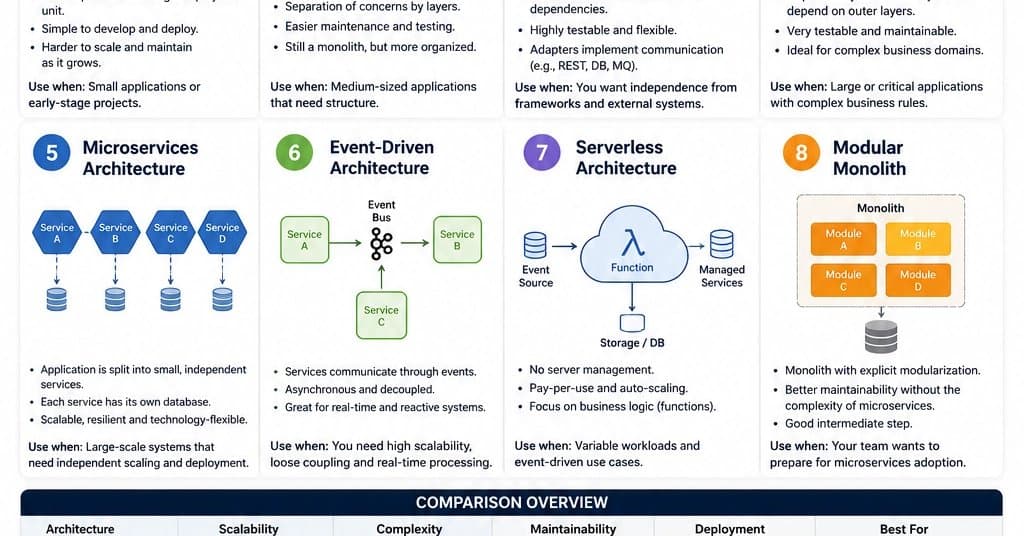
A pragmatic guide to Java architectural styles, their scalability impact, consistency concerns, and API design trade‑offs, helping engineers match the right pattern to project needs.
Choosing the Right Java Architecture
Java continues to dominate enterprise back‑ends because the language and its ecosystem give us stability and a rich set of libraries. The harder decision is often how to structure the code, especially when the system must grow, stay maintainable, and meet strict latency or consistency requirements. Below we break down the most common Java architectures, examine the problems they solve, and weigh the trade‑offs that matter in production.
1. The Problem: A Growing Codebase Becomes a Tangled Monolith
A new team starts with a single Spring Boot project. Everything—controllers, services, repositories—lives in one jar. Early on the build is fast, the CI pipeline is simple, and developers can push changes without coordinating across services. As user traffic climbs, the team notices three symptoms:
- Deployments take longer and a bug in one module forces a full restart.
- Scaling the web tier does not relieve database pressure because the whole app shares a single schema.
- Adding a new language‑specific client (e.g., a Go microservice) forces the Java team to expose REST endpoints that are tightly coupled to internal data models.
These issues point to high coupling and limited scalability—classic signs that a monolithic architecture is reaching its limits.
2. Solution Approaches and Their Trade‑offs
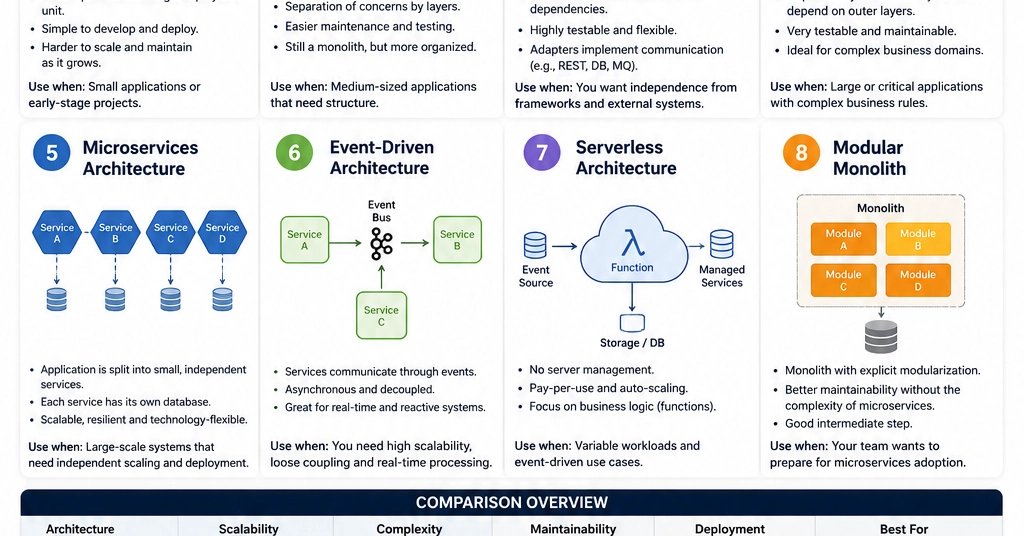
| Architecture | When It Helps | Core Consistency Model | API Pattern | Typical Trade‑offs |
|---|---|---|---|---|
| Monolithic (Spring Boot) | MVPs, small internal tools, teams < 5 | Strongly consistent within the single process | Direct method calls, simple REST controllers | Easy start, but tight coupling makes horizontal scaling expensive |
| Layered (Presentation → Business → Persistence) | Traditional enterprise back‑ends, clear domain boundaries | Transactional consistency via JPA/Hibernate | Synchronous REST/GraphQL endpoints | Clear separation, but layers can become leaky and duplicate validation logic |
| Hexagonal (Ports & Adapters) | Complex domains where the business core must stay framework‑agnostic | Consistency enforced by the core, adapters handle eventual consistency | Interfaces (ports) expose use‑case driven services; adapters implement HTTP, DB, or messaging | Higher initial abstraction cost; tests are easier because adapters can be swapped |
| Clean Architecture | Large teams building long‑lived products | Same as hexagonal, but adds concentric circles to enforce dependency direction | Use‑case interactor objects called from controllers or message listeners | Over‑engineering for small services; requires disciplined layering |
| Microservices | High traffic, multiple autonomous squads, polyglot environment | Each service chooses its own consistency (often eventual) | API‑first contracts (OpenAPI), gRPC, or async messaging | Distributed tracing, network latency, and operational overhead increase |
| Event‑Driven | Real‑time pipelines, fintech, e‑commerce order flows | Eventual consistency is the default; compensating transactions may be needed | Publish‑subscribe via Kafka, RabbitMQ, or cloud event buses | Debugging message ordering and replay can be tricky |
| Serverless (Java on Lambda, Cloud Functions) | Sporadic workloads, cheap prototyping, short‑lived jobs | Stateless functions give per‑invocation consistency; external stores decide durability | Function handlers invoked by HTTP, queues, or storage events | Cold‑start latency, limited heap size, harder local debugging |
2.1. Monolith → Layered → Hexagonal → Microservices (A Migration Path)
- Start with a monolith built on Spring Boot. Keep the codebase small, use Maven or Gradle for builds, and expose a few REST controllers.
- Introduce layers once the code exceeds a few thousand classes. Separate
@Controller,@Service, and@Repositorypackages; enforce transaction boundaries with@Transactional. - Extract ports for any external dependency (e.g., a payment gateway). Define interfaces in a
domainmodule and implement adapters in separate modules. This isolates the core from framework changes. - Split services when a bounded context grows beyond a single JVM’s memory or when a team needs independent deployment cadence. Deploy each service in Docker containers managed by Kubernetes, using Spring Cloud for service discovery and OpenFeign for typed HTTP clients.
- Add an event bus if you need asynchronous communication between services. Publish domain events from the core and let other services react without tight coupling.
3. Consistency Implications Across Styles
- Strong consistency is natural in a monolith or layered app because a single transaction can span the whole request. JPA’s
EntityManagerguarantees ACID properties when the database supports it. - Hexagonal and Clean architectures keep the consistency contract inside the core. If a use case needs a two‑phase commit across two databases, the core orchestrates it; adapters merely provide the plumbing.
- Microservices usually relax to eventual consistency. Techniques such as the Saga pattern or outbox polling help keep data in sync without a distributed transaction manager.
- Event‑driven systems push consistency concerns to the consumer side. Consumers must be idempotent and be prepared to handle duplicate or out‑of‑order events.
- Serverless functions are stateless, so any consistency must be achieved through external stores (DynamoDB, Cloud SQL) or by chaining functions with Step Functions.
4. API Design Patterns and Their Fit
| Pattern | Fits Best With | Reason |
|---|---|---|
| CRUD Controllers | Monolith, Layered | Simple request/response, low latency |
| Command‑Query Separation (CQS) | Hexagonal, Clean | Keeps write‑side pure, read‑side can be optimized separately |
| Domain‑Driven Design (DDD) Aggregates | Hexagonal, Clean, Microservices | Enforces invariants inside the core, maps naturally to service boundaries |
| Event Sourcing | Event‑Driven, Microservices | Guarantees a complete audit log, but adds storage and replay complexity |
| GraphQL | Serverless, Microservices (gateway) | Allows clients to request exactly the shape they need, reducing over‑fetching |
5. Practical Recommendations
- If you are a solo developer or a startup: start with a plain Spring Boot monolith. Keep the package layout flat, use Spring Data JPA, and ship early.
- When the codebase hits 10‑15 k lines: introduce a layered structure. Move business logic into a
servicepackage and keep data access isolated. - If the domain has strict regulatory rules or you anticipate multiple UI clients: adopt hexagonal or clean architecture early. Write unit tests against the ports; you’ll avoid costly rewrites later.
- For traffic that spikes above 10 k RPS or when multiple squads need autonomy: break the monolith into microservices. Deploy each service in its own Docker image, use Kubernetes for scaling, and let Kafka handle cross‑service events.
- When you need to process bursts of events (e.g., payment notifications): add an event‑driven layer on top of microservices. Publish to a topic, let a consumer service handle retries and dead‑letter queues.
- If you have infrequent, short‑lived workloads: consider serverless functions. Write a small handler, let the cloud provider manage scaling, and pay only for execution time.
6. Best Practices Across All Styles
- Apply SOLID principles – they keep each class focused and make swapping adapters trivial.
- Use dependency injection – Spring’s
@Autowiredor constructor injection keeps the core decoupled from frameworks. - Separate domain from infrastructure – place pure business rules in a
coremodule that has no Spring annotations. - Instrument observability – structured logs, Prometheus metrics, Grafana dashboards, and OpenTelemetry traces help you see where latency or failures occur, especially in distributed setups.
- Automate CI/CD – GitHub Actions, Jenkins, or GitLab CI can build Docker images, run JUnit/Mockito tests, and push to a registry.
7. Tools and Resources
- Spring Boot – the de‑facto starter for Java services. https://spring.io/projects/spring-boot
- Spring Cloud – service discovery, circuit breakers, and distributed configuration. https://spring.io/projects/spring-cloud
- Quarkus – a lightweight runtime that shines in serverless environments. https://quarkus.io
- Kafka – the go‑to platform for event‑driven pipelines. https://kafka.apache.org
- Docker & Kubernetes – containerization and orchestration for microservices. https://kubernetes.io
- OpenTelemetry – vendor‑neutral tracing and metrics. https://opentelemetry.io
8. Closing Thoughts
Choosing an architecture is not about chasing the newest buzzword. It is about matching the system’s consistency requirements, scalability goals, and team capabilities to a pattern that keeps the codebase testable and the deployment pipeline manageable. Start simple, evolve deliberately, and always keep the business core insulated from framework churn. That discipline is what separates a maintainable Java platform from a fragile code dump that breaks under load.

Comments
Please log in or register to join the discussion