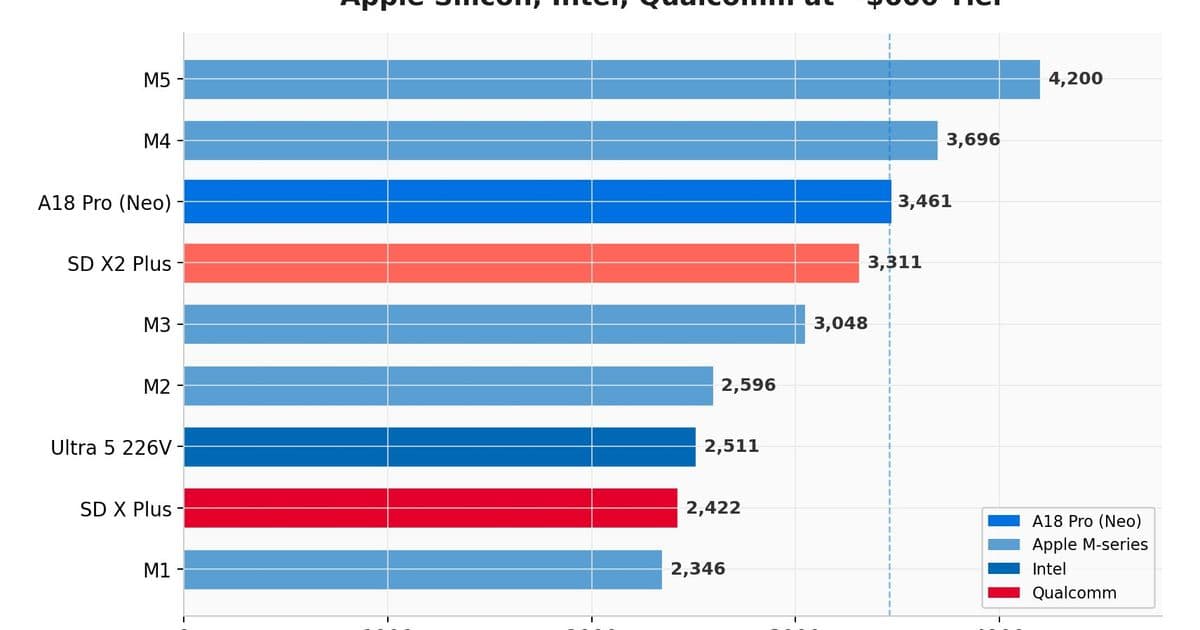
The MacBook Neo uses Apple's A18 Pro processor (from iPhone 16 Pro) in a fanless aluminum chassis at $599. Benchmarks show single-core performance between M3 and M4, but significant thermal throttling after 60 seconds. The article analyzes the silicon economics, wafer costs, and strategic decisions behind Apple's entry-level Mac.
MacBook Neo Processor Benchmarks: A18 Pro CPU vs M1 and M4
Apple's MacBook Neo, released in March 2026 at $599, represents a significant shift in Apple's laptop lineup by using the A18 Pro processor—the same chip found in the iPhone 16 Pro. This article provides a deep dive into the actual performance characteristics, thermal behavior, architectural comparisons, and the economics that make this unprecedented price point possible.
Benchmark Results: More Than Meets the Eye
The headline benchmarks for the MacBook Neo show impressive Geekbench 6 scores: 3,569 single-core and 8,879 multi-core in cold start conditions. These numbers place the A18 Pro's single-core performance between the M3 and M4, while its multi-core performance is closer to the original M1.
However, these numbers only tell part of the story. When testing under different thermal conditions, the results reveal significant performance variation:
- Cold start (fan-assisted): 3,569 single-core, 8,879 multi-core
- Development workload (with Claude Code active): 709 single-core, 1,305 multi-core (-80%)
- After thermal soak (5-minute stress test): 476 single-core, 1,340 multi-core (-87%)
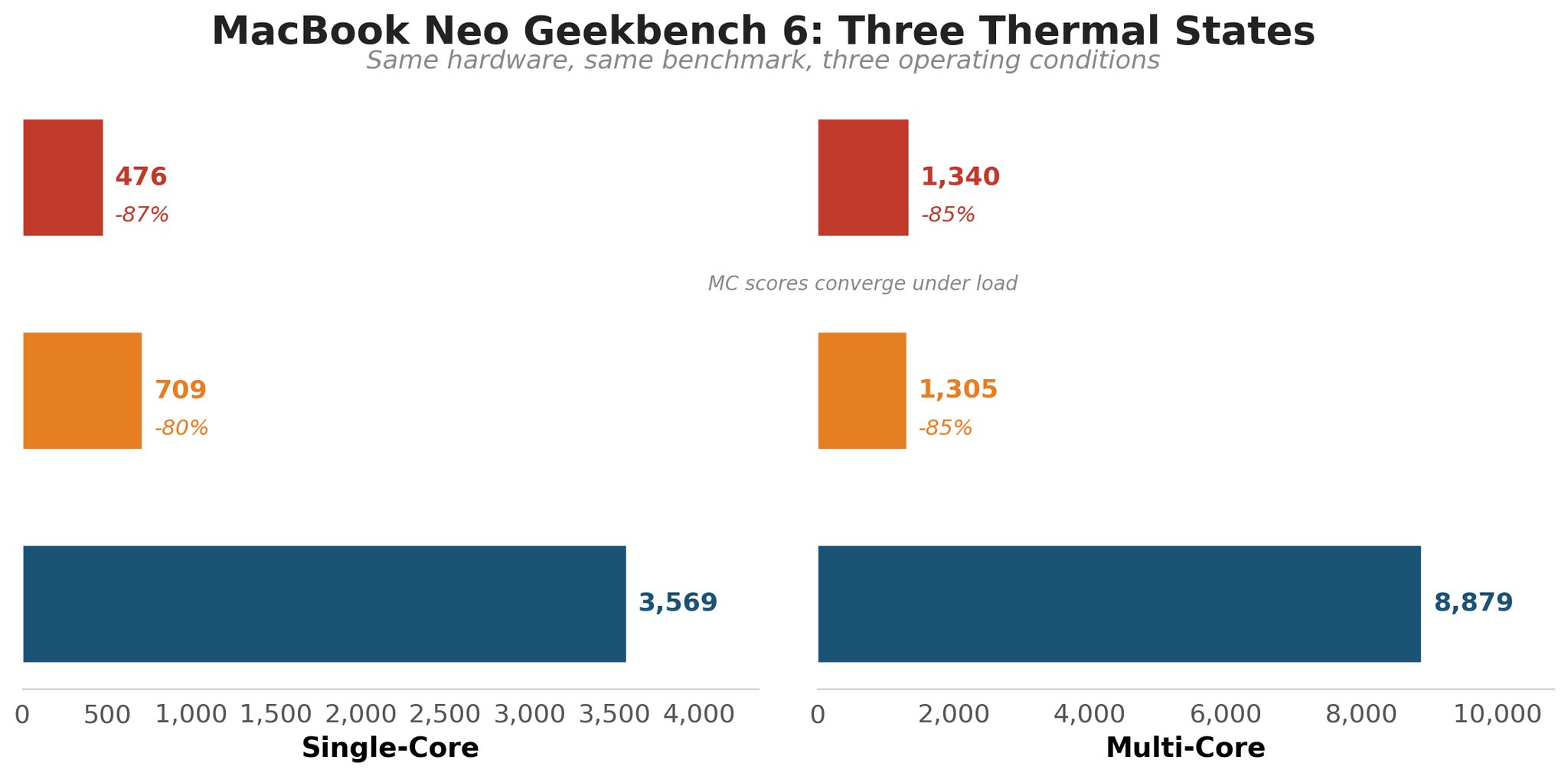 MacBook Neo Geekbench 6 scores across three thermal states
The most dramatic finding is the 87% reduction in single-core performance after sustained load. This occurs because the A18 Pro hits its thermal limit (approximately 105°C) and throttles aggressively. The chip delivers full performance for about 60 seconds before thermal throttling drops CPU utilization by 64% in just 15 seconds.
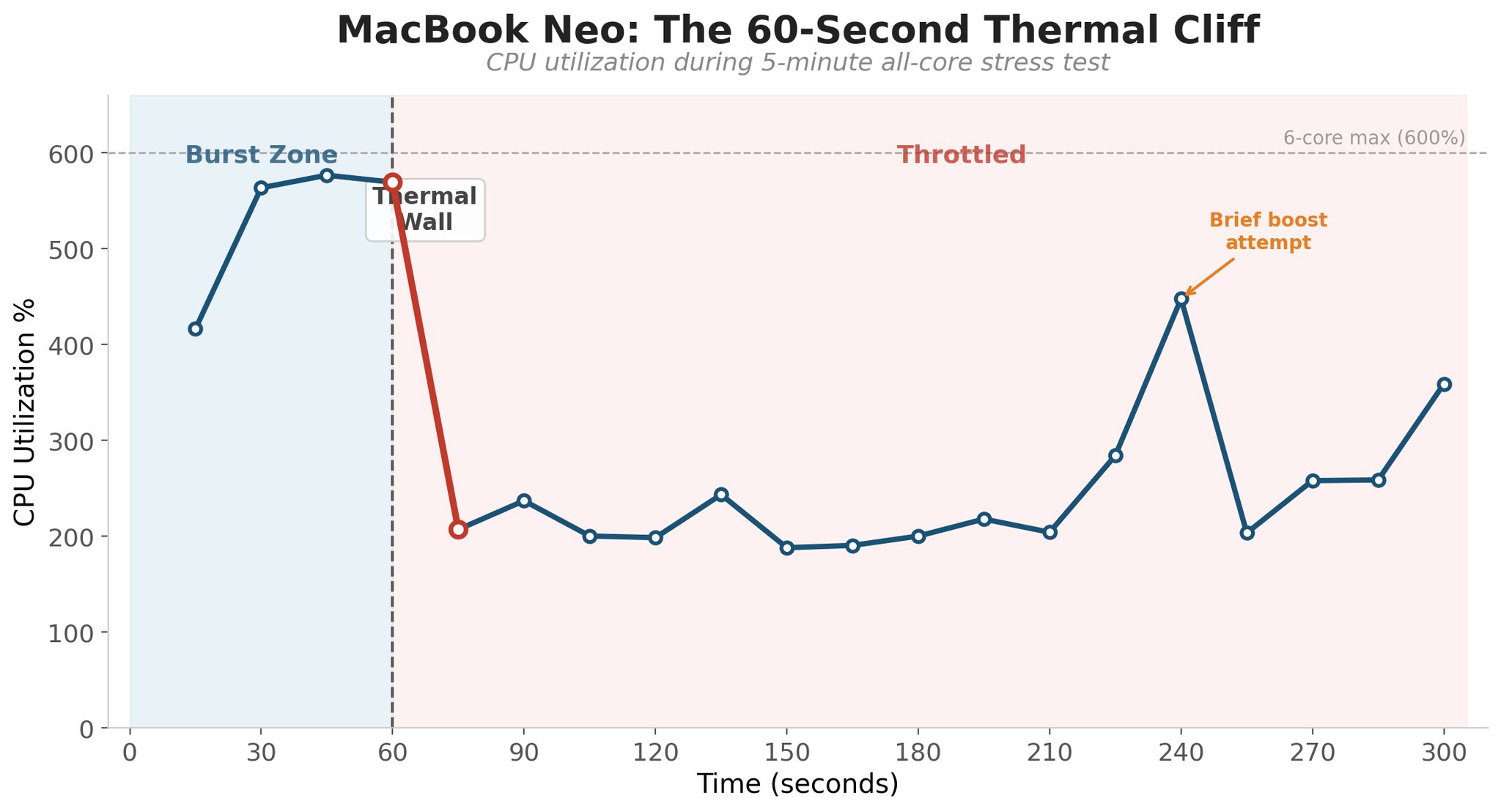 MacBook Neo 60-second thermal cliff timeline
Apple made a deliberate design choice prioritizing comfort over sustained power. During sustained load, the chassis temperature reaches only 97.6°F (36.4°C)—barely above body temperature—while the internal chip temperature reaches 105°C. This thermal management ensures the laptop remains comfortable to use on your lap but comes at the cost of sustained performance.
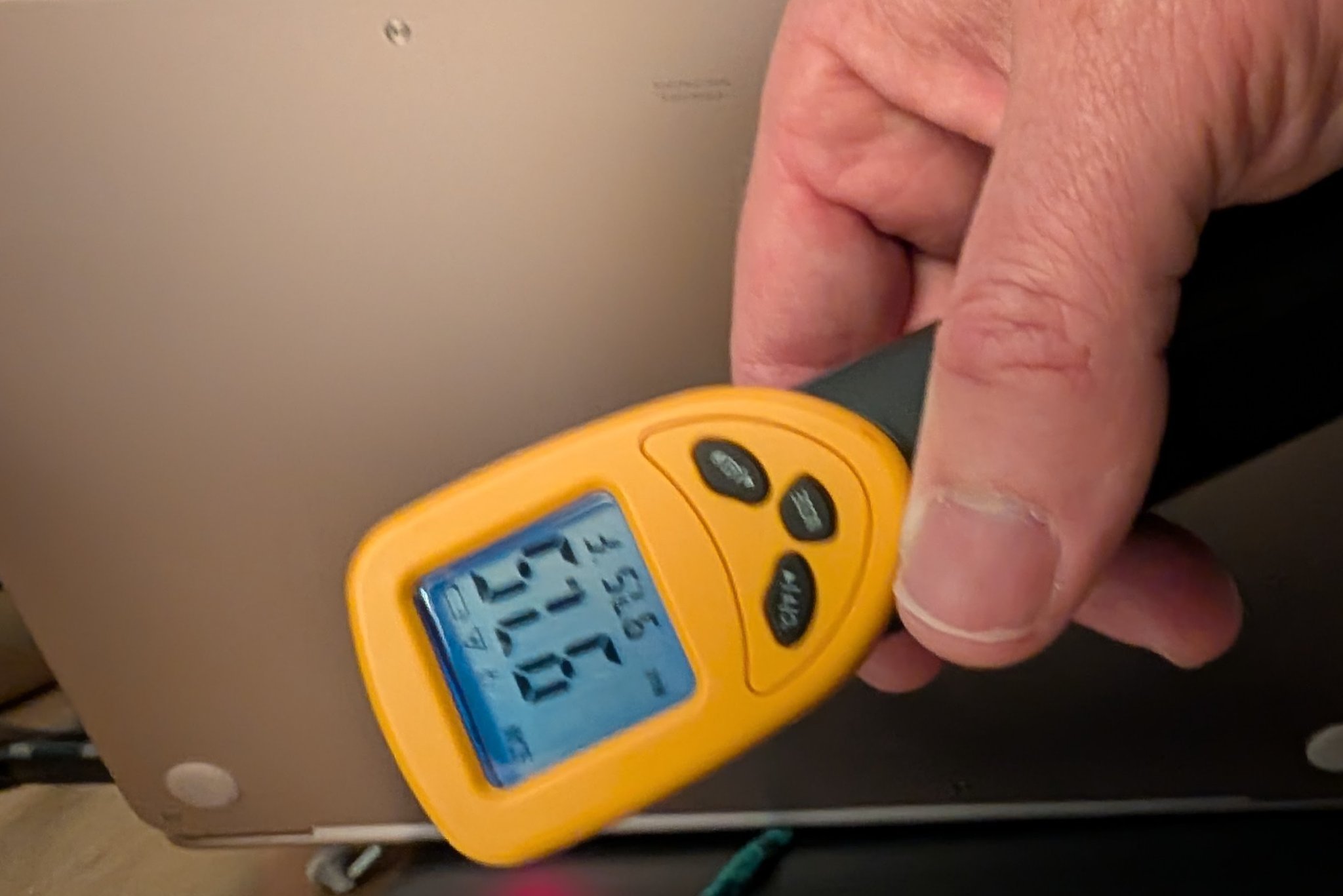 IR thermometer reading 97.6F on MacBook Neo chassis during sustained load
Architecture: A18 Pro vs M-series
The internet discourse has focused on whether an "iPhone chip" belongs in a Mac. Architecturally, this framing is misleading. The A18 Pro and M4 share the same core DNA:
- Both use ARMv9.2-A instruction set
- Both feature Apple's custom Everest performance cores and Sawtooth efficiency cores
- Both are fabricated on TSMC's N3E 3nm process
- Both achieve approximately 857 points per GHz in Geekbench (identical IPC)
The key differences are at the system level:
| Attribute | A18 Pro | M4 |
|---|---|---|
| CPU cores | 2P + 4E (6 total) | 4P + 6E (10 total) |
| GPU cores | 5 | 10 |
| Memory bandwidth | 60 GB/s | 120 GB/s |
| System Level Cache | 24 MB | 16 MB |
| Thermal envelope | ~10W peak | ~20-25W sustained |
| I/O | USB 3 + USB 2 | Thunderbolt 4, PCIe 4.0 |
The memory bandwidth difference (60 vs 120 GB/s) is particularly significant for memory-intensive workloads. The A18 Pro compensates with a larger System Level Cache, but this doesn't fully eliminate the bandwidth limitation.
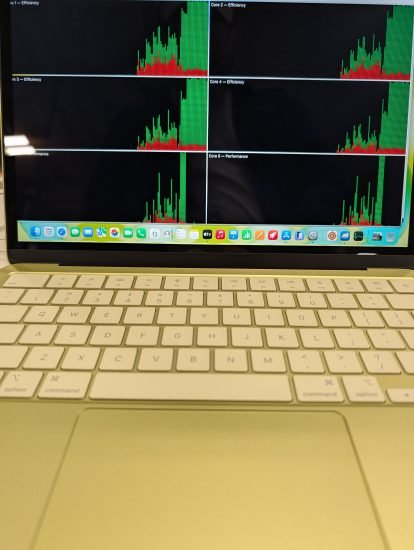 Activity Monitor on the MacBook Neo showing all six cores (4 efficiency + 2 performance) during benchmark testing
Silicon Economics: How Apple Hits $599
The MacBook Neo's price becomes less surprising when examining the chip economics. The A18 Pro die measures approximately 105 mm² on TSMC N3E, confirmed by TechInsights die photography. This small die size results in significant cost advantages:
- 25% smaller than the M4 (~140 mm²)
- 76% smaller than the M4 Max (~440 mm²)
Smaller dies yield more chips per wafer and have higher yield rates. With approximately 586 gross dies per wafer and 85-90% yields after 16 months of production, Apple gets 498-527 good dies per wafer. At an estimated wafer cost of $18,000-$20,000, this works out to $34-40 per die before packaging and test—roughly $38-47 per fully loaded SoC.
The A18 Pro has been in volume production since September 2024, with all mask costs and design engineering amortized across approximately 230 million iPhones. The marginal cost to Apple of routing these dies into the Neo is minimal.
Additionally, the Neo may use binned A18 Pro dies that failed their sixth GPU core during iPhone production—a common industry practice that further improves effective yield.
The 8GB RAM Decision: Strategic, Not Just Cheap
The most common criticism of the MacBook Neo is its 8GB RAM ceiling with no upgrade path, especially when competitors at this price point ship with 16GB. This decision looks stingy until considering the 2026 DRAM market context.
The 2026 DRAM shortage is not a typical supply/demand cycle but a structural reallocation of global memory fabrication capacity toward AI infrastructure. High Bandwidth Memory (HBM) for AI accelerators consumes approximately 3x the wafer area per gigabyte compared to standard DDR5 or LPDDR5x. Samsung, SK Hynix, and Micron control 93% of global DRAM production and have reallocated up to 40% of advanced wafer output to HBM.
The pricing impact has been dramatic:
- DDR5 32GB kits that cost $120 in Q3 2025 hit $350 by Q1 2026
- Memory's share of a PC's bill of materials rose from 16% to 23%
- Gartner projects a 90-95% quarter-over-quarter jump in PC DRAM contract prices
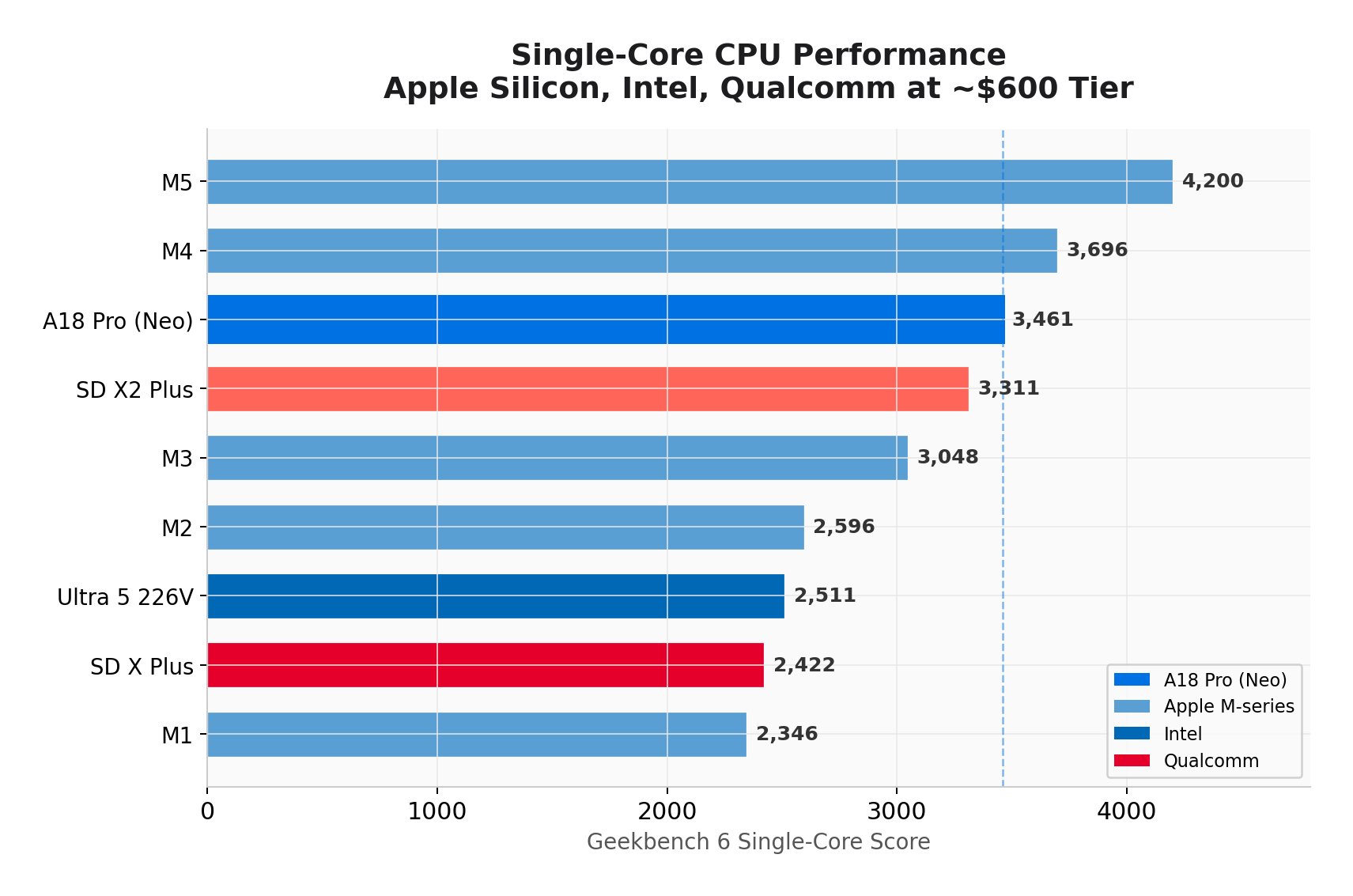 Featured image: MacBook Neo single-core benchmark results
Apple's 8GB decision is strategic on multiple levels:
- Cost savings: At shortage pricing, 8GB of LPDDR5x costs $25-35, while 16GB would add another $25-35 per unit
- Engineering constraint: The A18 Pro was designed for the iPhone 16 Pro, which has always shipped with 8GB
- Pricing umbrella: As competitor laptop prices rise 15-20%, Apple's fixed $599 becomes more competitive
- Ecosystem math: A Neo buyer who subscribes to iCloud+ and Apple One generates $240-480 in services revenue over 2 years
Who Should (and Shouldn't) Buy This
The MacBook Neo excels at:
- Web browsing, email, document editing
- Streaming media and messaging
- Light photo work
- Running Apple Intelligence on-device
It is not suitable for:
- Development work, especially with large codebases
- Content creation or video editing
- Virtual machines
- Heavy multitasking
- Applications that regularly exceed ~1.5-2GB of available memory
The I/O limitations are also significant: one USB 2.0 port is functionally useless for data transfer, no Thunderbolt means no fast external storage, and charging occupies your only USB 3 port.
The Bottom Line
The MacBook Neo is genuinely impressive engineering at an unprecedented price point. The A18 Pro is not a compromise chip but the same core architecture as the M4, delivering M3-to-M4 class single-threaded performance. Apple reused mature iPhone silicon at massive scale, eliminated incremental R&D cost, and shipped a product with healthy margins at $599.
The defining constraint is the 8GB memory ceiling—a product of engineering constraint, market economics, and strategic calculation. While it will age poorly and is not upgradeable, Apple's second-generation Neo with 12GB or 16GB is already the obvious follow-up product.
In March 2026, with sub-$500 PCs disappearing and average laptop prices climbing 17%, the MacBook Neo represents the most strategically significant product Apple has shipped in years—not because it's the best Mac, but because it's the most accessible entry point into Apple's ecosystem.
Comments
Please log in or register to join the discussion