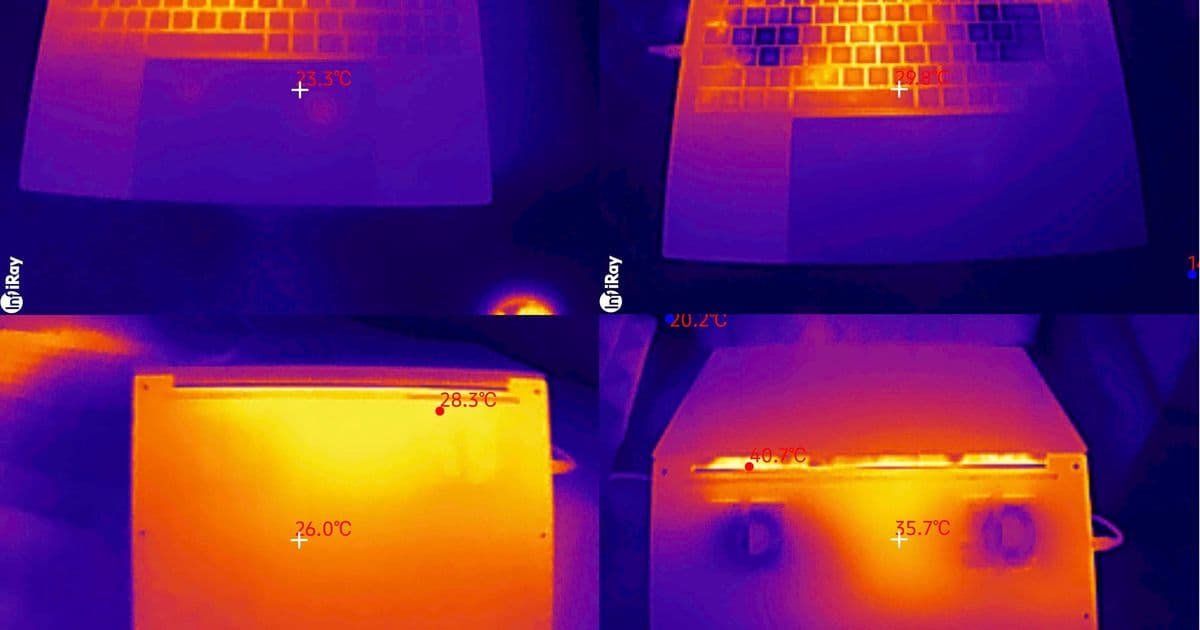
The Acer Swift 16 showcases an effective cooling system that keeps temperatures in check even when pushing its Panther Lake processor to its limits, making it an attractive option for users who need performance without the heat issues common in slim laptops.
What's New: Advanced Cooling Design in a Slim Package
The Acer Swift 16 introduces a sophisticated cooling solution that defies expectations for a slim aluminum chassis laptop. Unlike many ultraportables that struggle with thermal management under load, the Swift 16 employs a dual-fan cooling system that efficiently dissipates heat from its high-performance components. A standout feature is the innovative air intake design, which draws fresh air not only through the bottom of the chassis but also through strategic gaps in the keyboard deck. This dual fresh-air intake approach is typically reserved for high-end gaming laptops and significantly improves thermal performance while keeping contact surfaces cool.
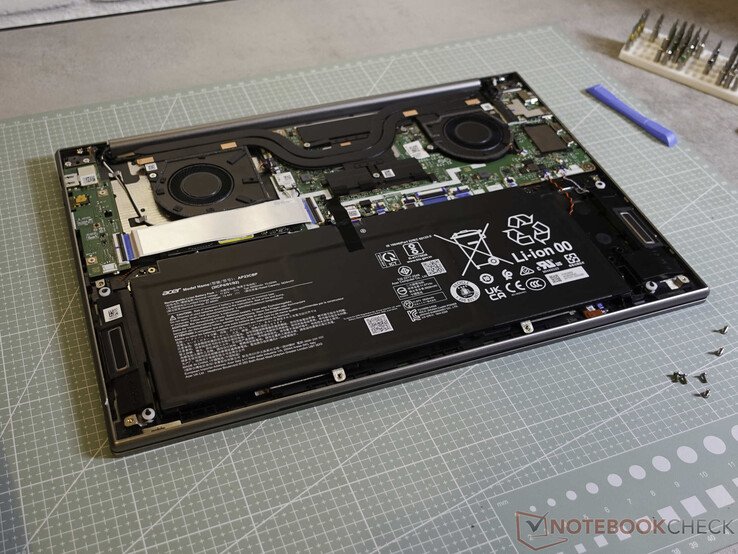
During our testing, we observed that this cooling system effectively manages heat from the Panther Lake processor, allowing it to deliver strong performance without the thermal throttling that plagues many competitors. The palm rests and other contact surfaces remain almost entirely cool to the touch, even during extended periods of intensive use.
How It Compares: Thermal Performance Benchmark
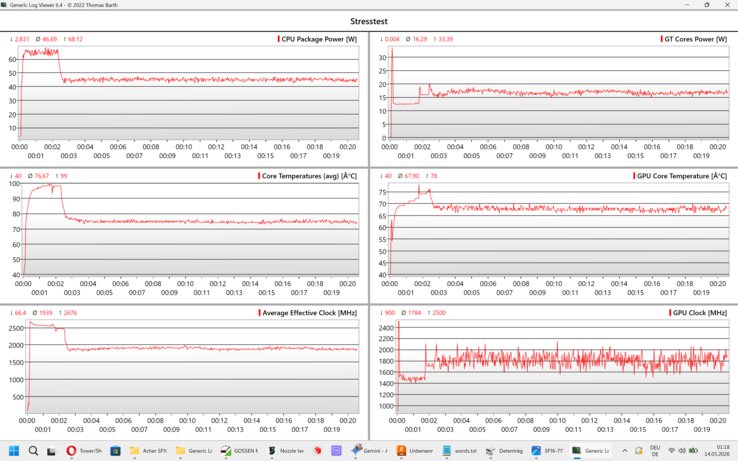
When subjected to stress testing, the Acer Swift 16 demonstrates impressive thermal dynamics. The processor can briefly draw a peak power of approximately 68 watts, causing core temperatures to spike up to 99°C. This initial high-power phase is typical for modern processors that briefly boost performance before settling into sustained operation.
After this initial phase, the system stabilizes at a sustained power draw of 45 watts, with temperatures settling at a non-critical 75°C. This represents a significant improvement over many ultraportables that either throttle performance more aggressively or run at higher temperatures. Meanwhile, the integrated graphics unit maintains consistent temperatures between 68°C and 70°C, indicating balanced thermal management across components.
The cooling system's effectiveness is further evidenced by how little internal heat reaches the exterior of the laptop. Most ultraportables in this class struggle with heat dissipation, often resulting in uncomfortably warm keyboard decks or palm rests. The Swift 16 avoids these issues through its efficient heat pipe design and strategic vent placement.
One design consideration worth noting is the position of the exhaust vents, which direct hot air toward the lower section of the OLED panel. While measured display temperatures remain within acceptable limits, prolonged exposure to heat can potentially impact the long-term lifespan of organic light-emitting diodes. This is a trade-off that many thin-and-light laptops with OLED displays face, as the display technology is more sensitive to heat than traditional LCD panels.
Noise Performance: Balancing Cooling and Acoustics
The Swift 16's cooling system becomes audible under full load but remains within acceptable parameters for its performance class. Under maximum stress, the device reaches a sound pressure level of 48.4 dB(A) when measured at a distance of 15 cm from the chassis. This places it in the moderate range for ultraportables, quieter than many gaming laptops but noticeably louder than basic ultrapooks.
What sets the Swift 16 apart is the frequency profile of its fan noise. The noise is concentrated in the lower frequencies between 2,000 Hz and 6,000 Hz, which means the laptop avoids the annoying high-pitched whistling that many users find particularly distracting. This lower-frequency noise is generally less fatiguing during extended use.
For users who prioritize quiet operation, Acer provides multiple cooling modes. The normal cooling mode operates at 39 dB(A), while a silent mode reduces noise to just 27 dB(A). These significantly quieter settings are ideal for office work or less demanding tasks where maximum performance isn't required. The ability to balance performance and noise levels gives users flexibility depending on their environment and needs.
Who It's For: Performance-Minded Users Without Compromise
The Acer Swift 16 appears particularly well-suited for professionals and content creators who need reliable performance in a portable form factor. The effective cooling system makes it a strong contender for those who regularly run demanding applications like video editing, programming environments, or development tools that push hardware limits.
Students and frequent travelers will appreciate the combination of portability and sustained performance. Unlike many ultraportables that throttle performance after just a few minutes of intensive tasks, the Swift 16 maintains consistent performance thanks to its thermal management system.
The cooling design also benefits users who work in various environments. The ability to switch between performance and silent modes makes it adaptable to quiet libraries, busy offices, or noisy co-working spaces. This flexibility extends the laptop's usability across different scenarios without requiring users to sacrifice either performance or quiet operation.
For users specifically concerned about display longevity, the heat management toward the lower portion of the OLED panel might be worth considering, especially for those who plan to use the laptop for intensive tasks over several years. However, the overall temperature management appears to keep display temperatures within safe operating ranges.
In conclusion, the Acer Swift 16 represents a successful implementation of thermal engineering in a slim chassis. By incorporating design elements typically found in larger, more powerful laptops, Acer has created a device that doesn't compromise performance for portability. The dual-fan system with innovative air intake, combined with multiple cooling modes, makes it an attractive option for users who need reliable performance without the heat-related issues common in ultraportables.
Comments
Please log in or register to join the discussion