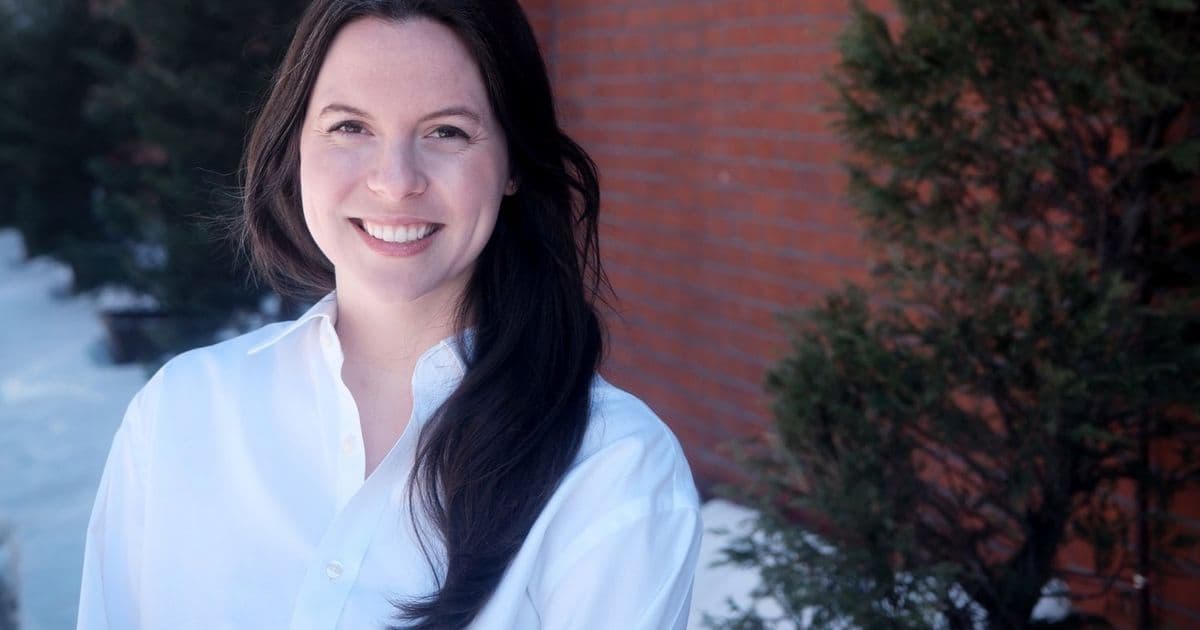
The new host of MIT's Ask MIT Climate podcast discusses her journey into science communication, the importance of connecting climate change to everyday life, and what makes MIT an exciting place for climate knowledge sharing.
Since her first journalism fellowship covering energy and the environment at the NPR station in Harrisburg, Pennsylvania, Madison Goldberg has been drawn to science communication and audio storytelling. Now, after reporting on topics from solar storms to sewer systems to cryptography, she's bringing her passions to MIT as the new host of the Institute's climate change podcast.
Launched in 2019 as TILclimate, the show began its eighth season this year with a new name: Ask MIT Climate. But the podcast's mission remains the same: teaming up with scientists and subject matter experts to bring listeners clear, accessible information on climate change topics in 15 minutes or less.
In this interview, Goldberg talks about her path to science communication, the ideas she thinks it's important for climate communicators to convey, and what makes MIT an exciting place to share knowledge with the world.
Finding Her Voice in Science Communication
Goldberg's journey into science communication wasn't a straight path. Her first love in science was astronomy, sparked by childhood nights spent looking at the stars. She had the opportunity to do an internship in high school at UC Santa Cruz with a professor in their astronomy department.
"Space kind of puts everything in the biggest possible perspective, and for me, that's a very calming thing," Goldberg explains. However, in college, she found herself drawn to Earth science, which she describes as exciting because "pretty much all the sciences are somehow involved. You know, you got chemistry, biology, physics... everything all rolled into one."
What ultimately drew her to science communication was the realization that she was especially compelled by learning about scientific topics and then talking to people about them. In her senior year of college, she discovered that science communication and science journalism were viable career paths.
"I took a science podcasting course that year — which I still can't believe even existed — and I got my first taste of interviewing people and working in audio, which was just incredible," she recalls. Having been a longtime podcast listener, the medium felt familiar and exciting.
The Importance of Connecting Climate to Everyday Life
When asked what's important for science communicators to convey about climate change, Goldberg emphasizes one central idea: climate change affects every single aspect of our lives.
"One of the ideas that I try to always keep in mind, and that I think is really important to convey, is that climate change affects every single aspect of our lives. And we need to communicate about it accordingly," she explains. "I think it's crucial to consider the ways climate change intertwines with all these other realms of people's experiences; it affects where we live, it affects what we eat, it affects the economy, it affects our health."
This approach of not treating climate change in isolation is central to Goldberg's philosophy. She believes that approaching it in isolation doesn't seem to be the most productive framework. Instead, communicators have a responsibility to listen, learn, and talk about the many varied ways that climate change shows up in people's lives.
Goldberg also highlights a central theme in Ask MIT Climate: that working towards climate solutions not only allows us to avoid the worst impacts of climate change but can also help make people's lives better in other ways. This perspective allows for thinking expansively about the future we want to build.
Why MIT is Special for Climate Communication
For Goldberg, MIT represents an exciting place to be engaged in climate communication for several reasons. First and foremost is the generosity and kindness of the people she's encountered there.
"The folks that I've talked to at MIT are just so kind and generous with their time. And these people are so busy! They have so much on their plates, and yet, somehow, even when I have a million follow-up questions, extremely prominent researchers will hop on a Zoom or exchange emails to answer them," she says. "I feel so lucky to be part of this community."
Beyond the personal connections, Goldberg appreciates the interdisciplinary climate work happening at MIT. She notes that tackling climate change is a generational challenge that requires inputs from all kinds of fields. At MIT, there are multiple centers and initiatives dedicated to different aspects of climate work, including the Climate Project, the Climate Policy Center, the Center for Sustainability Science and Strategy, and the Living Climate Futures Lab.
"All of these ways to approach the issue and bring folks into the conversation who have different expertise, experiences, and perspectives," she explains. "I think it's really special to be at MIT, to see that happen in real-time, and to see students, faculty, and staff working to bridge across subject matter boundaries."
The Power of Audio Storytelling
Goldberg's background in audio storytelling brings a unique dimension to climate communication. The Ask MIT Climate podcast, with its commitment to delivering clear, accessible information in 15 minutes or less, represents an ideal format for reaching audiences who might be intimidated by longer, more technical content.
In Season 8, Episode 1 of the podcast, Goldberg speaks with MIT D-Lab Lecturer Julie Simpson about marshes, mangroves, and meadows, demonstrating how the show tackles specific, tangible aspects of climate science and solutions.
What makes audio particularly powerful for climate communication is its accessibility and intimacy. Listeners can engage with complex topics while commuting, exercising, or doing household tasks. The conversational format allows for natural explanations that can make difficult concepts more approachable.
Gratitude and Responsibility
Throughout the interview, Goldberg returns to themes of gratitude and responsibility. She expresses deep appreciation for the people inside and outside of MIT who have shared their work and lives with her.
"All I can hope to do is to communicate that information faithfully," she says. "Because I think there's a huge number of people who are curious about climate change and what we can do about it, and who want to learn."
This sense of responsibility to communicate faithfully while making complex topics accessible encapsulates the challenge and opportunity of science communication in the age of climate change. For Goldberg, it's not just about conveying facts, but about building connections between scientific understanding and people's lived experiences.
The Ask MIT Climate podcast represents one approach to meeting this challenge, using the power of audio storytelling to make climate science and solutions accessible to a broad audience. As Goldberg continues her work at MIT, she brings both the enthusiasm of a lifelong learner and the skills of a trained communicator to help bridge the gap between climate science and public understanding.
Comments
Please log in or register to join the discussion