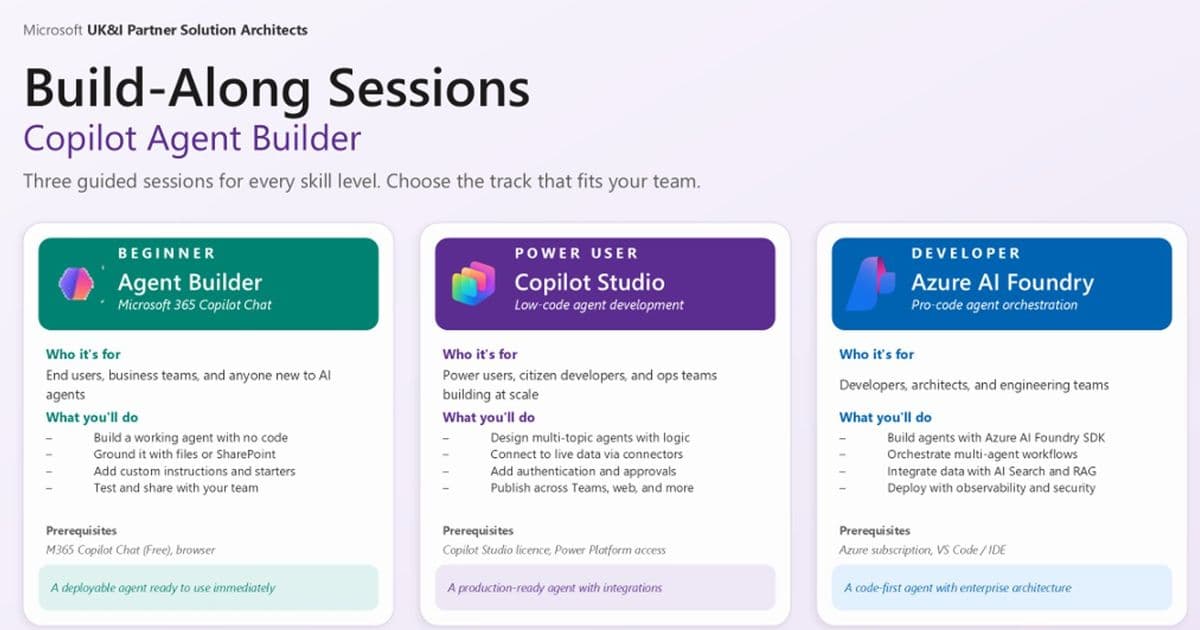
Microsoft's new Agent Build-Along Series provides partners with a self-serve repository of ready-to-run workshops across three tiers of its AI platform, enabling customers to build functional AI agents tailored to their specific industry and business needs.
Microsoft Launches Agent Build-Along Series to Democratize AI Agent Development
Microsoft has introduced a comprehensive Agent Build-Along Series designed to help partners and customers build functional AI agents across different skill levels and use cases. This initiative addresses the diverse needs of various user types, from business makers who want no-code solutions to professional developers requiring code-first environments with advanced evaluation capabilities.
What Changed: The Agent Build-Along Series
The Agent Build-Along Series introduces a structured approach to AI agent development through a self-serve GitHub repository. This repository contains curated workshops organized across three axes: industry (Financial Services, Healthcare, Retail, etc.), business function (Sales, Marketing, Finance, etc.), and workload tier (Agent Builder, Copilot Studio, Azure AI Foundry).
Each session includes real-world scenarios, step-by-step instructions, sample data, prompts, and facilitator narratives. Partners can select the appropriate session based on their customers' needs and run it with minimal preparation, eliminating the need for bespoke content creation.
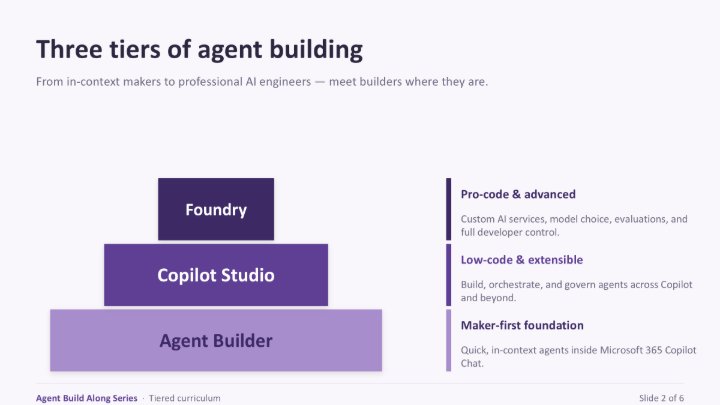 Diagram illustrating three tiers of agent building, showing progression from Maker-first foundation to Pro-code & advanced levels.
Provider Comparison: Three Tiers for Different Needs
The three-tier approach meets builders where they are in their journey:
Tier 1: Microsoft 365 Copilot Agent Builder
- Target Audience: Business makers, end users, departmental teams
- Duration: 60 minutes
- Approach: No-code
- Key Activities: Define → Ground → Refine → Test & Share
- Outcome: A working agent in Microsoft 365 Copilot that can be immediately shared with colleagues
- Best For: Departmental teams wanting to operationalize Copilot without engineering involvement
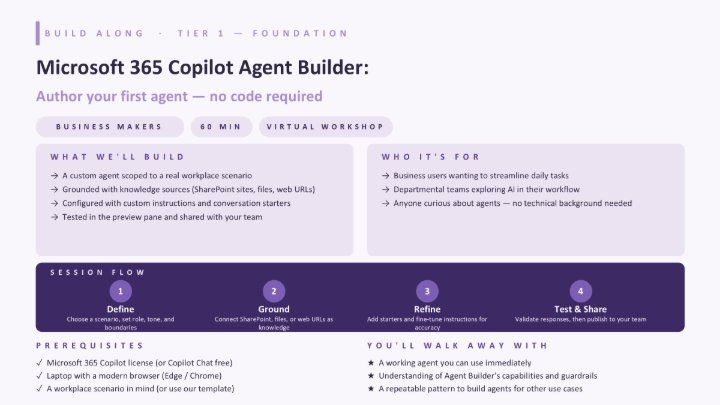 Screenshot of a Microsoft 365 Copilot Agent Builder virtual workshop overview, detailing session purpose and flow for business makers.
Tier 2: Copilot Studio
- Target Audience: Citizen developers, power users, operations teams
- Duration: 90 minutes
- Approach: Low-code
- Key Activities: Design → Connect → Author → Publish
- Outcome: A published copilot running in Teams or on the web, connected to enterprise systems
- Best For: Turning manual processes into orchestrated, agent-driven workflows
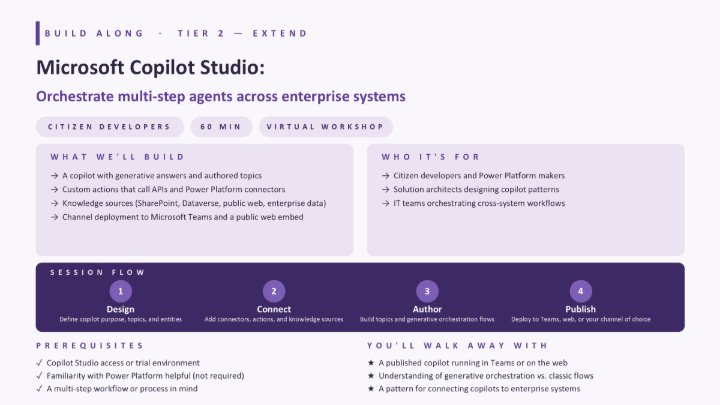 Screenshot of a workshop overview for Microsoft Copilot Studio, detailing a virtual 60-minute session aimed at citizen developers and Power Platform makers.
Tier 3: Azure AI Foundry
- Target Audience: Professional developers, architects, AI engineers
- Duration: 180+ minutes
- Approach: Code-first
- Key Activities: Provision → Build → Evaluate → Deploy
- Outcome: A deployed agent with evaluations, tracing, and SDK templates
- Best For: Shipping agents into production with enterprise-grade governance
Business Impact: From Theory to Practice
This initiative significantly lowers the barrier to entry for AI agent development across Microsoft's ecosystem. By providing ready-to-run sessions tailored to specific industries and business functions, Microsoft enables partners to deliver immediate value to customers rather than just theoretical concepts.
For customers, this means they can leave workshops with functional agents rather than just presentations. For partners, it reduces the overhead of content creation while ensuring consistent quality across engagements.
The tiered approach acknowledges that different users have different needs and skill levels, addressing a common pain point in AI adoption where one-size-fits-all solutions often fail to meet specific requirements.
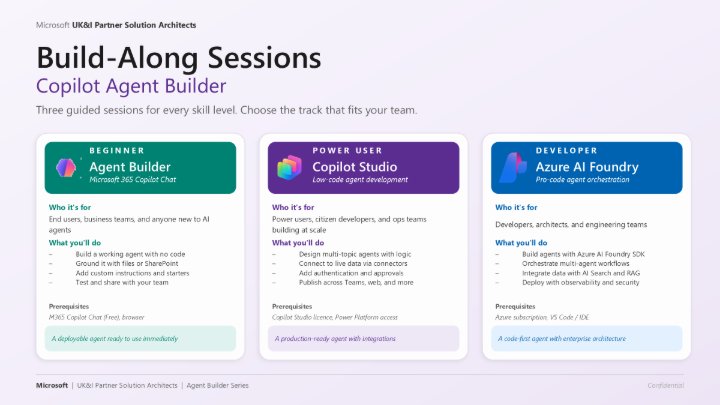 A screenshot of a three-column table outlining Build-Along Sessions for Copilot Agent Builder, targeting beginner, power user, and developer skill levels.
Implementation Details: The Self-Serve Repository
The Agent Build-Along GitHub repository serves as a central catalog of workshops. Each session is carefully curated and includes:
- A real-world scenario grounded in the selected industry and business function
- Step-by-step build instructions appropriate for the selected tier
- Sample data for the agent to ground against
- Prompts, conversation starters, and configuration snippets
- Facilitator narrative to ensure anyone can run the session
The repository is organized along three axes, allowing partners to quickly find the right session for their specific needs. For example, a partner working with a healthcare client might select the Copilot Studio tier with a patient-flow scenario, while a financial services client might benefit from the Azure AI Foundry tier with a deal-desk scenario.
What Attendees Walk Away With
Regardless of the tier selected, attendees leave with tangible assets:
- Agent Builder: A working agent in Microsoft 365 Copilot, ready to share with colleagues
- Copilot Studio: A published copilot running in Teams or on the web, connected to enterprise systems
- Foundry: A deployed Foundry agent with evaluations, tracing, and SDK templates for the next build
In all cases, attendees leave with assets—not slides—and the confidence to build the next one without facilitation.
Conclusion
Microsoft's Agent Build-Along Series represents a strategic approach to democratizing AI agent development across its ecosystem. By providing tiered solutions that meet users where they are, Microsoft addresses the diverse needs of its customer base while enabling partners to deliver tangible value. The self-serve repository model ensures scalability and consistency, making it easier for organizations of all sizes to begin their AI journey with confidence.
For partners looking to get started, Microsoft recommends browsing the self-serve repository of Build-Along sessions, which are curated by industry and business function with step-by-step instructions ready to run: Agent Build Along.
This initiative reflects Microsoft's broader strategy to make AI development accessible across different skill levels while maintaining the depth and sophistication required for enterprise-grade solutions. By addressing the full spectrum of user needs—from no-code to code-first environments—Microsoft is positioning itself as a comprehensive platform for AI agent development.
Comments
Please log in or register to join the discussion