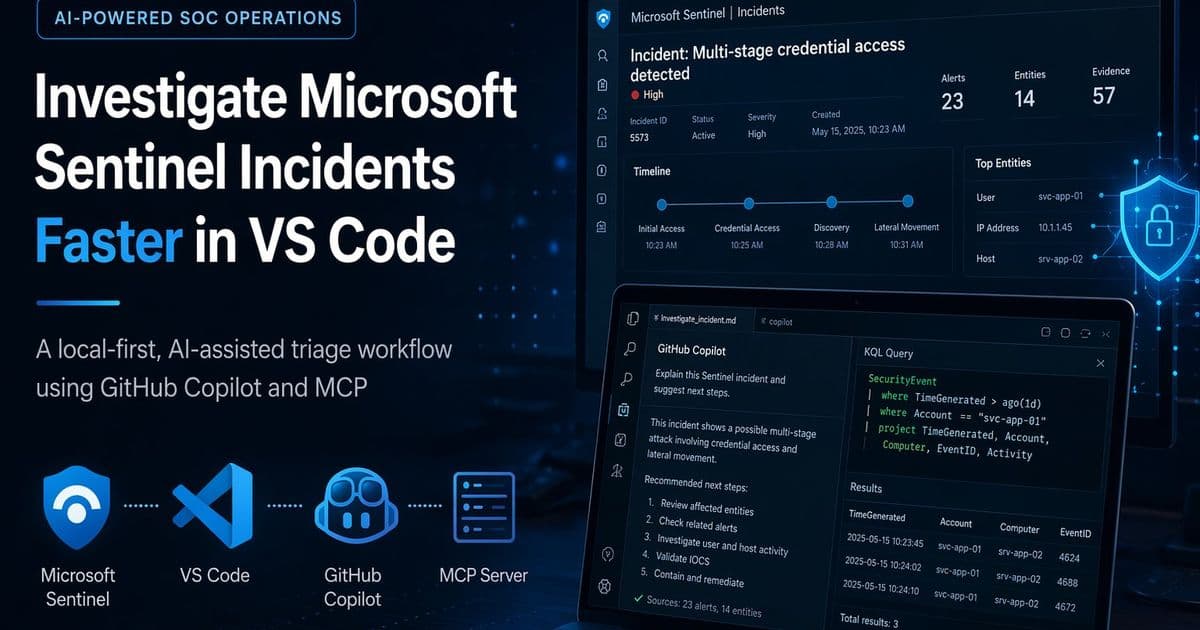
A new approach to Microsoft Sentinel incident investigation that combines local development environments with AI-powered triage, reducing context switching while maintaining security controls and improving analyst efficiency.
The security operations landscape continues to evolve with Microsoft's introduction of a local-first Sentinel triage workflow that bridges the gap between cloud-native security platforms and developer-centric tools. This innovation addresses a critical pain point in modern security operations: the friction between cloud-based security platforms and the development environments where many security analysts now work.
What Changed in the Microsoft Sentinel Ecosystem
Microsoft Sentinel, Azure's cloud-native SIEM, has traditionally operated through a portal-based interface that requires analysts to navigate multiple contexts. The new approach introduces a local TypeScript MCP (Model Context Protocol) server that enables direct interaction with Sentinel APIs from within Visual Studio Code. This represents a fundamental shift from cloud-only workflows to hybrid cloud-local operations.
The architecture exposes a controlled set of triage tools to Copilot Chat in VS Code, creating a deterministic environment where:
- Reads come directly from Sentinel and Log Analytics APIs
- Writes (incident comments) are optional and require explicit approval
- The entire workflow remains traceable and auditable
This approach specifically addresses the reliability issues common in cloud security operations where subresource APIs can be inconsistent. The solution implements a fallback mechanism to KQL queries when direct API access fails, ensuring continuous investigation capabilities.
Provider Comparison: Traditional vs. Local-First Triage
When comparing traditional cloud-based triage workflows with this new local-first approach, several key differences emerge:
Traditional Cloud-Only Workflows:
- Require constant context switching between portal, KQL, and case notes
- Dependent on API availability and portal responsiveness
- Limited automation capabilities without complex scripting
- Write operations typically require direct portal interaction
Local-First Copilot Integration:
- Consolidates investigation within a single environment (VS Code)
- Implements deterministic tooling with defined interfaces
- Provides reliability through API fallback mechanisms
- Maintains safety boundaries through approval-gated operations
From a cloud provider perspective, this approach represents a hybrid model that leverages Microsoft's cloud services while allowing local processing and reasoning. It's particularly valuable for organizations with hybrid cloud strategies or those managing security across multiple cloud providers.
Migration Considerations
Organizations considering adopting this local-first triage approach should evaluate several factors:
Technical Requirements:
- TypeScript development environment
- Azure CLI authentication setup
- Microsoft Sentinel API access permissions
- VS Code with GitHub Copilot Chat extension
Operational Changes:
- Analyst training on new workflows
- Updated incident response procedures
- Modified playbooks to incorporate approval gates
- Enhanced logging for audit purposes
Security Implications:
- Local processing of security data
- Token management for API access
- Tool surface reduction as a security benefit
- Explicit approval mechanisms for state changes
Business Impact
The implementation of this local-first triage workflow delivers measurable business value across several dimensions:
Operational Efficiency:
- Reduced context switching between tools and environments
- Faster incident resolution through streamlined workflows
- More consistent investigation processes across the SOC team
Risk Management:
- Improved accuracy through evidence-based narratives
- Safer automation with explicit approval gates
- Reliable operation even when cloud APIs experience issues
Cost Considerations:
- Potential reduction in incident response time
- Lower training costs through familiar development environments
- Improved analyst productivity through workflow consolidation
The approach specifically addresses the growing challenge of data-rich security environments where the bottleneck shifts from data collection to investigation efficiency. By grounding AI assistance in deterministic tooling and maintaining human oversight for critical operations, this workflow represents a pragmatic evolution of security automation.
For organizations implementing multi-cloud strategies, this approach offers particular value as it can be adapted to work with other cloud providers' security tools while maintaining the local development workflow. The MCP server architecture provides a pattern that could extend beyond Microsoft Sentinel to other security platforms.
The business case centers on improved analyst efficiency, reduced operational friction, and enhanced security outcomes through more reliable and consistent incident response. As security operations continue to evolve toward developer-centric approaches, this hybrid cloud-local model may represent a significant step forward in security automation.
For technical implementation details, refer to the Microsoft Community Hub post and explore the GitHub Copilot documentation for development environment setup.
Comments
Please log in or register to join the discussion