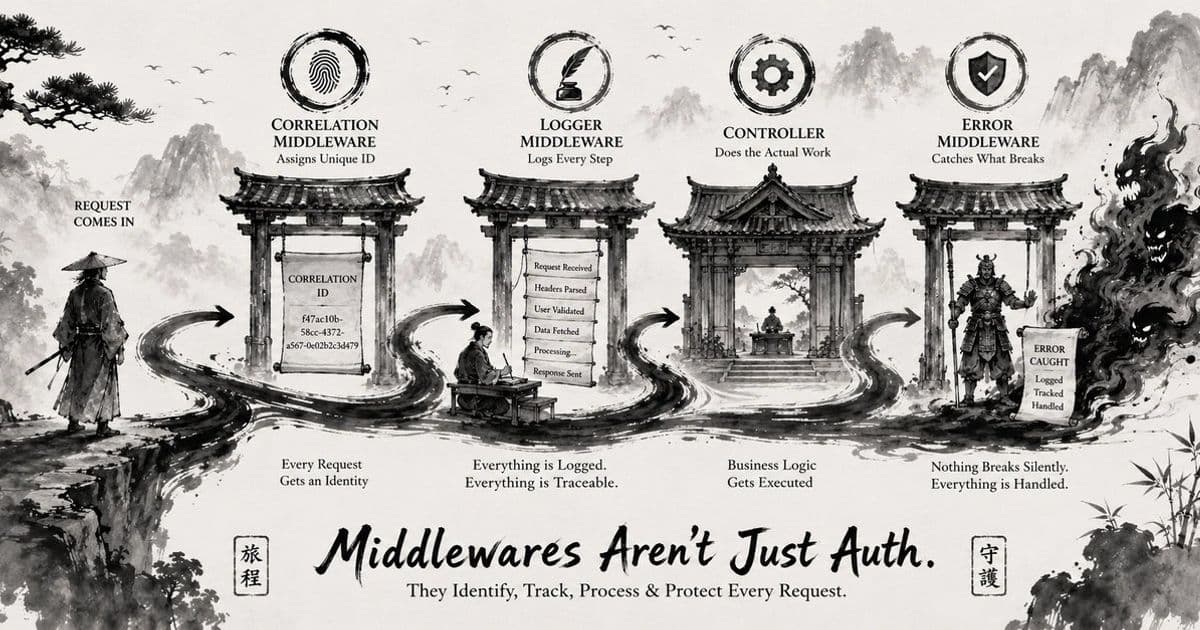
Most developers think middleware is just authentication with extra steps. Four production middlewares proved that wrong.
Most of us think middleware is for one thing: verify the user, check the token, move on. I thought the same. For a long time, when someone said middleware, I thought authentication. That's it. One step before the controller runs, check if the user is allowed, done.
But when I started learning more about how production systems actually work, my perspective completely changed. Middleware is not just a gatekeeper. It's the entire processing layer that runs before, during, and after your controller. And three specific middlewares changed how I think about this.

Correlation Middleware: For Every Request Gets an Identity
In a production system, hundreds of requests are happening at the same time. If something goes wrong, how do you find exactly which request caused the problem? That's what correlation middleware solves.
Before the request even reaches the controller, this middleware creates a unique ID for that request using randomUUID. Every single event that comes into your system gets its own identity, a personal ID that travels with it through the entire execution flow.
This ID is not just for the request. It's for your logs. When something breaks in production, you don't search through thousands of log lines hoping to find the right one. You search by correlation ID and you find every single log entry connected to that specific request. Where it started, what happened, where it failed.
Without this, debugging in production is guessing. With this, it's tracing.
Logger Middleware: What's Happening at Every Step
Once the request has its correlation ID, it moves to the logger middleware. This middleware logs each event during the entire execution flow. Not just at the start, not just at the end, every step. The correlation ID from the first middleware travels with every log entry, so everything stays connected and traceable.
In development you can just console.log things and move on. But in production, you need a proper record of what happened, in what order, with what data. Logger middleware does that automatically for every request without you writing logging code inside every controller.
Controller: The Actual Work
After passing through correlation and logger middleware, the request finally reaches the controller. This is where the actual business logic runs. By this point, the request already has an identity and everything happening is being logged.
Error Middleware: When Things Go Wrong
The last middleware in the chain is error middleware. Every production system will have errors. The question: are those errors handled properly or do they just silently fail?
Error middleware catches what goes wrong during the entire execution flow and creates a proper track record of it. And because the correlation ID is already attached to the request, every error log is also traceable back to the original request.
This is the last line of defense before something breaks without you knowing.
How the Flow Actually Looks
Request comes in → Correlation Middleware (assigns unique ID) → Logger Middleware (starts logging with that ID) → Controller (does the actual work) → Error Middleware (catches anything that breaks)
Every step is connected. Every step is traceable. Nothing gets lost.
What Changed for Me
I used to think middleware was just about who is allowed in. Now I think of it as the system that makes sure every request is identified, tracked, and handled from the moment it arrives to the moment it exits.
This is the difference between an app that runs and an app you can actually debug when something goes wrong in production. That's the real role of middleware.
MongoDB

Build seamlessly, securely, and flexibly with MongoDB Atlas. Try free.
MongoDB Atlas lets you build and run modern apps in 125+ regions across AWS, Azure, and Google Cloud. Multi-cloud clusters distribute data seamlessly and auto-failover between providers for high availability and flexibility.
Comments
Please log in or register to join the discussion