Lenovo's maxed-out ThinkPad P16 Gen 3 pairs an Intel Core Ultra 9 275HX with 192GB of DDR5, an RTX Pro 5000 Blackwell GPU, and a 1,500-nit tandem OLED. It is a genuine local-AI workstation, but the 105W GPU ceiling and 180W power brick reveal where Lenovo drew its engineering lines.
Mobile workstations occupy a strange corner of the laptop market. They borrow the chassis language of gaming machines, the color accuracy ambitions of content-creation laptops, and the reliability expectations of enterprise hardware, then ask you to pay for all three at once. The Lenovo ThinkPad P16 Gen 3 sits at the top of that pile, and the maxed-out configuration is about as loaded as a 16-inch notebook gets in 2026.
{{IMAGE:1}}
What's new
The headline configuration is built around Intel's Core Ultra 9 275HX, the company's top HX-class mobile chip, paired with a staggering 192GB of DDR5 memory and a 4TB SSD. That memory figure is the part worth pausing on. For years, 64GB was the practical ceiling for all but a handful of workstation notebooks, and 128GB was exotic. Lenovo offering 192GB in a portable machine signals where local AI inference and large in-memory datasets have pushed professional demand. If you are running quantized large language models, large simulation workloads, or multi-application virtualization on-device, system RAM stops being a checkbox and becomes the whole point.
Graphics come from an Nvidia RTX Pro 5000 Blackwell GPU with 24GB of VRAM. The Pro-class silicon matters here for reasons beyond raw frame rates. Professional drivers, ECC memory support, and certification for CAD and DCC applications are the actual reasons buyers in this segment pay the premium over a consumer GeForce part. The 24GB framebuffer also lets the GPU hold larger models and scene data resident, which is the difference between a workflow that runs and one that swaps constantly.
The display is a tandem OLED panel at 3200 x 2000 resolution, 120Hz, and up to 1,500 nits of peak HDR brightness. Tandem OLED, which stacks two emissive layers to share the load, is the same approach Apple brought to its iPad Pro line, and it addresses OLED's traditional weaknesses around sustained brightness and burn-in longevity. On a workstation that may display static UI elements for ten hours a day, that durability argument is more than marketing.
How it compares
Relative to its predecessor, the Gen 3 has actually become more portable, which is the kind of sentence you rarely get to write about a machine this specified. Lenovo's engineering team trimmed the chassis while keeping the component ceiling high, and a notebookcheck review of a lower-tier configuration described it bluntly as a "local AI monster." That portability gain is the single most interesting story in this generation, because the usual trade for this much hardware is a desktop-replacement brick you resent carrying.
There are real compromises behind the spec sheet, though, and they cluster around power delivery. The RTX Pro 5000 is capped at a 105-watt TGP, well below what the same GPU can draw in a thicker chassis or a desktop. More pointedly, the notebook ships with only a 180-watt power supply. Under a combined CPU and GPU load, that 180W budget can be overwhelmed, meaning the machine will throttle to stay inside its power envelope rather than sustain peak clocks. For a buyer comparing raw GPU model numbers against a larger workstation or a desktop, this is the asterisk that matters. The silicon is capable of more than this chassis lets it deliver.
{{IMAGE:4}}
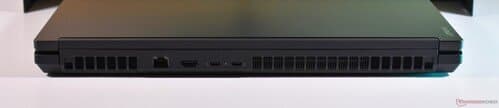
Connectivity is where the ThinkPad lineage shows its strengths. Port selection includes Thunderbolt 5, HDMI, and 2.5GbE wired networking, the combination that distinguishes a true workstation from a thin-and-light pretending to be one. Thunderbolt 5 roughly doubles the bandwidth ceiling of TB4, which is genuinely useful when you are driving external GPUs, high-resolution multi-monitor setups, or fast external storage arrays. The 2.5GbE port is the quiet hero for anyone moving large files across a studio or lab network. This generation also brings back a replaceable Wi-Fi module after a period of soldered wireless, a small but welcome reversal for users who care about repairability and long-term upgrades.

Who it's for
This is not a laptop you buy on impulse, and the maxed-out configuration carries a list price near $14,499. That number alone defines the audience. This is hardware for engineers running on-device AI inference, simulation specialists, 3D artists working with large scenes, and developers who need a workstation-class machine that can occasionally leave the desk. For those users, the 192GB of RAM and 24GB of VRAM are not bragging rights, they are the entry requirements for the work.
For everyone else, including professionals who think they might want this much headroom, the honest recommendation is to look one or two tiers down. A 128GB configuration with the same GPU delivers most of the capability for meaningfully less money, and most workflows that don't specifically need 192GB will never touch the difference. The power-delivery ceiling is also worth weighing against a desktop or a larger workstation if sustained full-load performance is your priority rather than portability. The ThinkPad P16 Gen 3 is an impressive piece of engineering precisely because it crams this much into a more portable frame, but that same achievement is what forces the compromises on TGP and PSU. Knowing where those limits sit is the whole job of buying at this level.
{{IMAGE:3}}
Comments
Please log in or register to join the discussion