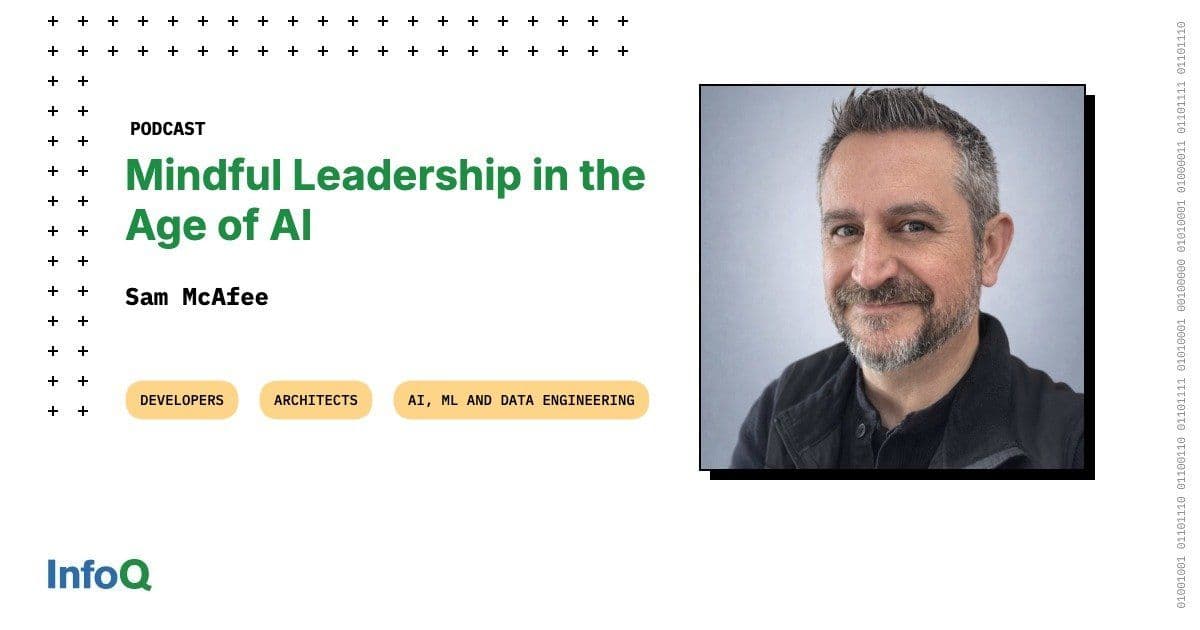
Sam McAfee discusses how AI hype is reshaping organizational behavior, why many companies struggle with experimentation, and how unclear decision structures create friction. He explores psychological safety and mindful leadership as essential foundations for healthier, more effective engineering cultures.
In this episode of The InfoQ Podcast, Thomas Betts speaks with Sam McAfee, a Silicon Valley veteran with over 25 years of experience leading technology organizations. They discuss how AI hype is reshaping organizational behavior, why many companies struggle with experimentation, and how unclear decision structures create friction. The conversation explores psychological safety and mindful leadership as essential foundations for healthier, more effective engineering cultures.
Startup vs. Enterprise: Why Big Companies Struggle to Innovate
McAfee explains that he typically gets brought into organizations after they've experienced some success and are now facing scaling challenges. "When the stuff that used to work, now because of our success, is starting to crack in the foundation, for a variety of reasons, is usually when I get brought in."
The core issue is that large organizations are optimized for stability, not experimentation. While startups embrace iterative development and Lean Startup principles involving lots of experiments and customer conversations, established companies struggle to support this mindset. Their existing structures, processes, and cultures that make them successful at scale actually create friction when trying to innovate.
The AI Pressure Wave: Innovation or Mandate?
McAfee identifies two aspects of AI's impact on software development: building AI capabilities into products and how AI affects the tooling used to build systems. The pressure to add AI features often comes from executive or market demands rather than customer needs. "Every chief product officer he's spoken to in the last year is either desperately trying to launch something with AI in it because they were told to by the board or has been fired for not doing it."
This creates a gold rush mentality similar to previous technology trends like websites, mobile apps, and cloud adoption. The key lesson is that AI features only succeed when they solve real customer problems. Organizations need to validate with paying customers that AI features provide genuine value rather than just checking a box.
Experiments, Failure, and the Misunderstood Heart of Agile
A critical insight is that experiments rarely work—and that's the point. "In most environments, where you're experimenting the scientific method, most experiments should be expected to fail. The point isn't to get all your experiments right or even get them to have a successful outcome."
The misunderstanding of Agile principles contributes to this problem. While Agile emphasizes shipping in smaller pieces for faster feedback, many organizations miss that this approach allows for being wrong more often, safely and more quickly. Every line of code is essentially an experiment, and the ability to recover quickly from mistakes is crucial.
Finding Friction: Where Systems Break and Decisions Bottleneck
McAfee identifies structural problems when organizations put in more effort but see the same or less throughput. Key indicators include excessive escalation of decisions to senior management and confusion about decision authority. "If there's an escalation, it's because we didn't actually plan for the logic of these decisions in advance."
Clear goals, guidelines, and constraints enable teams to operate with high autonomy. When these elements are missing, organizations falter. The cost of decisions matters, and unclear decision structures create bottlenecks that slow innovation.
Speaking Up For Psychological Safety
Psychological safety is visible when individual contributors can challenge leaders' ideas without fear. "You can tell psychological safety is present when people on a team, particularly ICs, individual contributors, are completely comfortable pushing back on bad ideas that come from their leaders."
The opposite is also true—performative psychological safety exists when leaders say all the right words but teams remain silent in meetings. When 12 people are in a room and only two or three talk, or when nobody asks questions after a presentation, these are signs of low psychological safety.
Mindful Leadership: Creating Space Between Stimulus and Response
Mindful leadership is about being aware of decisions made under pressure. "It's really more about being aware of your thoughts and feelings and those of the people around you in the moment when the pressure is on. It's just about creating a tiny space between stimulus and response to slow down enough to make decisions with clarity."
This approach directly relates to psychological safety. Leaders often unintentionally create environments with low psychological safety through their reactions to pressure. Mindfulness allows leaders to examine their own behavior and its impact on team dynamics.
McAfee emphasizes that leadership is an indirect job—you can't control everything but must create conditions for success. Like a gardener planting seeds and watering, leaders must create environments where teams can thrive.
Humanize: AI-Supported Leadership and the Human-in-the-Loop Future
McAfee's company, Humanize, builds an AI-powered leadership platform that helps leaders with difficult decisions. The tool reframes problems and points users to relevant resources while maintaining human intervention at appropriate points. "We are calibrating the point of human intervention. The robots can help us a lot, but they can't help with everything."
This approach reflects the broader challenge of balancing AI capabilities with human judgment. As AI tools become more prevalent in development workflows, organizations must maintain experimental mindsets while figuring out what's truly different about AI versus previous technological shifts.
The conversation highlights that we're in a Wild West period for AI adoption, with patterns emerging but still unclear. Success requires thoughtful experimentation, clear decision structures, psychological safety, and mindful leadership—principles that remain relevant regardless of technological changes.
Key Takeaways
- Large organizations struggle to innovate because their processes, culture, and decision structures are optimized for stability, not experimentation
- Agile and Lean principles only work when leaders embrace experimentation, including the reality that most experiments fail and are meant to reduce uncertainty
- Many organizations chase AI features because of executive or market pressure, even when there's little evidence that those features solve a real customer problem
- Psychological safety is visible when individual contributors can challenge leaders' ideas without fear, and invisible when meetings are quiet and only a few voices speak
- Mindful leadership helps teams perform better by creating a small pause between pressure and response, allowing leaders to act with clarity instead of reactivity
This discussion provides valuable insights for engineering leaders navigating the intersection of AI adoption, organizational change, and effective team leadership in today's rapidly evolving technology landscape.
Comments
Please log in or register to join the discussion