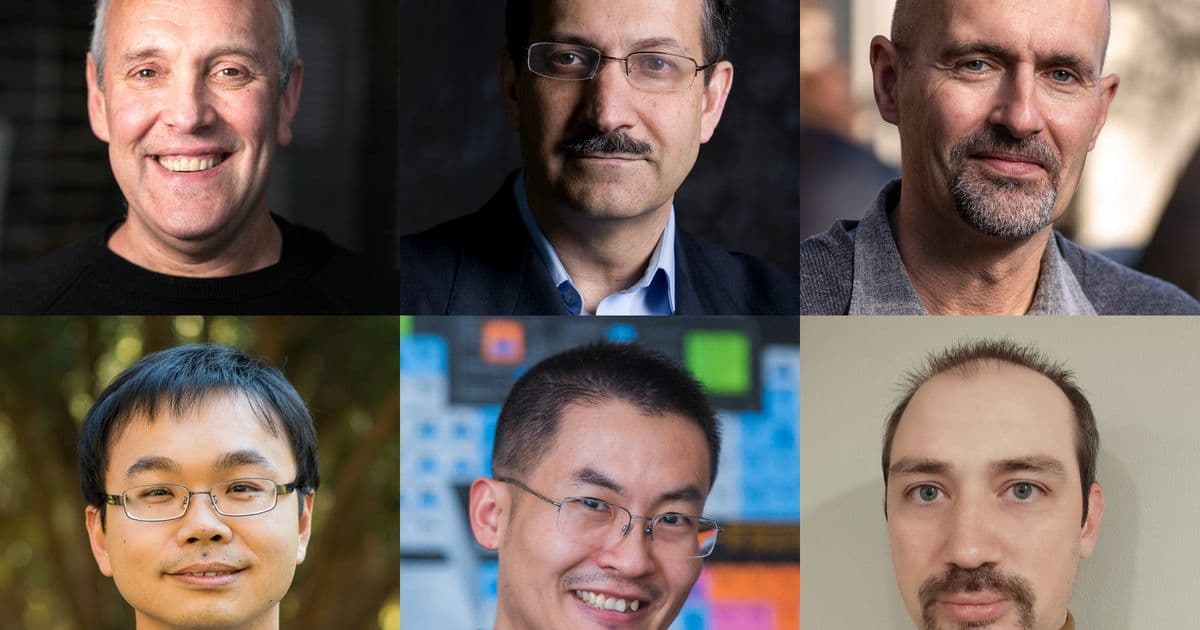
MIT faculty and alumni have been recognized with top American Physical Society awards and fellowships, recognizing breakthroughs in statistical physics, computing fabrics, quantum mechanics, and more.
The American Physical Society (APS) has honored members of the MIT community with its most prestigious awards and fellowships for 2025-26, recognizing groundbreaking research across multiple disciplines and exceptional leadership in physics. Two faculty members and six alumni received major APS prizes, while four faculty and twelve additional alumni were named APS Fellows for their significant contributions to physics research.
Faculty Award Recipients
Yoel Fink: Andrei Sakharov Prize
Yoel Fink PhD '00, the Danae and Vasilis (1961) Salapatas Professor in the Department of Materials Science and Engineering, received the Andrei Sakharov Prize "for defending the academic freedom and human rights of scientists working in the U.S." Named after physicist and human rights advocate Andrei Sakharov, this prestigious award recognizes scientists whose leadership and impact advance the principles of intellectual freedom and human dignity.
Fink's research focuses on "computing fabrics"—fibers and textiles that sense, communicate, store, and process information. By embedding functionality at the fiber level, fabrics become computing systems that can infer human activity and context while maintaining traditional garment qualities. These textiles enable noninvasive monitoring of physiological and health conditions, with applications ranging from fetal and maternal health to human performance analytics, injury prevention in challenging environments, and defense systems.
"The integration of computation into textiles represents a paradigm shift in how we interact with our environment," explains Fink. "Our work transforms ordinary materials into intelligent systems that can monitor health, enhance safety, and provide new interfaces for human-machine interaction."
Mehran Kardar: Lars Onsager Prize
Mehran Kardar PhD '83, the Francis Friedman Professor of Physics, received the Lars Onsager Prize "for ground-breaking contributions to statistical physics, including the Kardar-Parisi-Zhang equation, Casimir forces, active matter, and aspects of biological physics."
Kardar's research explores how complex behavior emerges from simple interactions in systems both in and far from equilibrium. His development of the Kardar-Parisi-Zhang equation provides a unifying framework for understanding how randomness and fluctuations shape evolving phenomena, from fluids and interfaces to biological and quantum systems. His work has also advanced the theoretical understanding of disordered materials, soft matter such as polymers and gels, and fluctuation-induced forces—including Casimir forces arising from quantum and thermal effects.
"The beauty of statistical physics lies in its ability to describe vastly different systems using similar mathematical frameworks," Kardar notes. "Whether we're studying the growth of a crystal surface or the dynamics of a flock of birds, the same principles of collective behavior often apply."
Alumni Award Recipients
Joel Butler PhD '75: W.K.H. Panofsky Prize
Joel Butler received the W.K.H. Panofsky Prize in Experimental Particle Physics "for wide-ranging scientific, technical, and strategic contributions to particle physics, particularly exceptional leadership in fixed-target quark flavor experiments at Fermilab and collider physics at the Large Hadron Collider."
Anthony Duncan PhD '75: Abraham Pais Prize
Anthony Duncan was awarded the Abraham Pais Prize for History of Physics "for research on the history of quantum physics between 1900 and 1927 that culminated in 'Constructing Quantum Mechanics,' an exemplary work that uses primary sources masterfully and employs scaffold and arch metaphors to describe developments in the quantum revolution."
Laura A. Lopez '04: Edward A. Bouchet Award
Laura A. Lopez received the Edward A. Bouchet Award "for pioneering contributions to X-ray astronomy, including foundational studies of supernova remnants, compact objects, and stellar feedback in galaxies, and for transformative leadership in advancing equity and inclusion in physics through innovative mentorship programs, national advocacy, and unwavering support for students from historically marginalized communities."
Zhiquan Sun PhD '25: J.J. and Noriko Sakurai Dissertation Award
Zhiquan Sun received the J.J. and Noriko Sakurai Dissertation Award in Theoretical Particle Physics "for applying effective field theory to advance our understanding of QCD [quantum chromodynamics], including establishing a new formalism to study heavy quark fragmentation, determining how confinement affects energy correlators, and revealing an overlooked complexity of the axion solution to the strong CP [charge conjugation symmetry and parity symmetry] problem."
Charles B. Thorn III '68: Dannie Heineman Prize
Charles B. Thorn III received the Dannie Heineman Prize for Mathematical Physics for "fundamental contributions to elementary particle physics, primarily the theory of strong interactions and the development of string theory."
Christina Wang '19: Mitsuyoshi Tanaka Dissertation Award
Christina Wang received the Mitsuyoshi Tanaka Dissertation Award in Experimental Particle Physics "for pioneering a novel technique using CMS [Compact Muon Solenoid] muon chambers to search for weakly-coupled sub-GeV [giga-electronvolt] mass dark matter using long-lived particle searches, and for groundbreaking work in quantum sensing to enable new probes of dark matter."
APS Fellows
Several MIT faculty members were elected 2025 APS Fellows:
Faculty Fellows
Jorn Dunkel, MathWorks Professor of Mathematics, received the Division of Statistical and Nonlinear Physics Fellowship "for pioneering contributions to statistical, nonlinear, and biological physics, notably in understanding pattern formation in soft matter and biology, cell positioning in tissues, and turbulence in active media."
Yen-Jie Lee PhD '11, professor of physics, received the Division of Nuclear Physics Fellowship "for pioneering measurements of jet quenching, medium response and heavy-quark diffusion in the quark-gluon plasma, and for using electron-positron collisions as an innovative control to understand collectivity in small collision systems."
Mingda Li PhD '15, associate professor of nuclear science and engineering, received the Topical Group on Data Science Fellowship "for pioneering the integration of artificial intelligence with scattering and spectroscopy, enabling breakthroughs in phonons, topological states, optical and time-resolved spectra, and data-driven discovery for quantum and energy applications."
Julien Tailleur, associate professor of physics, received the Division of Soft Matter Fellowship "for foundational theoretical work on motility-induced phase separation and emergent collective behavior in scalar active matter."
Alumni Fellows
Twelve additional MIT alumni were honored as APS Fellows:
- Andrew Cross SM '05, PhD '08 (EECS), Division of Quantum Information Fellowship
- Kevin D. Dorfman SM '01, PhD '02 (ChemE), Division of Polymer Physics Fellowship
- Geoffroy Hautier PhD '11 (DMSE), Division of Computational Physics Fellowship
- Douglas J. Jerolmack PhD '06 (EAPS), Division of Statistical and Nonlinear Physics Fellowship
- Brian Lantz '92, PhD '99 (Physics), Division of Gravitational Physics Fellowship
- Valerio Lucarini SM '03 (EAPS), Topical Group on Physics of Climate Fellowship
- Giles Novak '81 (Physics), Division of Astrophysics Fellowship
- Steve Presse PhD '08 (Physics), Division of Biological Physics Fellowship
- Jonathan Rothstein PhD '01 (MechE), Division of Fluid Dynamics Fellowship
- Gray Rybka PhD '07 (Physics), Division of Particles and Fields Fellowship
- Sarah Sheldon '08, PhD '13 (Physics, NSE), Forum on Industrial and Applied Physics Fellowship
- Lian Shen ScD '01 (MechE), Division of Fluid Dynamics Fellowship
Significance of the Awards
These recognitions highlight MIT's continued leadership in physics research across theoretical and experimental domains, from fundamental particle physics to applied materials science. The diversity of awards reflects the broad impact of MIT's research community and its ability to address fundamental questions while developing practical applications.
"The American Physical Society's recognition of our faculty and alumni underscores the quality and breadth of research conducted at MIT," says Maria Zuber, MIT's Vice President for Research. "These awards not only celebrate individual achievements but also highlight the collaborative environment that fosters innovation across disciplines."
The APS, founded in 1899, is the world's largest organization of physicists, with over 50,000 members worldwide. Its awards and fellowships represent some of the highest honors in the field of physics, recognizing exceptional contributions to the advancement of physics knowledge.
Comments
Please log in or register to join the discussion