Engineers at MIT have created a chip-scale sensor that can detect disease biomarkers in a patient's breath within minutes, potentially enabling fast, point-of-care diagnosis of pneumonia and other lung conditions without requiring laboratory equipment.
Engineers at MIT have developed a portable, chip-scale sensor that can detect disease biomarkers in a patient's breath within minutes, potentially enabling fast, point-of-care diagnosis of pneumonia and other lung conditions without requiring laboratory equipment.
The new breath test, dubbed "PlasmoSniff," works by having patients inhale nanoparticles tagged with synthetic biomarkers. If disease is present, enzymes produced by the infection would cleave these biomarkers from the nanoparticles, which would then be exhaled and detected by the sensor.
Until now, detecting such exhaled biomarkers required laboratory-grade instruments that are not available in most doctor's offices. The MIT team has now shown they can detect exhaled biomarkers of pneumonia at extremely low concentrations using the new portable, chip-scale breath test.
"In practice, we envision that a patient would inhale nanoparticles and, within about 10 minutes, exhale a synthetic biomarker that reports on lung status," says Aditya Garg, a postdoc in MIT's Department of Mechanical Engineering. "Our new PlasmoSniff technology would enable detection of these exhaled biomarkers within minutes at the point of care."
The technology could enable fast, point-of-care diagnoses for pneumonia and other lung conditions. Jennifer Chu | MIT News
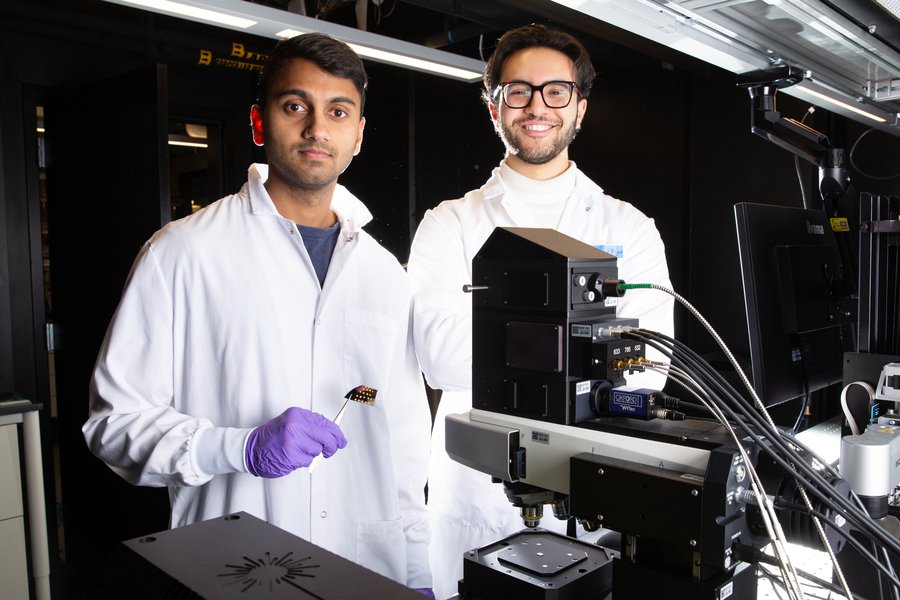
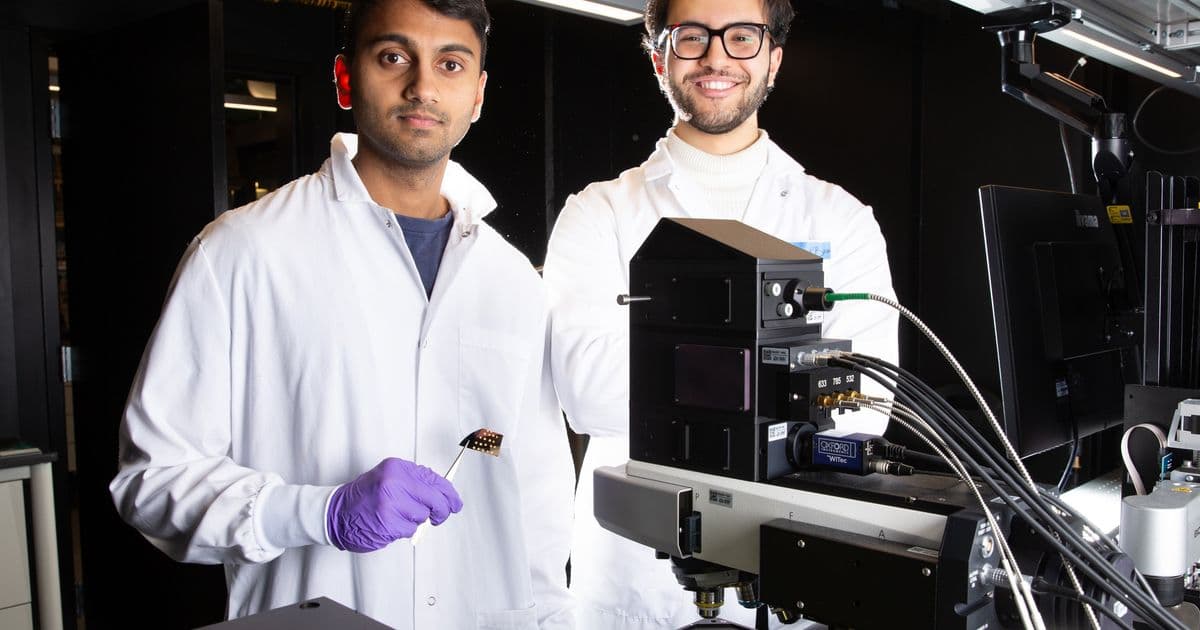
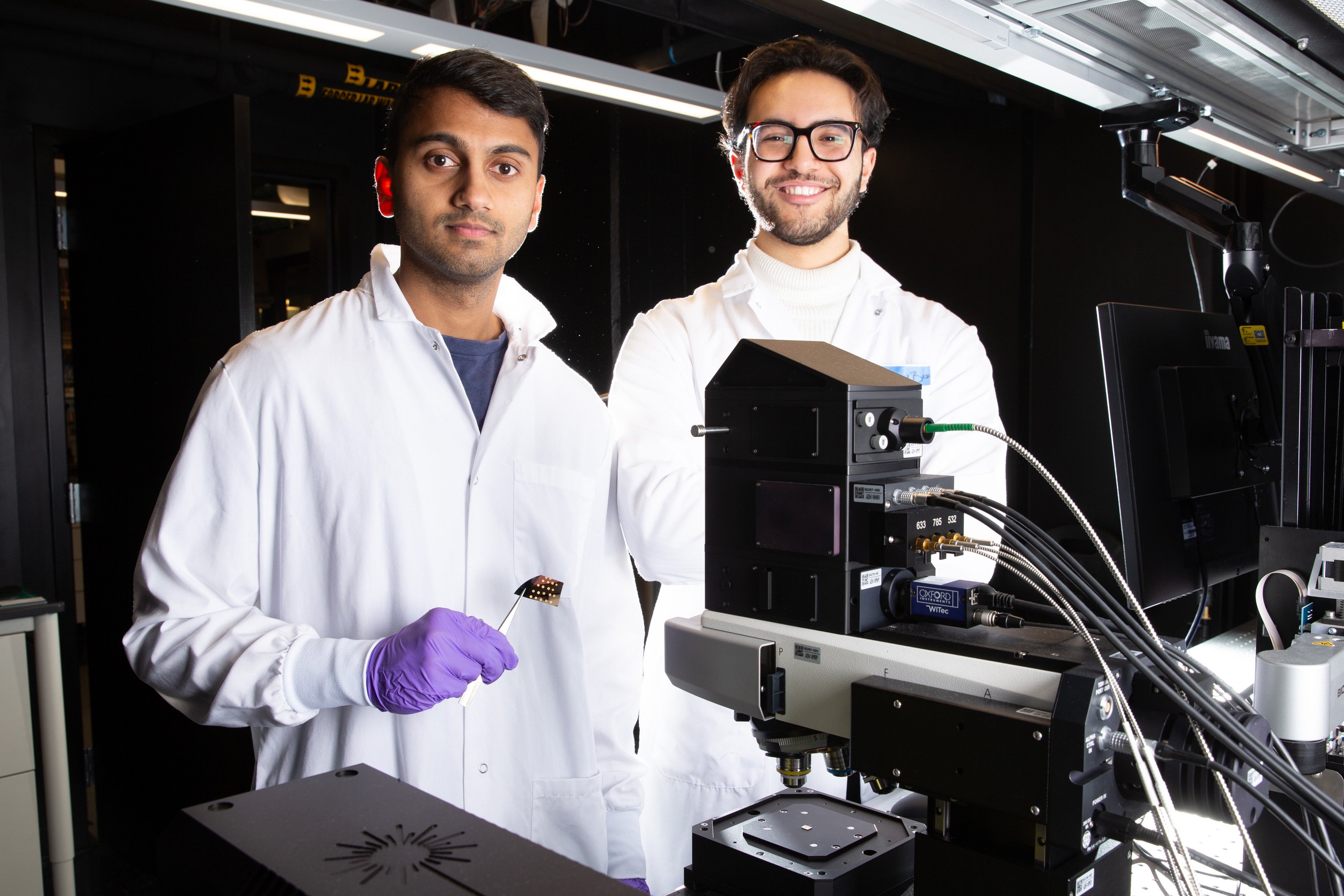
MIT MechE Postdoctoral Associate Aditya Garg (left) and MechE Doctoral student Seleem Badawy stand behind the Raman microscope used to evaluate the PlasmoSniff chip. Credits: Photo: Tony Pulsone
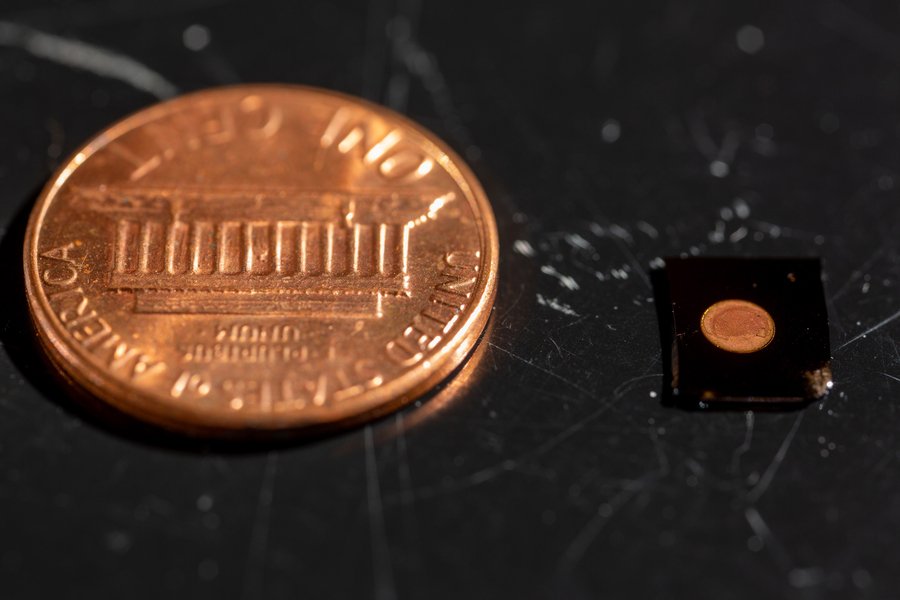
The PlasmoSniff chip is tiny compared to a penny. Credits: Photo: Tony Pulsone
The core of the sensor is made from a thin gold film, above which the researchers suspended a layer of gold nanoparticles. The gold nanoparticles are coated with a porous silica shell, generating a 5-nanometer-wide gap between the gold nanoparticles and the gold film.
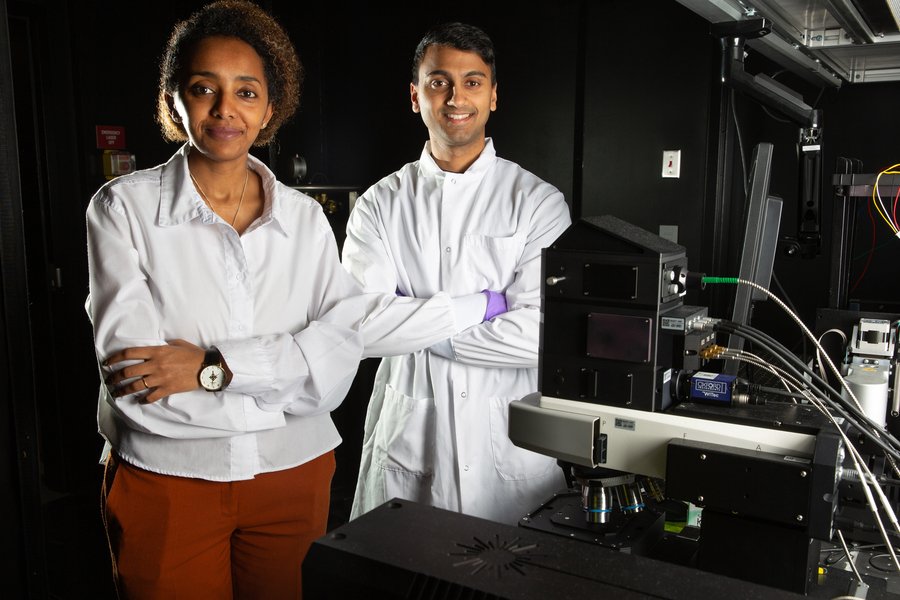
Loza Tadesse and Aditya Garg in lab. Credits: Photo: Tony Pulsone
The silica is modified to strongly bond with molecules of water. The hydrogen in water can in turn bond with the target biomarkers. If any biomarkers pass through the sensor's gap, they stick to the water molecules like Velcro.
The sensor's gap is engineered to strongly amplify light due to plasmonic resonance, where electrons in the nearby gold structures collectively oscillate in response to incoming light, concentrating the electromagnetic field into the gap. Biomarkers trapped in these gaps experience a greatly enhanced electromagnetic field, which amplifies their Raman scattering signal.
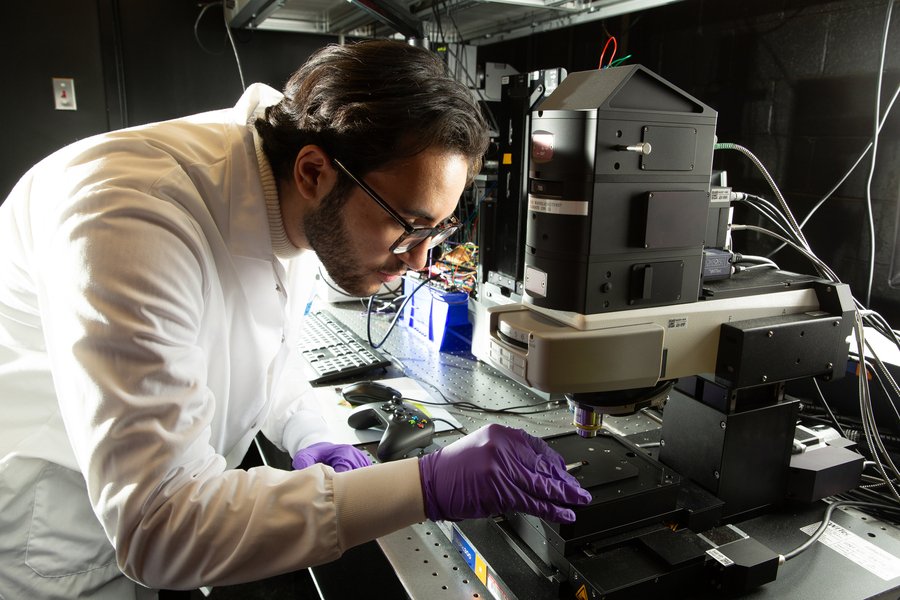
Seleem Badawy in lab. Credits: Photo: Tony Pulsone
Through experiments, the researchers showed the sensor quickly detected biomarkers of pneumonia at extremely low, clinically relevant concentrations. "Our next goal is to have a breath collection system, like a mask you can breathe into," Garg says. "A patient would first use something like an asthma inhaler to inhale the nanoparticles. They could then breathe through the mask sensor for five minutes. We could then integrate a handheld Raman spectrometer to detect whatever biomarker is breathed out, within minutes."
The team notes that their design can be used to detect diseases beyond pneumonia, as well as biomarkers that are not related to disease, as long as the biomarker of interest has a known vibrational "fingerprint."
"It's not just limited to these biomarkers or even diagnostic applications," Tadesse says. "It can sniff out industrial chemicals or airborne pollutants as well. If a molecule can form hydrogen bonds with water, we can use its vibrational fingerprint to detect it. It's a pretty universal platform."
This work was supported, in part, by funding from Open Philanthropy (now Coefficient Giving). Several characterization and fabrication steps were conducted at MIT.nano.
Comments
Please log in or register to join the discussion