New research shows that Asian immigrants' impact on US housing markets stems not just from demand, but from their positive influence on K-12 education quality, which drives up property values across entire communities.
A comprehensive new study from MIT and the University of Cincinnati reveals that the rapid growth of Asian immigrants in the United States is reshaping communities in ways that extend far beyond simple housing demand. The research, published in the Journal of Urban Economics, demonstrates that rising home values in areas with growing Asian populations are significantly driven by improvements in K-12 education quality that benefit all residents.
The Education-Driven Housing Boom
The study examines the period from 2008 to 2019, a window that saw a notable spike in immigration from six Asian countries: China, India, Japan, Korea, the Philippines, and Vietnam. What makes this research particularly compelling is its focus on immigrants arriving on non-permanent visas for study or work—a cohort that represents a distinct and growing channel of new immigrant inflow, often pre-selected by universities and employers for their academic and professional achievements.
"We're looking at a window when the influx of Asian immigrants has a particularly strong preference for education, and who themselves were also highly educated," explains Eunjee Kwon, West Shell, Jr. Assistant Professor of Real Estate at the University of Cincinnati and co-author of the study. "This period also marks a notable shift in the socioeconomic profile of Asian immigrants to the U.S., with this cohort arriving with higher levels of education and income relative to earlier waves of Asian immigrants and, in many cases, relative to the native-born population."
Quantifying the Impact
The researchers found that 30 to 40 percent of the rise in home values in areas where Asian immigrant buyers have school-age children correlates directly with improved quality of education. This improvement is measured by the average rise in standardized test scores of all children in the county—not just those of Asian descent.
"Maybe some Asian buyers are pure investors, but many of them become residents who buy homes for themselves and their families, and transform the neighborhoods," says Siqi Zheng, the Samuel Tak Lee Professor of Urban and Real Estate Sustainability at MIT. "We show that this is not negligible; it is a big component. We can attribute at least one-third of housing price increases to improved education."
Geographic Distribution and Community Effects
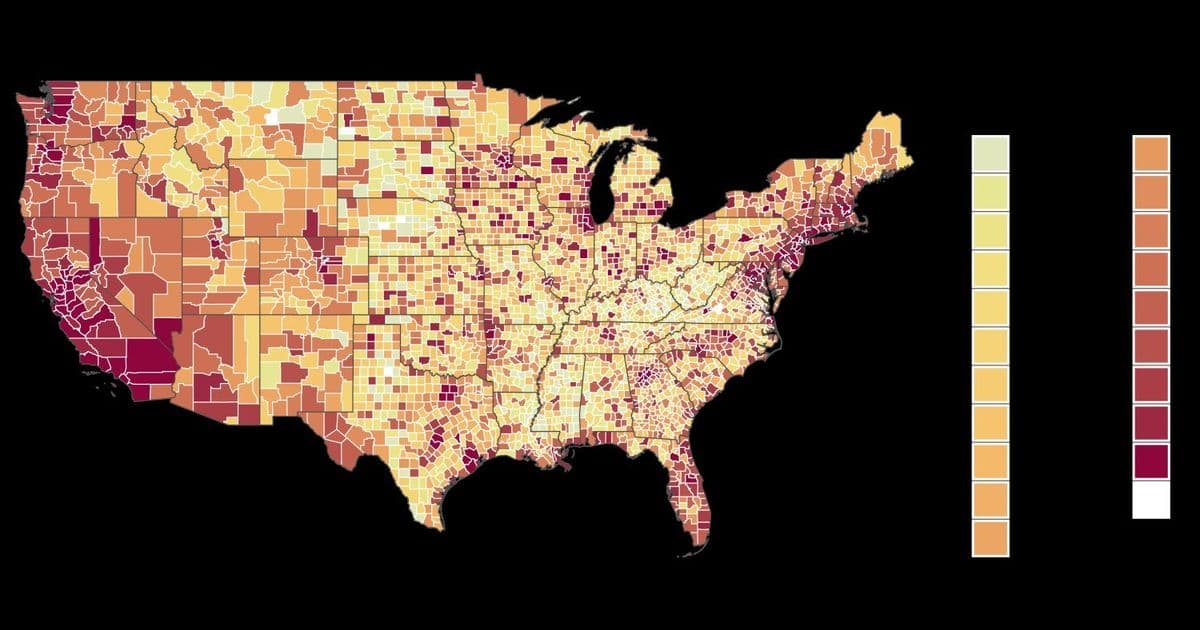
The study's maps reveal a fascinating evolution in Asian population distribution across the United States. While traditional gateway cities like San Francisco, Los Angeles, and New York have long been home to large Asian communities, the research deliberately excluded these areas to capture the impact of recent immigrants on other counties. This approach revealed a broader geographic distribution, with notable concentrations on the West Coast and in major metropolitan areas nationwide, but also significant growth in previously underrepresented regions.
Comparing county-level shares of Asian residents in 1980 versus 2019 shows both higher concentrations and a much broader geographic distribution. The maps illustrate how Asian immigrants have expanded their presence across the country, bringing their educational values and aspirations to new communities.
Methodological Rigor
The research team employed an econometric approach called an instrumental variable to establish causal correlation rather than mere association. This methodological choice was crucial for isolating the specific effects of Asian immigrant communities on education quality and housing values, while accounting for other factors that might influence these outcomes.
Matthew Kahn, Provost Professor of Economics and Spatial Sciences at the University of Southern California, who was not involved in the research, praised the study's approach: "What really interests me about this paper is that it suggests that there can be a positive spillover effect: that U.S. areas that attract Asian immigrants also gain from improved school quality. It's the first I've seen undertaken on this very important hypothesis, which certainly merits additional future research, possibly using school-level and individual-level data."
Personal Motivation and Broader Implications
The work was somewhat personal for the researchers, who undertook the study without external funding to understand the real impact of this particular immigrant group on American communities. "We wanted to understand what this group contributes to the communities where they settle," Kwon explains. "We found that their presence benefits children of all other backgrounds, too."
This finding challenges simplistic narratives about immigration and housing markets. Rather than viewing Asian immigrants solely as drivers of housing demand and price increases, the research reveals a more nuanced picture: these communities are actively contributing to the improvement of public goods—specifically education—that benefit entire communities.
The Broader Context
The study's findings align with other recent research on immigration's economic impact. A separate MIT study found that immigrants in the U.S. are more likely to start firms and create jobs, while the university's role in attracting global talent helps keep America competitive. The current research adds another dimension to understanding how immigration shapes American communities—not just through economic activity, but through cultural values that enhance public institutions.
As Asian immigrants continue to be both the fastest-growing and highest-earning immigrant ethnic group in the United States, understanding their community impact becomes increasingly important for policymakers, urban planners, and residents alike. The MIT study suggests that the presence of these communities can be a catalyst for educational improvement that raises property values and quality of life for all residents.
The research ultimately paints a picture of immigration as a complex, multifaceted phenomenon with both direct economic effects and broader social benefits. In the case of Asian immigrants and their impact on American education and housing markets, the evidence suggests that their influence extends well beyond the communities they initially join, creating positive spillover effects that strengthen the fabric of American society as a whole.
Comments
Please log in or register to join the discussion