
Gartner's latest Hype Cycle report predicts widespread failure in generative AI initiatives, with custom models particularly vulnerable to budget overruns and abandonment, while highlighting China's growing dominance in open-source AI development.
According to Gartner's 2026 Hype Cycle for Generative AI, the current enthusiasm for generative AI projects may be setting organizations up for significant disappointment. The analyst firm projects that at least half of all generative AI initiatives "will overrun their budgeted costs due to poor architectural choices and lack of operational know-how," while most custom model development efforts "will abandon their efforts due to costs, complexity and technical debt in their deployments."
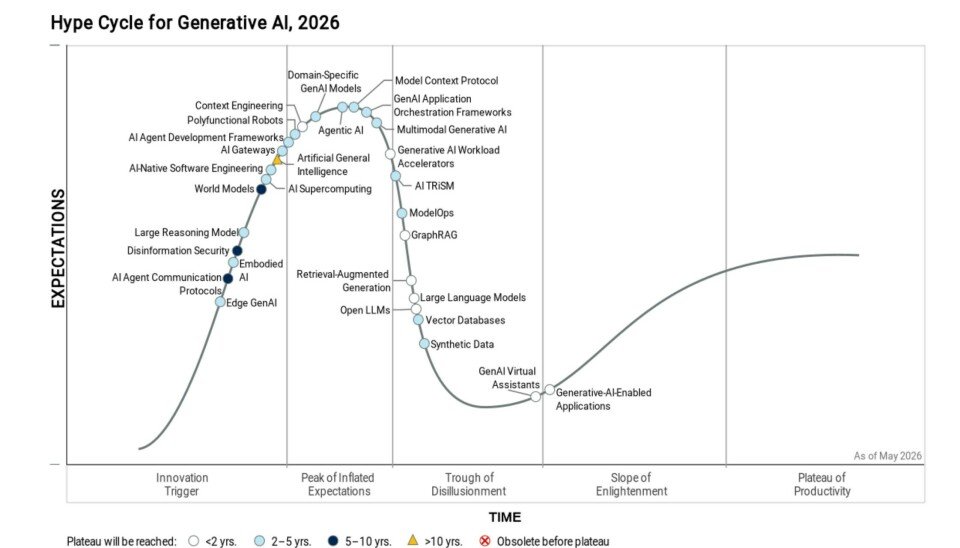
The Hype Cycle framework, which tracks technologies through stages of inflated expectations, disillusionment, enlightenment, and eventual productivity, paints a sobering picture of the current generative AI landscape. Gartner examined 30 AI technologies and found none have reached the "plateau of productivity" – the point where technologies have matured through multiple generations and deliver consistent, verifiable benefits.
"The generative AI field is still experiencing the classic pattern of emerging technologies," explains one industry analyst who reviewed Gartner's findings. "Organizations are rushing to implement solutions without fully understanding the operational requirements or long-term maintenance costs."
Domain-specific models represent one promising but challenging approach. Gartner notes that models built from scratch or fine-tuned on domain data "are likely to produce superior results and fewer hallucinations compared to the output of general-purpose models in fields such as healthcare, finance, law and other industries." However, the firm cautions that building these models "requires significant compute resources, specialized expertise and ongoing maintenance," rating their maturity as "adolescent" and placing them at least two to five years from mainstream adoption.
The report does identify one area showing more mature development: Generative-AI-enabled applications such as coding assistants, graphics and video creation, and content summarization tools. Gartner acknowledges that intellectual property concerns and inaccuracy issues persist but observes that rapid model evolution has led to over half the target market adopting these applications.
Not all industry voices share Gartner's pessimistic outlook. "While there are certainly challenges in implementing generative AI, many organizations are finding significant value," counters a technology director at a major AI implementation firm. "The key is starting with focused use cases rather than attempting to transform entire operations overnight."
Gartner also highlights the rapid evolution of AI agent communication protocols, labeling them as the least mature AI technology. While Model Context Protocol (MCP) and agent-to-agent protocol (A2A) currently dominate the space, the firm notes that alternatives are emerging quickly as early adopters identify weaknesses in existing solutions.
Among the most concerning findings is the assessment of disinformation security tools, which Gartner identifies as having significant potential impact but being five to ten years from maturity. The firm warns that "attack vectors are varied and can include using GenAI-created content to fool voice or face biometric authentication, or to trick identity verification processes used in account recovery workflows."
Perhaps most striking is Gartner's observation about the geographic shift in AI innovation. "The commercialization of open LLMs has been challenging for builders and many Western tech companies are being selective with releasing open models, which has relegated innovation in this space to China," the report states. This suggests organizations seeking cutting-edge open-source AI may need to look beyond traditional Western tech hubs.
The report concludes with a focus on World Models – abstractions of physical environments that "empower AI to perform more sophisticated prediction and planning tasks, moving beyond mere pattern recognition." These models could enable more reliable AI systems for robotics and content generation while better accounting for real-world physics and uncertainty.
As organizations navigate these challenges, Gartner's findings suggest a need for more measured approaches to generative AI adoption, with greater emphasis on realistic planning, domain-specific applications, and consideration of global innovation sources beyond traditional Western markets.
Comments
Please log in or register to join the discussion