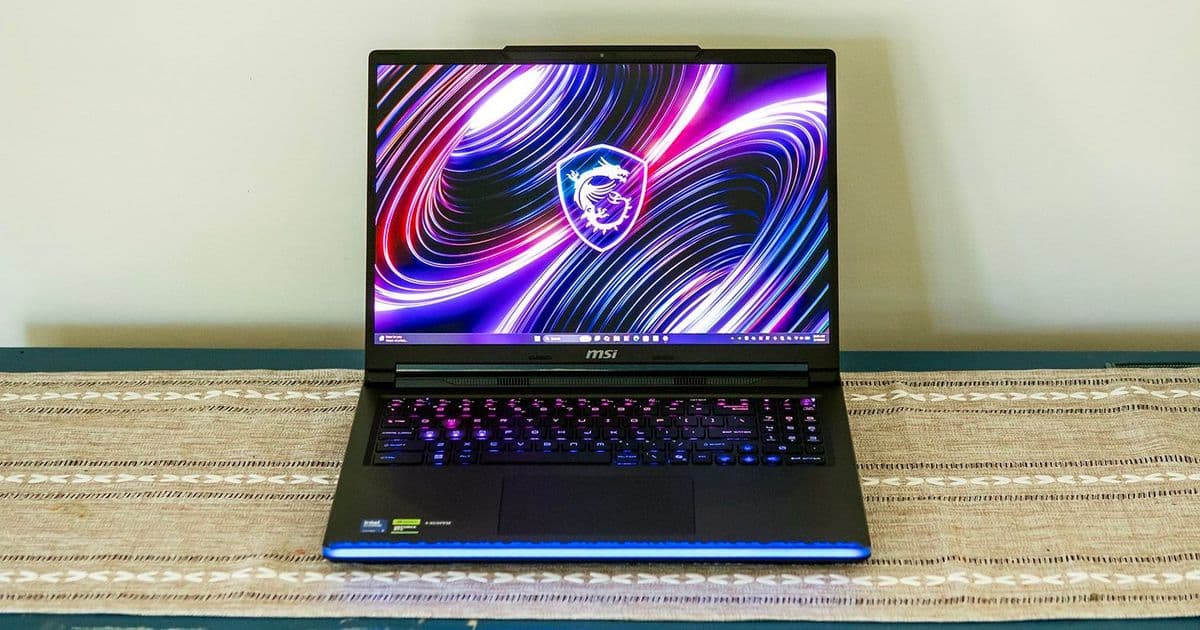
The MSI Raider 16 Max HX pairs an Intel Core Ultra 9 290HX Plus CPU with an Nvidia RTX 5090 GPU, a 16‑inch 240 Hz OLED panel and a 92 Wh battery. It delivers flagship‑class frame rates, bright visuals and strong battery life, while its plastic chassis, lack of a mechanical keyboard and PCIe 4.0 storage keep it from being flawless.
MSI Raider 16 Max HX Review – Elite Gaming Performance and OLED Brilliance
Announcement
MSI has launched the Raider 16 Max HX as a direct challenger to high‑end gaming laptops such as Dell’s Alienware Area‑51 16. Starting at $2,999 and topping out at $4,099 for the RTX 5090 configuration, the machine bundles Intel’s latest Core Ultra 9 290HX Plus processor, up to 32 GB DDR5‑6400 RAM, a 1 TB PCIe 4.0 SSD and a 16‑inch 2560 × 1600 OLED display running at 240 Hz.
The review unit tested was the top‑spec model with an RTX 5090, 32 GB RAM and the 1 TB drive. Below we break down the technical specifications, performance numbers and market implications.
Technical specifications
| Component | Specification |
|---|---|
| CPU | Intel Core Ultra 9 290HX Plus (Arrow Lake Refresh) – 8 P‑cores / 8 E‑cores, up to 5.3 GHz boost |
| GPU | Nvidia GeForce RTX 5090 – 24 GB GDDR7, 1,597 MHz boost, 175 W TGP |
| Memory | 32 GB DDR5‑6400 (2 × 16 GB) |
| Storage | 1 TB PCIe 4.0 SSD (Micron 2500) – one M.2 slot supports PCIe 5.0 but is not populated |
| Display | 16‑inch OLED, 2560 × 1600, 240 Hz, 456 nits peak, 86.1 % DCI‑P3 coverage |
| Networking | Killer BE1750 – Wi‑Fi 7, Bluetooth 5.4, 2.5 Gbps Ethernet |
| Ports | 2 × Thunderbolt 4 (USB‑C), 3 × USB‑A 3.2 Gen 2, HDMI 2.1, SD‑card reader, 2.5 Gbps Ethernet |
| Battery | 92 Whr, 400 W proprietary power brick |
| Dimensions / Weight | 363 × 270 × 29 mm, 2.6 kg (5.73 lb) |
| OS | Windows 11 Home |
Design and build
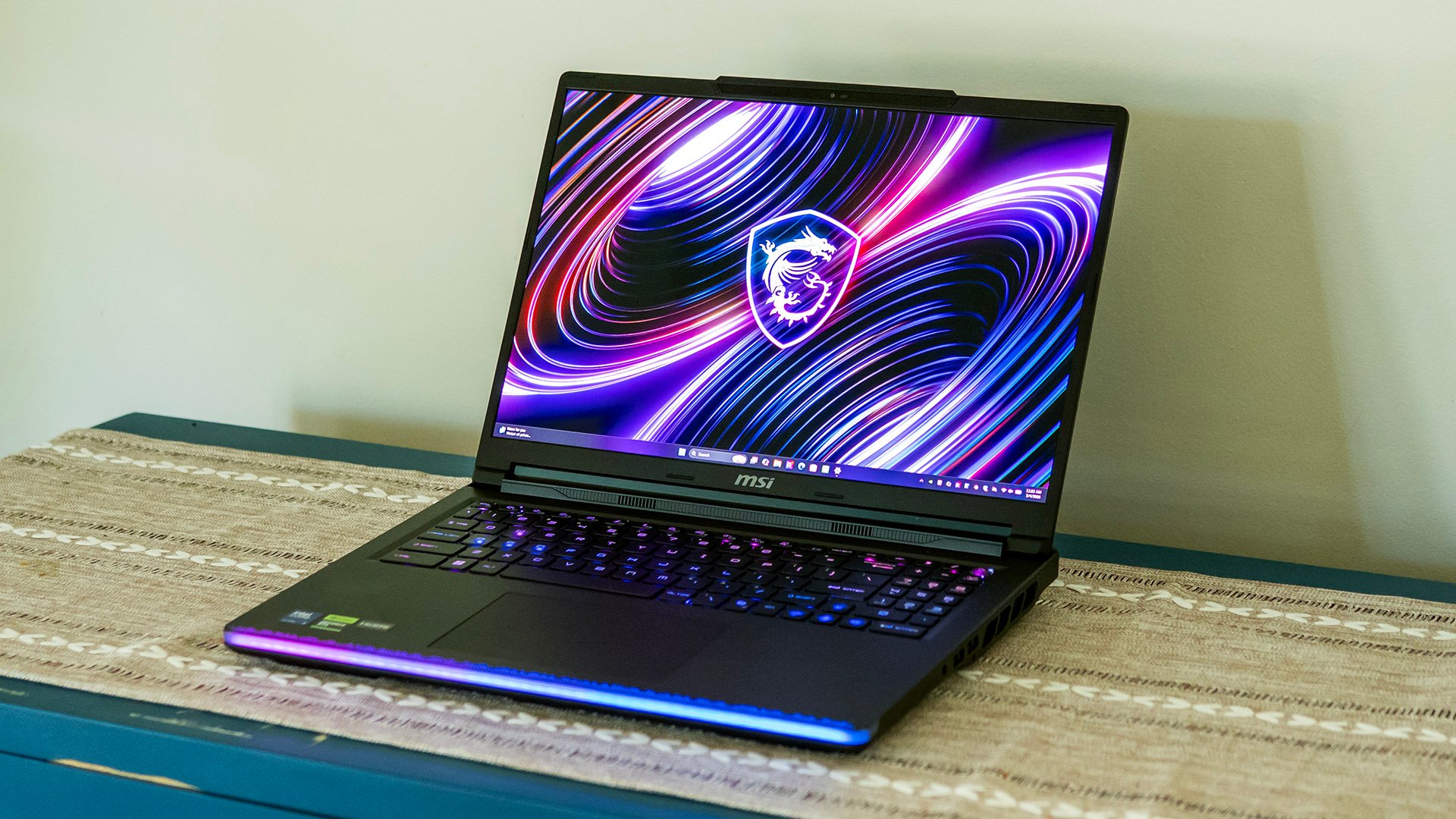
The chassis measures 14.29 × 10.62 × 1.14 in, making it marginally slimmer than the Alienware Area‑51 16 (14.37 × 11.41 × 1.12 in) while weighing 2.6 kg, roughly 1.8 kg lighter than Dell’s offering. The lid is aluminum but thin enough to flex under pressure; the rest of the body is high‑grade plastic, which helps keep the weight down but feels less premium than a full‑metal build.
Customizable RGB lighting runs along the front edge and on the keyboard’s WASD/arrow cluster, controllable via the SteelSeries GG app. The hinge is robust, and the bottom panel opens with two Phillips screws to expose two SODIMM slots, two M.2 2280 slots (one PCIe 5.0 compatible) and the 92 Wh battery.
Performance analysis
Gaming benchmarks
All tests were run at the laptop’s native 2560 × 1600 resolution unless otherwise noted. The RTX 5090’s 24 GB VRAM gave it a modest edge over the RTX 5080 models in the same class.
| Game | Settings | 1080p FPS (average) | 2560 × 1600 FPS |
|---|---|---|---|
| F1 24 | Ultra, DLSS off | 92 | 71 |
| Shadow of the Tomb Raider | Highest | 197 | 134 |
| Cyberpunk 2077 | Ray‑Tracing Ultra | 70 | 42 |
| Red Dead Redemption 2 | Medium | 130 | 90 |
| Borderlands 3 | Badass | 189 | 149 |
The Raider 16 Max HX consistently ranked second only to the Razer Blade 18 (also RTX 5090) and ahead of the Alienware Area‑51 16 and Asus ROG Strix Scar 16, which use RTX 5080 GPUs. The performance gap between RTX 5090 and RTX 5080 averaged 5‑8 % across titles, most noticeable in ray‑traced workloads.
CPU and productivity
Geekbench 6 scores placed the Core Ultra 9 290HX Plus at 13,200 (single‑core) and 78,400 (multi‑core), a few points above the Core Ultra 9 275HX found in the Asus and Razer models. In a 25 GB file copy test, the Raider’s PCIe 4.0 SSD delivered 1,358 MB/s, lagging behind the Asus’ PCIe 5.0 drive (1,841 MB/s) and the Alienware’s PCIe 5.0 configuration (2,739 MB/s). However, video transcoding in HandBrake was the fastest among the group, completing a 4 K file in 1 min 51 s.
Thermals and acoustics
During a 15‑loop Metro Exodus stress test, the chassis surface peaked at 87 °F on the keyboard, 74 °F on the touchpad and 109 °F near the exhaust vents. Internally, the CPU held at 75 °C and the GPU at 72 °C. Fan noise stayed below 38 dB(A) in idle and rose to 45 dB(A) under full load, remaining audible but not intrusive.
Battery endurance
A mixed workload of web browsing, OpenGL rendering and video streaming at 150 nits yielded 8 h 34 min of runtime. This outlasts the Asus (6 h 30 min) and dwarfs the Alienware (3 h 33 min), highlighting the efficiency gains from the 12th‑gen Intel core and the 92 Wh battery.
Market implications
Pricing competitiveness
At $4,099 for the RTX 5090 configuration, the Raider 16 Max HX sits roughly $400 below the Razer Blade 18 and $600 above the RTX 5080 variant of the same model. Compared with the Alienware Area‑51 16, which retails around $4,300 (often discounted to $3,700), MSI offers a lighter chassis, brighter OLED panel and substantially longer battery life for a similar price point.
Supply‑chain context
The Raider uses a PCIe 4.0 SSD despite having a PCIe 5.0 slot, a decision that likely reflects current inventory constraints on high‑capacity PCIe 5.0 NAND. As PCIe 5.0 drives become more abundant, MSI can upgrade the base configuration without redesigning the motherboard, preserving the same thermal envelope.
The RTX 5090 GPU is built on Nvidia’s Ada Loveland architecture, fabricated on TSMC’s 4 nm process. Its 24 GB GDDR7 memory and 175 W TGP push the envelope for laptop graphics, but the modest performance delta over the RTX 5080 (also Ada‑based) suggests that future laptop generations may need higher power budgets or improved cooling to fully exploit the GPU’s potential.
Competitive positioning
- Performance: Marginal advantage over RTX 5080 laptops; sufficient for most gamers.
- Display: OLED with 456 nits peak and 86 % DCI‑P3 coverage beats most mini‑LED rivals.
- Portability: Lightest in its class, making it a viable option for gamers who travel.
- Weaknesses: Plastic chassis, no mechanical keyboard, and the lack of a PCIe 5.0 SSD in the flagship model.
Overall, the Raider 16 Max HX solidifies MSI’s standing in the premium gaming laptop segment. Its blend of high‑end CPU/GPU, bright OLED screen and strong battery life gives it a clear edge over bulkier competitors, while the price gap remains narrow enough to keep it attractive to enthusiasts willing to pay for top‑tier performance.
Bottom line
The MSI Raider 16 Max HX delivers flagship gaming performance, a stunning OLED panel and impressive endurance in a relatively lightweight package. Its main compromises are a plastic‑heavy chassis, an absent mechanical keyboard and a PCIe 4.0 SSD where a PCIe 5.0 drive would be expected. For buyers who prioritize raw power, display quality and battery life over chassis premium, the Raider 16 Max HX is a compelling alternative to the Alienware Area‑51 16 and other RTX 5090 laptops.
For full specifications, see the official MSI product page.
Comments
Please log in or register to join the discussion