
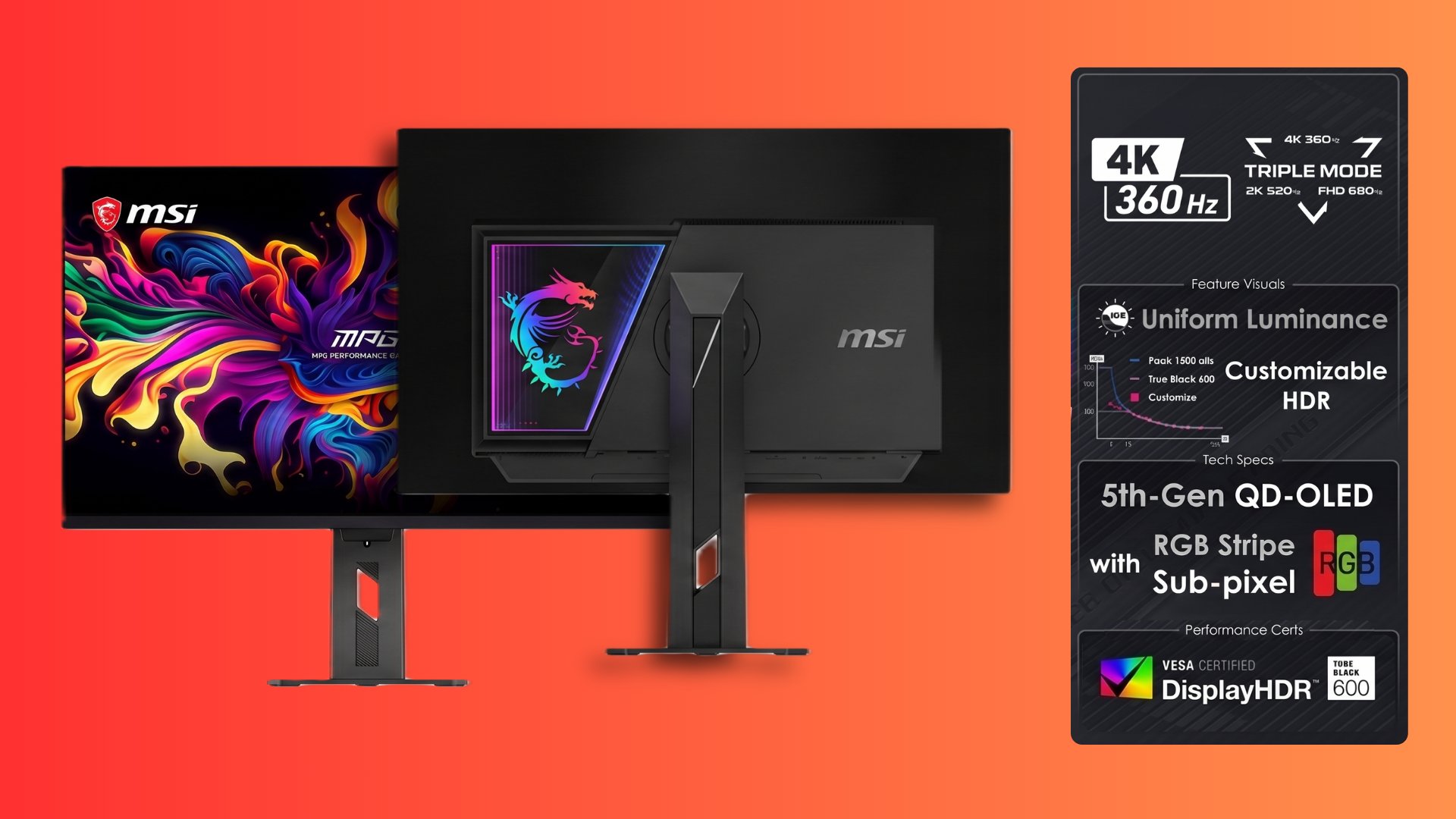
MSI’s MPG OLED 322URDX36 pairs Samsung’s fifth‑gen Penta‑Tandem QD‑OLED panel with a DisplayPort 2.1 UHBR20 link, delivering three native refresh‑rate tiers and the first VESA DisplayHDR 600 True Black certification for an OLED monitor.
MSI’s new 32‑inch OLED monitor can switch between 4K 360 Hz, 1440p 520 Hz, and 1080p 680 Hz
Announcement
MSI announced the MPG OLED 322URDX36 ahead of Computex 2026. The model packs a 32‑inch 4K panel capable of 360 Hz, adds a 1440p 520 Hz mode and a 1080p 680 Hz mode. Samsung supplies the underlying Penta‑Tandem QD‑OLED panel, the first dual‑mode OLED that can down‑scale from 4K to 1080p without losing the high‑refresh capability.
Technical specifications
| Parameter | Value |
|---|---|
| Panel size | 32 in (81.3 mm diagonal) |
| Resolution options | 3840×2160 @ 360 Hz, 2560×1440 @ 520 Hz, 1920×1080 @ 680 Hz |
| Panel technology | Samsung 5th‑gen QD‑OLED, Penta‑Tandem stack, RGB‑stripe subpixels |
| Brightness | VESA DisplayHDR 600 True Black (600 nits peak on 10 % window, 350 nits full‑screen) + 1 500 nits peak in small windows |
| Contrast | OLED‑inherent infinite contrast, "DarkArmor" film reduces black‑level lift by ~40 % |
| Interface | DisplayPort 2.1 UHBR20 (up to 80 Gbps), USB‑C 98 W PD, 2× HDMI 2.1 |
| Color gamut | DCI‑P3 99 % + Adobe RGB 95 % |
| Response time | 0.1 ms (GTG) |
| Power consumption | 45 W (typical), 12 W (idle) |
| Warranty | 3‑year burn‑in coverage |
Panel architecture
Samsung’s Penta‑Tandem stack adds two extra emissive layers to the classic QD‑OLED stack. The extra layers increase photon extraction efficiency, pushing peak brightness from the usual 500 nits (TB 500) to True Black 600. The RGB‑stripe subpixel layout replaces the earlier triangular arrangement, simplifying scaling algorithms and allowing true 1440p rendering without the interpolation artifacts that plague 4K‑to‑1440p conversion.
Refresh‑rate tiers
- 4K 360 Hz – Uses the full 3840×2160 matrix with a 5 ns pixel‑clock, delivering 1.4 B pixels per second.
- 1440p 520 Hz – The monitor’s on‑board scaler interpolates 1.5 × 1.5 pixel blocks into native 1440p rows, preserving the RGB stripe geometry. The resulting pixel‑rate is 1.34 B pixels per second, only 4 % slower than the 4K mode.
- 1080p 680 Hz – Down‑scales by a factor of two in both axes, halving the data stream to 0.74 B pixels per second while still exceeding the 720 p 720 Hz ceiling of competing WOLED panels.
Bandwidth and signaling
DisplayPort 2.1 UHBR20 supports 80 Gbps raw throughput. At 4K 360 Hz with 30‑bit color, the link consumes roughly 71 Gbps, leaving headroom for HDR metadata and auxiliary streams. The 1080p 680 Hz mode requires only 38 Gbps, well within the spec, which explains why MSI can offer three distinct modes on a single DP 2.1 connector.
Market implications
- Refresh‑rate hierarchy – By delivering three native refresh tiers, MSI creates a new class of “multi‑mode” high‑refresh monitors. Gamers who prioritize ultra‑low latency can switch to 1080p 680 Hz for competitive titles, while content creators retain 4K 360 Hz for high‑resolution work.
- HDR leadership – The first OLED monitor to earn VESA DisplayHDR 600 True Black pushes the HDR ceiling for OLED displays. Competing panels from LG and Sony top out at TB 500, so MSI gains a measurable advantage in peak luminance and black‑level control.
- Supply‑chain timing – Samsung’s 5th‑gen QD‑OLED production line is slated for ramp‑up in Q3 2025, with an estimated capacity of 1.2 M units per quarter. MSI’s early adoption signals confidence that Samsung can meet the volume demand for premium gaming monitors, potentially stabilizing OLED panel pricing for the rest of 2026.
- DisplayPort 2.1 adoption – The monitor’s reliance on DP 2.1 UHBR20 may accelerate GPU manufacturers’ support for the standard. Nvidia’s RTX 5080 and AMD’s Radeon RX 9 X0 series already list DP 2.1 on their specs sheets; a high‑profile product like this could push OEMs to include DP 2.1 on mainstream laptops as well.
- Competitive positioning – While LG’s UltraGear OLED 32GQ950 offers 1440p 240 Hz, MSI’s 520 Hz at the same resolution is a 116 % increase in frame delivery. Even the 1080p 680 Hz figure outpaces the 720 Hz ceiling of the latest WOLED panels, making the MPG 322URDX36 the fastest OLED monitor currently announced.
Outlook
If pricing lands in the US $1 200–$1 400 bracket, the monitor will sit between premium IPS gaming panels and the niche OLED segment. Its multi‑mode capability, HDR 600 certification, and DP 2.1 bandwidth make it a reference point for future OLED gaming displays. Analysts will watch the first production units for yield rates; early OLED panels have historically suffered from higher defect densities, but Samsung’s new 3‑H surface hardness coating and “DarkArmor” film could improve first‑pass yields.
For the full specification sheet, see MSI’s product page.
Comments
Please log in or register to join the discussion