Nasdaq transformed its Boardvantage platform by integrating AI capabilities with PostgreSQL on Azure, achieving 91-97% accuracy in document summarization while maintaining strict security and tenant isolation.
When people think of Nasdaq, they usually think of markets, trading floors, and financial data moving at extraordinary speed. But behind the scenes, Nasdaq also plays an equally critical role in how boards of directors govern, deliberate, and make decisions.
Nasdaq Boardvantage® is the company's governance platform, used by more than 4,400 organizations worldwide—including nearly half of the Fortune 100. It's where directors review board books, collaborate in an environment designed with robust security, and prepare for meetings that often involve some of the most sensitive information a company has.
In recent years, Nasdaq set out to modernize Nasdaq Boardvantage with AI, without compromising security and reliability. That journey was featured in a Microsoft Ignite session, "Nasdaq Boardvantage: AI-Driven Governance on PostgreSQL and Foundry." It offers a practical look at how Azure Database for PostgreSQL can support AI-driven applications where precision, isolation, and data control are non-negotiable.
Introducing AI Where Trust Is Everything
Board governance isn't a typical productivity workload. Board packets can run 400 to 600 pages, meeting minutes are legal records, and any AI-generated insight must be confined to a customer's own data.
"Our customers trust us with some of their most strategic, sensitive data," said Mohsin Shafqat, Senior Manager of Software Development at Nasdaq.
That trust meant tackling several core challenges upfront, including:
- How do you minimize AI hallucinations in a governance context?
- How do you guarantee tenant isolation at scale?
- How do you keep data regional across a global customer base?
A Cloud Foundation Built for Governance
Before adding intelligence, Nasdaq decided to re-architect Nasdaq Boardvantage on Microsoft Azure, using Azure Kubernetes Service (AKS) to run containerized, multi-tenant workloads with strong isolation boundaries. Microsoft Foundry provides the managed foundation for deploying, governing, and operating AI models across this architecture, adding consistency, security, and control as intelligence is introduced.
At the data layer, Azure Database for PostgreSQL and Azure Database for MySQL became the backbone for governance data. PostgreSQL, in particular, plays a central role in managing structured governance information alongside vector embeddings that support AI-driven features.
Together, these services give Nasdaq the performance, security, and operational control required for a highly regulated, multi-tenant environment, while still moving quickly.
Key architectural choices included:
- Tenant isolation by design, with separate databases and storage
- Regional deployments to align with data residency requirements
- High availability and managed operations, so teams could focus on product innovation instead of infrastructure maintenance
PostgreSQL and pgvector: Powering Context-Aware AI
With that foundation in place, Nasdaq was ready to carefully introduce AI. One of the first AI capabilities was intelligent document summarization. Board materials that once took hours to review could now be condensed into concise, contextually accurate summaries.
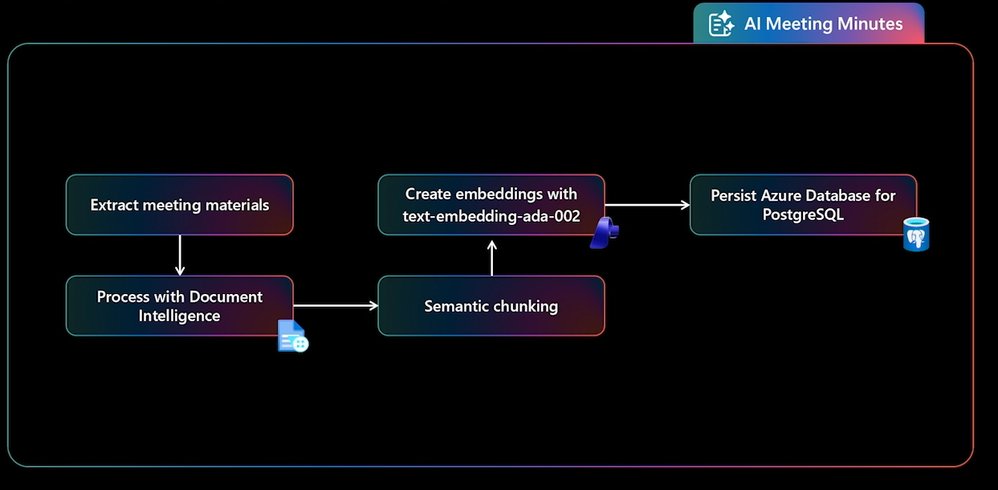
Under the hood, this required more than just calling an LLM. Nasdaq uses pgvector, natively supported in Azure Database for PostgreSQL, to store and query embeddings generated from board documents. This allows the platform to perform hybrid searches that combine traditional SQL queries with vector similarity to retrieve the most relevant context before sending anything to a language model.
Instead of treating AI as a black box, the team built a pipeline where:
- Documents are processed with Azure Document Intelligence to preserve structure and meaning
- Content is chunked and embedded
- Embeddings are stored in PostgreSQL with pgvector
- Vector similarity searches retrieve precise context for each AI task
Because this runs inside PostgreSQL, the same database benefits from Azure's built-in high availability, security controls, and operational tooling – delivering tangible results, including a 25% reduction in overall board preparation time and internal testing shows 91–97% accuracy for AI-generated summaries and meeting minutes.
From Summaries to an AI Board Assistant
With summarization working in production, Nasdaq expanded further. The team is now building an AI-powered Board Assistant that will help directors prepare for upcoming meetings by surfacing trends, risks, and insights from prior discussions.
This introduces a new level of scale. Years of board data across thousands of customers translate into millions of embeddings. PostgreSQL continues to anchor this architecture, storing vectors for semantic retrieval while MySQL supports complementary non-vector workloads.
Across Nasdaq Boardvantage, users are advised to always review AI outputs, and no customer data is shared or used to train external models.
"We designed AI for governance, not the other way around," Shafqat said. More importantly, customers trust the system because security, isolation, and data control were engineered in from day one.
Looking Ahead
Nasdaq's work shows how Azure Database for PostgreSQL can support AI workloads that demand both intelligence and integrity. With PostgreSQL at the core, Nasdaq has built a governance platform that scales globally, respects regulatory boundaries, and introduces AI in a way that feels dependable and not experimental.
What started as a modernization of Nasdaq Boardvantage is now influencing how Nasdaq approaches AI across the enterprise.
To dive deeper into the architecture and hear directly from the engineers behind it, watch the Ignite session and check out these resources:
- Watch the Ignite breakout session for a technical walkthrough of how Nasdaq Boardvantage is built, including PostgreSQL on Azure, pgvector, and Microsoft Foundry in production.
- Read the case study to see how Nasdaq introduced AI into board governance and what changed for directors, administrators, and decision-making.
- Watch the Ignite broadcast for a candid discussion on Azure Database for PostgreSQL, Azure HorizonDB, and what it takes to scale AI-driven governance.
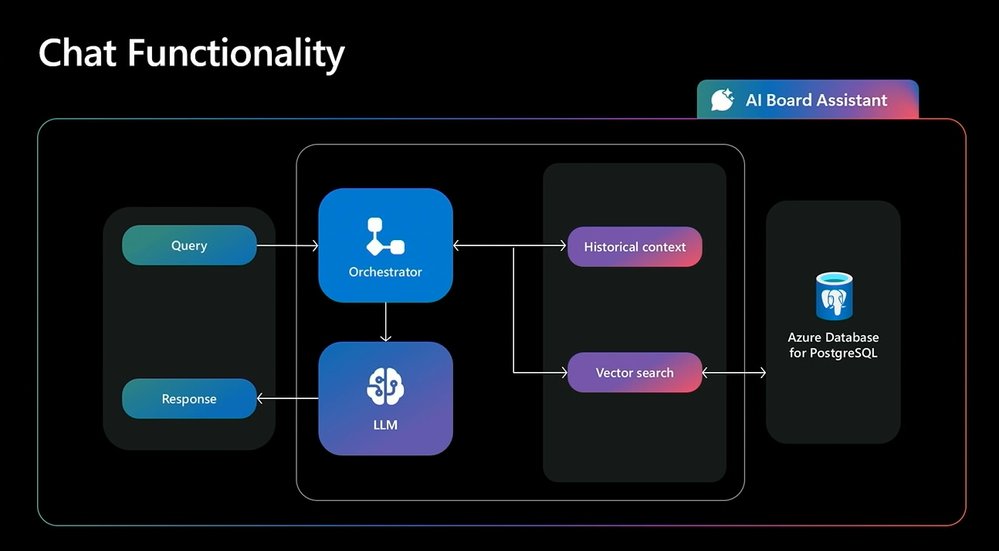
The journey from traditional board governance to AI-enhanced decision support demonstrates how thoughtful architecture choices—particularly the use of PostgreSQL with pgvector for vector embeddings—can enable powerful AI capabilities while maintaining the trust and security that governance platforms require. For organizations considering similar AI transformations, Nasdaq's approach offers a blueprint for introducing intelligence without compromising on the fundamentals of data protection and operational reliability.
Comments
Please log in or register to join the discussion