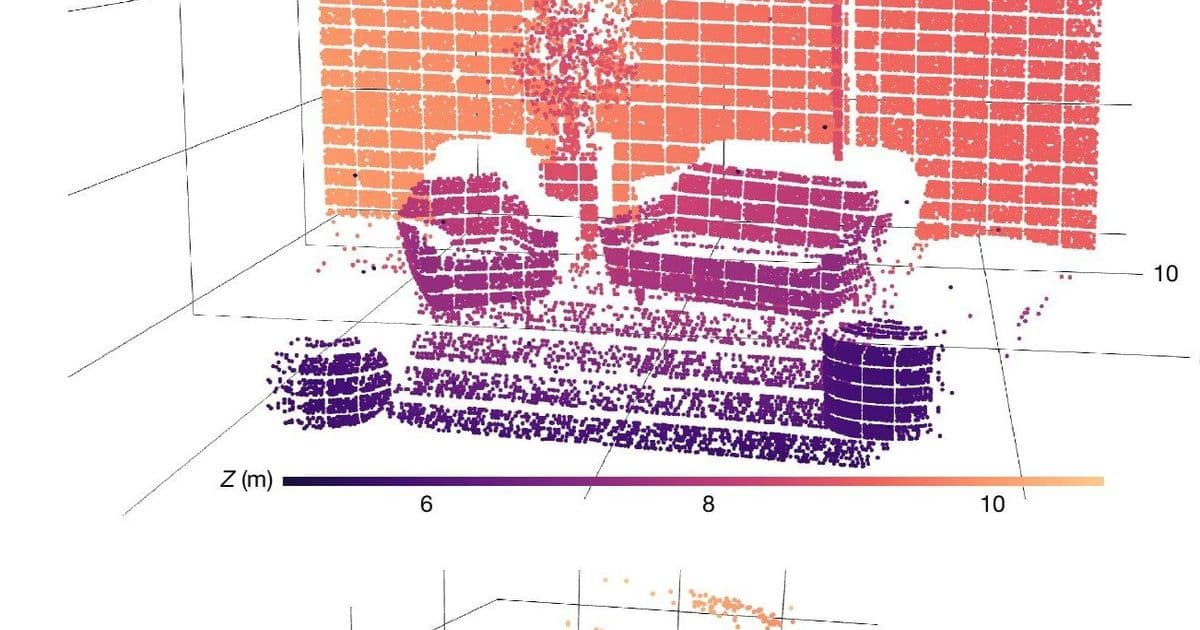
Researchers have developed a compact 4D imaging sensor that fits on a single chip, enabling robots and drones to perceive depth and motion simultaneously with unprecedented accuracy.
A breakthrough in imaging technology could dramatically improve how robots and autonomous vehicles perceive their surroundings. Researchers have developed a compact 4D imaging sensor that fits on a single silicon chip, potentially solving long-standing limitations of current three-dimensional vision systems.
Traditional 3D vision systems used in robotics and drones typically rely on bulky, expensive components that struggle with fast-moving objects and unpredictable environments. These systems often require separate transmitters and receivers, making them impractical for many applications. The new sensor, detailed in a recent Nature publication, consolidates all necessary components onto one chip while adding the critical fourth dimension of motion tracking.
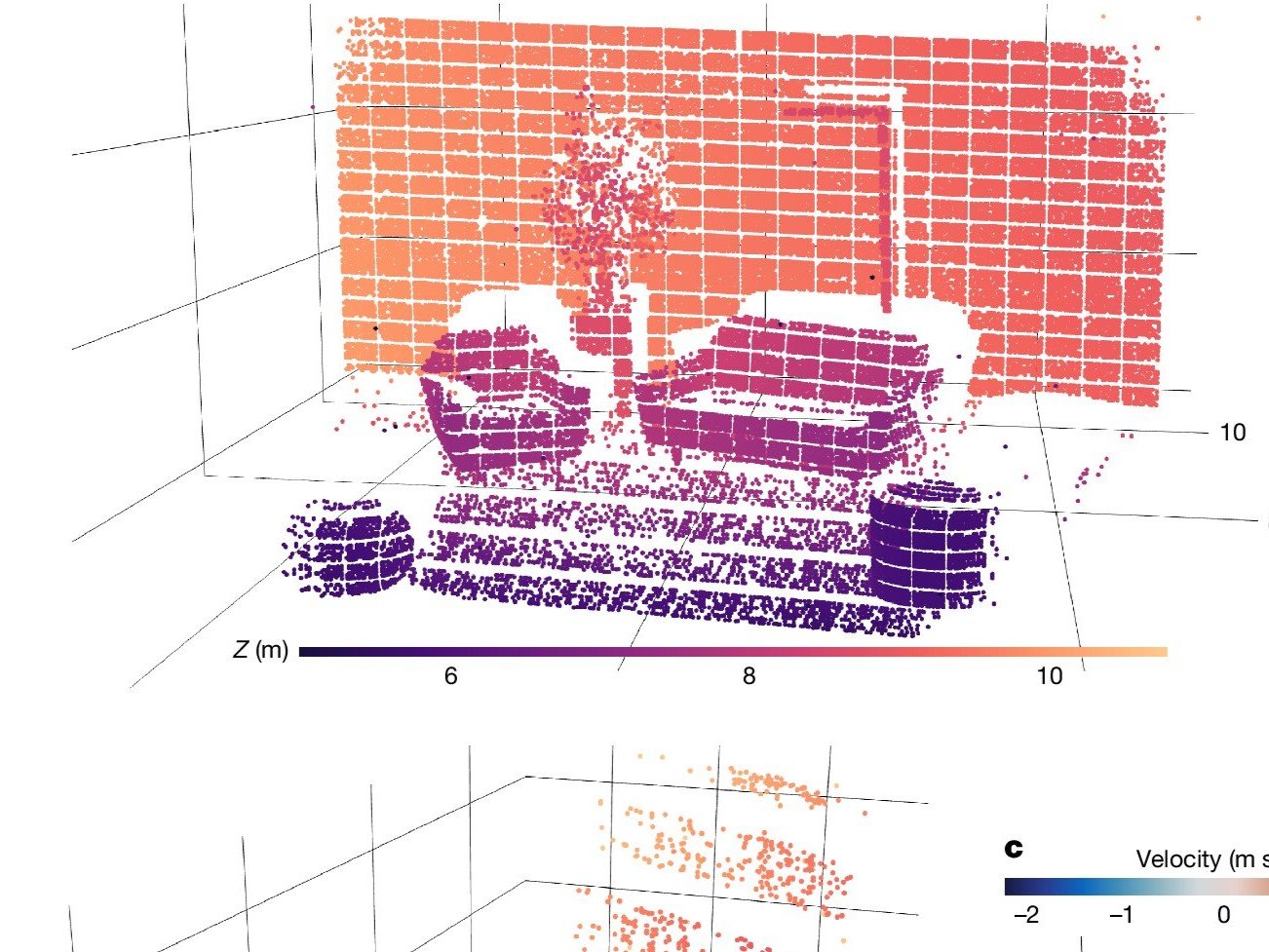
The sensor operates using a continuous laser beam rather than the rapid light pulses common in existing systems. This laser light travels through a physical grid containing nearly 62,000 microscopic stationary pixels. Each pixel serves a dual purpose, functioning as both a transmitter and receiver. This innovative design keeps the overall device exceptionally compact while maintaining high performance.
By analyzing minute shifts in the frequency of returning light waves, the system can instantly calculate both the distance to objects and their velocity. This frequency analysis, known as the Doppler effect, allows the sensor to track motion in real-time without requiring complex processing algorithms.
The research team conducted extensive testing across various scenarios. In indoor environments, the sensor successfully mapped entire rooms with remarkable accuracy. It also measured the velocity of a spinning disk with precision that existing systems struggle to achieve. Perhaps most impressively, in long-range outdoor tests, the chip captured detailed features of a building located 65 meters away, including windows and balconies.
This level of detail from such a compact device represents a significant advancement. Current high-resolution 3D sensors often require multiple components and complex calibration procedures. The new chip's integrated design simplifies deployment while potentially reducing costs.
Because the design integrates all electronic and optical components directly onto one chip, it offers scalability advantages. Manufacturers could potentially produce these sensors at high volumes using existing semiconductor fabrication techniques. This could make advanced 3D vision technology accessible to a much broader range of applications.
While the technology shows immense promise, the researchers acknowledge that it still needs improvement in resolution and range. Current prototypes may not yet match the performance of specialized, larger systems in all scenarios. However, the potential applications extend far beyond robotics.
Autonomous vehicles could benefit from more reliable obstacle detection and motion tracking. Drones could navigate complex environments with greater confidence. The technology might eventually find its way into everyday devices, potentially enhancing the capabilities of digital cameras and smartphones.
The development represents a significant step toward more capable autonomous systems. As robots and drones become increasingly common in various industries, reliable vision systems remain a critical bottleneck. This compact 4D sensor could help overcome that limitation, enabling machines to better understand and interact with the dynamic world around them.
For more technical details, the full research paper is available in Nature with DOI: 10.1038/s41586-026-10183-6.
Comments
Please log in or register to join the discussion