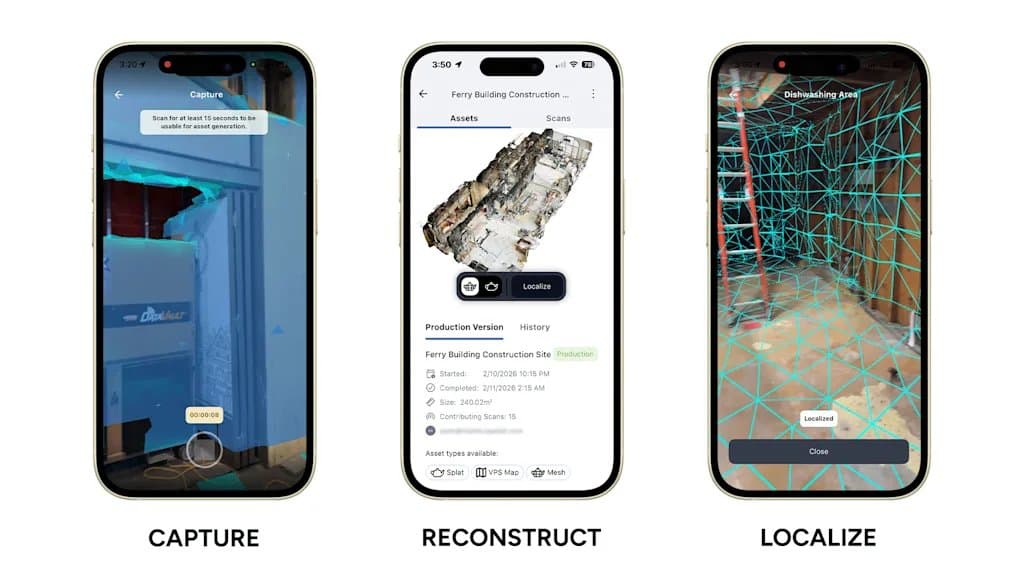
Niantic Spatial, the spatial computing division of Pokémon Go creator Niantic, has launched Scaniverse, a platform enabling companies and individuals to create detailed 3D maps using smartphones, 360-degree cameras, and drones. The technology aims to provide the spatial data infrastructure needed for AI systems and robotics to navigate and understand physical environments.
Niantic, the company behind the global phenomenon Pokémon Go, is expanding its vision beyond mobile gaming into the foundational infrastructure for spatial computing. The company's spatial computing division, Niantic Spatial, has launched Scaniverse, a platform designed to create detailed, robot-ready 3D maps of the physical world using data from smartphones, 360-degree cameras, and drones.
[Animation: Niantic]
The timing of this launch reflects a broader industry trend toward building the spatial data infrastructure necessary for the next generation of AI and robotics applications. As autonomous systems become more sophisticated, they require increasingly detailed and accurate representations of physical spaces to navigate effectively.
The Technology Behind Scaniverse
Scaniverse leverages Niantic's expertise in spatial mapping and computer vision to process data from multiple sources. The platform can handle inputs from consumer-grade smartphones, professional 360-degree cameras, and aerial drone imagery, making it accessible to both individual creators and enterprise customers.
The resulting 3D maps are designed to be "robot-ready," meaning they include the level of detail and semantic information that AI systems and robots need to understand and interact with physical environments. This includes not just geometric representations but also contextual information about objects, surfaces, and spatial relationships.
Market Context and Competition
Niantic's move into spatial mapping infrastructure comes as several tech giants are investing heavily in similar technologies. Google has its extensive Street View and Earth platforms, while Apple has been building its own mapping capabilities. However, Niantic's approach appears to focus more on creating data specifically optimized for AI and robotics applications rather than general-purpose mapping.
The company's experience with Pokémon Go provides a unique advantage. The game required sophisticated spatial understanding to place virtual objects accurately in real-world environments, and this technology can now be applied to more practical use cases.
Potential Applications
While Niantic hasn't detailed specific use cases, the potential applications for robot-ready 3D maps are extensive:
- Autonomous vehicles could use the maps for navigation and obstacle avoidance
- Warehouse robotics could optimize picking and packing operations
- Augmented reality applications could achieve more precise object placement
- Industrial inspection could leverage detailed 3D models for quality control
- Urban planning could benefit from comprehensive spatial data
The Broader Spatial Computing Landscape
Scaniverse represents a significant step in the evolution of spatial computing from a gaming novelty to a fundamental infrastructure layer. The technology addresses a critical bottleneck in the development of AI and robotics: the lack of detailed, up-to-date spatial data about the physical world.
As AI systems become more capable of understanding and interacting with physical environments, the demand for high-quality spatial data will only increase. Niantic's platform could become a key enabler for this next wave of spatial computing applications.
Challenges and Considerations
The launch of Scaniverse also raises questions about data privacy, ownership, and the potential for surveillance. Creating detailed 3D maps of public and private spaces involves collecting vast amounts of data, and the implications for privacy and security need to be carefully considered.
Additionally, the accuracy and reliability of the maps will be crucial for safety-critical applications like autonomous vehicles. Niantic will need to demonstrate that its technology can meet the rigorous standards required for these use cases.
Industry Implications
For the tech industry, Niantic's move signals a shift toward viewing spatial data as a foundational infrastructure layer, similar to how internet connectivity became essential for digital services. Companies building AI and robotics systems may increasingly rely on platforms like Scaniverse to provide the spatial understanding their systems need.
This could create new opportunities for startups and established companies alike, as the demand for spatial computing solutions grows across industries. It also positions Niantic as more than just a gaming company, potentially opening up new revenue streams and partnerships.
Looking Forward
The launch of Scaniverse represents Niantic's bet on the future of spatial computing. By creating the infrastructure for robot-ready 3D maps, the company is positioning itself at the intersection of several major technology trends: AI, robotics, augmented reality, and spatial computing.
Whether this bet pays off will depend on the adoption of the platform by developers and enterprises, the quality and scalability of the technology, and the company's ability to navigate the complex challenges around data privacy and security. But one thing is clear: the physical world is becoming increasingly digital, and Niantic wants to be the company that maps it.
The success of Pokémon Go demonstrated that Niantic can create compelling experiences that bridge the digital and physical worlds. With Scaniverse, the company is now aiming to build the infrastructure that makes those experiences possible in the first place.
Comments
Please log in or register to join the discussion