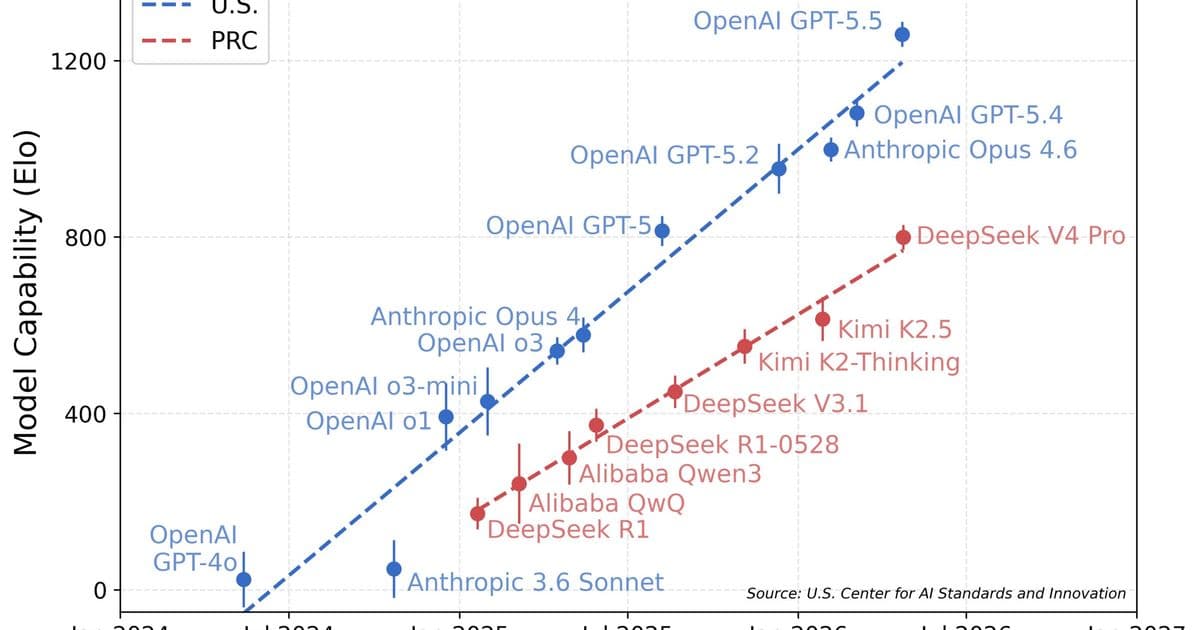
The Center for AI Standards and Innovation (CAISI) at the National Institute of Standards and Technology (NIST) has determined that DeepSeek V4 Pro, China's most capable AI model to date, still lags behind leading US AI models by approximately eight months in capability, highlighting the ongoing technological gap between the two superpowers in the artificial intelligence race.
The National Institute of Standards and Technology's (NIST) Center for AI Standards and Innovation (CAISI) has conducted an evaluation of DeepSeek V4 Pro, revealing that while this Chinese AI model represents a significant advancement for China's AI capabilities, it still trails the most advanced US AI models by about eight months in technological development.
According to the evaluation published in April 2026, DeepSeek V4 Pro demonstrates remarkable progress for Chinese AI development, marking a notable improvement over previous Chinese models. However, the assessment confirms a persistent technological gap between China's AI capabilities and those of leading US developers like OpenAI, Google, and Anthropic.
Evaluation Methodology and Findings
The NIST CAISI evaluation utilized a comprehensive benchmarking system that assesses AI models across multiple dimensions including reasoning capabilities, knowledge acquisition, technical proficiency, and ethical alignment. The evaluation framework, developed through collaboration with academic institutions and industry partners, provides a standardized methodology for comparing AI systems across different development environments.
"DeepSeek V4 Pro represents the current state-of-the-art in Chinese AI development," stated the NIST report. "However, when compared to leading US models, we observe an approximate eight-month lag in overall capability, particularly in complex reasoning tasks and domain-specific expertise."
The report highlights that while DeepSeek V4 Pro shows competitive performance in certain domains, particularly in Chinese language processing and culturally specific knowledge, it demonstrates notable shortcomings in advanced reasoning, multi-step problem solving, and cross-domain knowledge integration when compared to leading US models.
Market Context and Competitive Landscape
The AI market continues to be dominated by US-based companies, with OpenAI's GPT-5 series, Google's Gemini Ultra, and Anthropic's Claude 3.5 representing the current performance benchmarks. These models have benefited from substantial investment, access to vast training datasets, and more advanced chip architectures.
China's AI development has faced significant challenges, including restrictions on advanced semiconductor access and limitations on training data availability. Despite these obstacles, Chinese companies like DeepSeek, Baidu's ERNIE, and Alibaba's Tongyi Qianwen have made substantial progress, with DeepSeek emerging as the current leader in the Chinese AI space.
The investment landscape reflects this competitive imbalance. US AI companies have collectively raised over $100 billion in funding since 2023, with individual companies securing multi-billion dollar valuations. In contrast, Chinese AI firms have navigated a more complex funding environment, with domestic investment totaling approximately $40 billion during the same period, according to market analysis from PitchBook.
Strategic Implications
The NIST evaluation carries significant strategic implications for both US and Chinese AI development efforts. For China, the results underscore the challenges of catching up to US leadership in AI while facing technological restrictions and access limitations.
"The eight-month gap identified by NIST represents both a challenge and an opportunity," commented Dr. Li Wei, AI researcher at Tsinghua University. "While the gap exists, it is narrowing compared to previous evaluations, suggesting that China's focused development strategy is yielding results. The question is whether this trajectory can be sustained given ongoing technological constraints."
For the United States, the evaluation validates current investment strategies and technological approaches while highlighting the need to maintain competitive advantage. The US government has allocated over $50 billion for AI research and development through the National AI Initiative, with additional funding through the CHIPS and Science Act aimed at securing semiconductor supply chains.
The evaluation also has implications for global AI governance and standards development. NIST's assessment methodology is increasingly being adopted internationally, suggesting that the United States is establishing itself as a key arbiter of AI evaluation standards. This positioning could influence global regulatory frameworks and technical standards in the coming years.
Future Outlook
The eight-month gap identified by NIST is likely to evolve dynamically as both US and Chinese AI development efforts continue. US companies are already working on next-generation models expected to be released in late 2026 and early 2027, while Chinese developers are reportedly accelerating development cycles to close the gap.
The evaluation also highlights the increasing importance of specialized AI models that can outperform general-purpose systems in specific domains. This trend suggests that future competition may not only focus on general intelligence but also on specialized capabilities tailored to specific industries and applications.
As the AI race continues, the NIST evaluation provides a valuable benchmark for tracking technological progress and understanding the evolving competitive landscape. The persistent gap, while narrowing, underscores the complex challenges facing China's AI development efforts and the significant advantages enjoyed by US-based companies in terms of resources, infrastructure, and ecosystem development.
The full NIST CAISI evaluation report is available through the NIST website, offering detailed methodology and comprehensive results for researchers and industry stakeholders interested in understanding the current state of AI development across these two technological superpowers.
Comments
Please log in or register to join the discussion