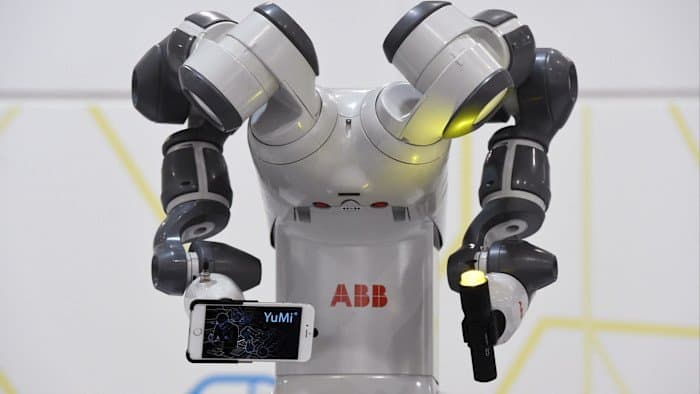
Nvidia partners with ABB to bring robot training software to Omniverse simulation platform, with Foxconn trialing autonomous robots in manufacturing
Nvidia and ABB Robotics are partnering to bring ABB's robot training software to Nvidia's Omniverse simulation platform, aiming to accelerate the development of autonomous industrial robots. The collaboration will allow manufacturers to train robots in virtual environments before deploying them in physical factories, potentially reducing development time and costs while improving safety and efficiency.
Virtual Training for Physical Robots
The partnership centers on integrating ABB's RobotStudio software with Nvidia's Omniverse platform. RobotStudio is ABB's simulation and offline programming software used by manufacturers to program and test industrial robots. By moving this training to Omniverse's physics-based virtual environment, companies can create digital twins of their factories and test robot behaviors in realistic conditions without disrupting actual production lines.
Nvidia's Omniverse is a platform for developing and operating metaverse applications, including industrial digital twins. It provides real-time physically accurate simulations that can model complex factory environments, robot movements, and interactions with humans and other equipment. This allows engineers to optimize robot programming, test safety scenarios, and identify potential issues before physical implementation.
Foxconn's Early Adoption
Foxconn, the world's largest electronics manufacturer and a major Apple supplier, is already trialing this technology. The company is using the Omniverse-based training system to develop more autonomous robots for its manufacturing facilities. This early adoption by Foxconn signals strong industry interest in virtual training as a way to accelerate automation in electronics manufacturing, where precision and efficiency are critical.
Strategic Implications for Manufacturing
The partnership represents a significant step toward fully autonomous manufacturing. By combining ABB's robotics expertise with Nvidia's simulation and AI capabilities, the collaboration could help manufacturers overcome traditional barriers to robot deployment, such as lengthy programming times and safety concerns. The ability to train robots in virtual environments before physical deployment could dramatically reduce the time and cost required to implement new automation systems.
This technology also aligns with broader industry trends toward digital twins and simulation-based design. As manufacturers seek to increase flexibility and reduce downtime, the ability to test and optimize robot behaviors in virtual space becomes increasingly valuable. The partnership could give both companies a competitive advantage in the growing industrial automation market.
Market Context and Competition
The industrial robotics market is projected to grow significantly in the coming years, driven by labor shortages, rising labor costs, and the push for greater manufacturing efficiency. Nvidia's entry into this space through simulation and AI represents a strategic expansion beyond its traditional graphics and data center businesses. For ABB, the partnership provides access to cutting-edge simulation technology that could enhance its robotics offerings.
Competitors in the industrial automation space, including companies like Fanuc, Yaskawa, and Rockwell Automation, may need to develop similar virtual training capabilities to remain competitive. The success of this partnership could accelerate industry-wide adoption of simulation-based robot training and development.
Technical Advantages
The Omniverse platform offers several technical advantages for robot training. Its physics-based simulation can accurately model real-world conditions, including gravity, friction, and material properties. The platform also supports multi-robot coordination and human-robot interaction scenarios, which are critical for modern manufacturing environments where robots work alongside human operators.
Additionally, Omniverse's AI capabilities can help optimize robot movements and behaviors based on learned patterns from virtual training sessions. This could lead to more efficient and adaptable robots that can handle variations in manufacturing processes without requiring extensive reprogramming.
Future Applications
Beyond traditional manufacturing, this technology could find applications in other industries requiring precise robotic operations, such as healthcare, logistics, and construction. The ability to train robots in virtual environments could also accelerate the development of more complex autonomous systems that can handle unpredictable real-world scenarios.
The partnership between Nvidia and ABB represents a convergence of simulation, AI, and robotics that could reshape how industrial automation is developed and deployed. As virtual training becomes more sophisticated, the line between digital and physical robot development may continue to blur, potentially leading to faster innovation cycles and more capable autonomous systems.
Comments
Please log in or register to join the discussion