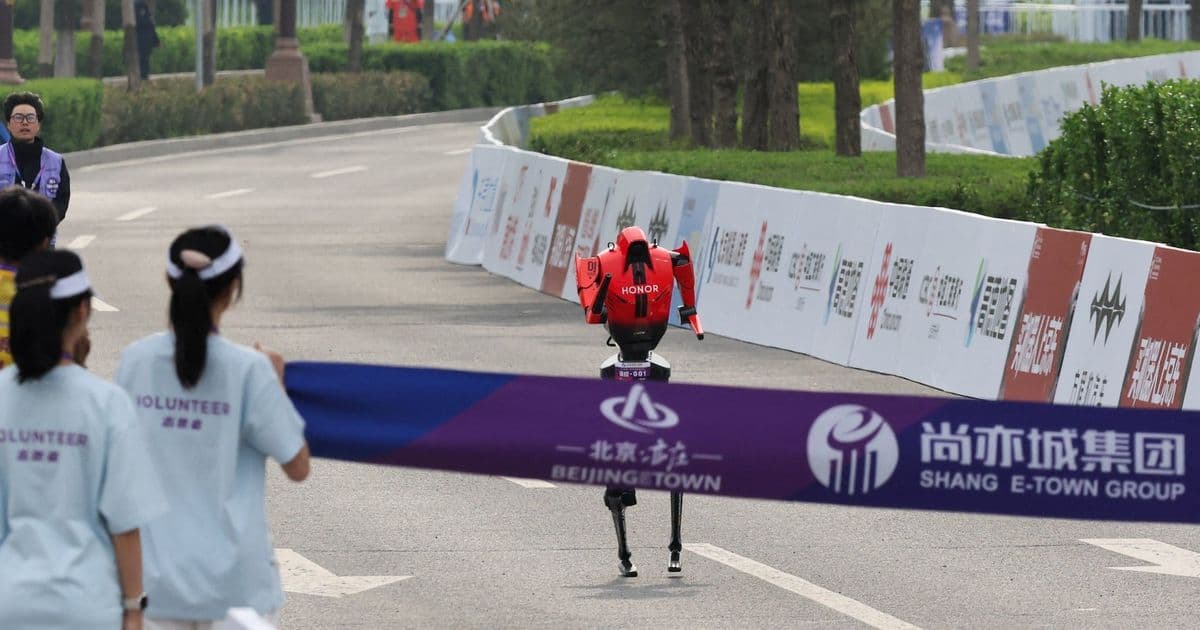
Several humanoid robots completed the Beijing half-marathon 10+ minutes faster than human winners, with Honor's robot breaking the world record held by Jacob Kiplimo.
In a striking demonstration of robotics advancement, multiple humanoid robots completed the Beijing half-marathon 10+ minutes faster than human winners, with an Honor-made robot breaking the human world record held by Jacob Kiplimo. The event showcased how quickly autonomous navigation and athletic capabilities are progressing in humanoid robotics.
Dozens of Chinese-made humanoid robots participated in the race, demonstrating their fast-improving athleticism and autonomous navigation skills. The robots' ability to maintain consistent pacing over 21 kilometers while navigating a real-world course represents a significant milestone in robotics development.
This achievement comes amid broader AI and robotics acceleration. Just days earlier, Tesla expanded its robotaxi service to Dallas and Houston after launching in Austin, with the company beginning to offer rides without safety drivers in January 2026. The convergence of autonomous vehicles and humanoid robotics suggests we're entering an era where AI-powered machines are increasingly capable of complex real-world tasks.
Market analysts are taking note. Autonomous vehicle startups raised a record $21.4 billion across 34 deals through April 15, up from $5.9 billion raised across 99 investments globally in all of 2025. This funding surge reflects investor confidence in AI-driven mobility solutions.
Meanwhile, the semiconductor industry faces its own challenges. Global DRAM supply is likely to meet only 60% of demand through 2027, with memory costs hitting approximately 40% of low-end smartphone manufacturing costs by mid-2026, up from 20% currently. This shortage could impact the production of AI hardware needed to power these advanced robots.
The Beijing half-marathon results raise questions about the future of human competition and employment. As robots demonstrate capabilities that surpass human performance in physical tasks, industries from manufacturing to service sectors may face rapid automation pressures. The robots' success in navigating a complex, dynamic environment like a marathon course suggests they're approaching readiness for broader real-world deployment.
The event also highlights China's aggressive push in humanoid robotics development. With multiple Chinese companies fielding competitive robots, the country appears determined to lead in this strategic technology area, potentially reshaping global competition in AI and robotics.
As humanoid robots continue to close the gap with human capabilities, the Beijing half-marathon may be remembered as a watershed moment when machines first decisively outperformed humans in a physically demanding endurance event.
Comments
Please log in or register to join the discussion