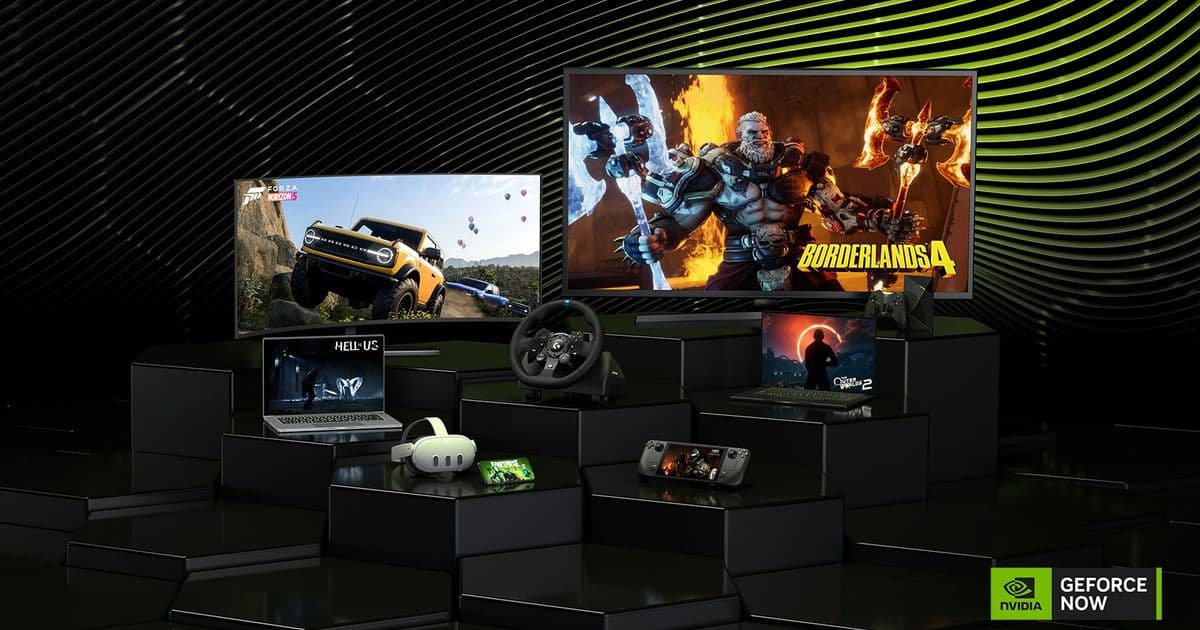
Nvidia demonstrated its GeForce Now cloud gaming service in India with RTX 5080-powered SuperPods, 5K 120 fps streaming, and broad device support, but left pricing and performance details unclear.
Nvidia has been teasing its GeForce Now (GFN) cloud gaming service for India since CES 2025, and after months of anticipation, the company finally brought the platform to the country. A recent media showcase in Mumbai offered an early hands-on experience, revealing impressive technical capabilities but also raising several unanswered questions about pricing, infrastructure, and real-world performance.
GeForce Now's Technical Prowess
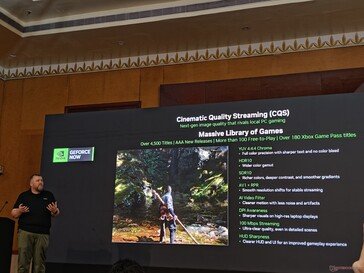
The service has evolved significantly since its 2020 launch, now leveraging Blackwell RTX 5080-class GPUs housed in custom SuperPods. These datacenters support streaming up to 5K resolution at 120 fps, with DLSS 4 multi-frame generation enabling smoother gameplay even at maximum settings. The new Cinematic Quality Streaming (CQS) mode introduces YUV 4:4:4 chroma subsampling, 10-bit HDR, AV1 encoding, and support for high DPI displays with up to 100 Mbps bitrates.
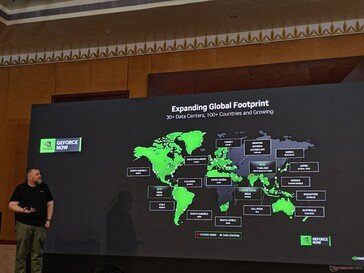
Nvidia's infrastructure spans 30+ data centers across 100+ countries, with facilities in North America, Western Europe, and now India fully owned by the company. The Indian SuperPods are located in Mumbai, powered by AMD Threadripper Pro CPUs clocked at 4.5 GHz, with eight cores and 16 threads per instance. The system employs Nvidia's ConnectX 7 smart NICs and Rivermax hardware packet pacing to minimize server-side latency.
Device Compatibility and Game Library
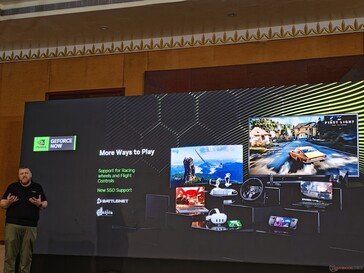
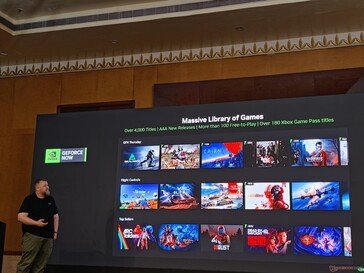
One of GeForce Now's strengths is its broad device support. The Mumbai showcase demonstrated the service running on everything from Linux ultrabooks and iPhones to Steam Decks and gaming PCs. The platform supports over 4,000 titles across major storefronts including Steam, GOG, Epic Games, EA, Battle.net, Xbox, and Ubisoft Connect.
A particularly impressive demo compared identical RTX 5080 gaming PCs—one running Doom: The Dark Ages natively, the other streaming via GeForce Now. The visual parity was remarkable, making it difficult to distinguish between the two experiences. The service also supports racing wheels and flight controllers, expanding its appeal beyond traditional gaming setups.
Performance in Real-World Conditions
During the Mumbai showcase, the proximity of SuperPods to the venue resulted in extremely low latency and minimal input lag. Games like Arc Raiders ran at 1080p 360 fps on a 360 Hz Asus monitor, though this required reducing in-game quality settings and using YUV 4:2:0 chroma subsampling. 4K gaming remains capped at 120 fps, with higher frame rates only achievable by lowering resolution to 1440p or 1080p.
The demo of Doom: The Dark Ages on a Meteor Lake ultrabook running Ubuntu highlighted both the service's potential and its current limitations. While the game eventually launched and ran impressively with path tracing, DLSS 3.5 ray reconstruction, and DLSS 4 Quality with MFG 4x enabled, the initial startup time was considerable. Minor input lag was noticeable, though Nvidia claims server-side optimizations can offset client-side latency introduced by multi-frame generation.
The Storage Advantage
GeForce Now includes a unique install-to-play feature powered by NVMesh, offering 100 GB of temporary, single-session storage. This allows users to install Steam games directly onto GeForce Now servers, even for titles not officially supported by the platform. For persistent storage, users can upgrade to 1 TB for $8 per month—a feature that could prove particularly valuable for Indian gamers with limited local storage.
Unanswered Questions and Concerns
Despite the impressive technical demonstration, several critical questions remain unanswered:
Pricing and Availability: Nvidia has only provided a vague Q1 2026 window for closed and open betas, with no official pricing details. Based on US pricing, tiers range from free (with RTX 3050-class compute, one-hour limits, and potential queue times) to $19.99 per month for the Ultimate tier with RTX 5080 SuperPod access.
Infrastructure Scalability: While the Mumbai showcase benefited from proximity to SuperPods, questions persist about performance in distant regions. India's diverse internet landscape, with varying ISP quality across states and districts, presents significant challenges. Nvidia claims 50 Mbps with <80 ms ping should suffice for 4K 120 fps gameplay, but real-world testing remains pending.
Market Competition: Microsoft's Xbox Cloud Gaming recently launched in India with a different approach—no free tier and Game Pass Ultimate required at $29.99 per month. GeForce Now's advantage lies in streaming PC versions with full graphics settings and support for up to 5K 120 fps, along with technologies like Reflex and DLSS.
Market Potential and Conclusion
India represents a massive opportunity for cloud gaming services. The country's combination of rising mobile device penetration, increasing internet infrastructure, and supply-constrained, expensive PC hardware creates ideal conditions for platforms like GeForce Now. An entry-level Performance tier around ₹500, scaling to ₹1,500 for Ultimate, could attract significant adoption if Nvidia ensures consistent performance nationwide.
The Mumbai showcase demonstrated that GeForce Now's technology is genuinely impressive, with the potential to deliver console-quality gaming on virtually any device. However, the service's success in India will ultimately depend on transparent pricing, reliable performance across diverse regions, and Nvidia's ability to scale infrastructure to meet demand. As beta testing begins in the coming weeks, Indian gamers will finally get to answer the question that the showcase left hanging: can cloud gaming truly replace local hardware in one of the world's most dynamic and challenging markets?
The GeForce Now India journey is just beginning, and while the technology shows immense promise, the real test lies ahead in delivering a consistent, high-quality experience to gamers from Mumbai to Manipur.
Comments
Please log in or register to join the discussion