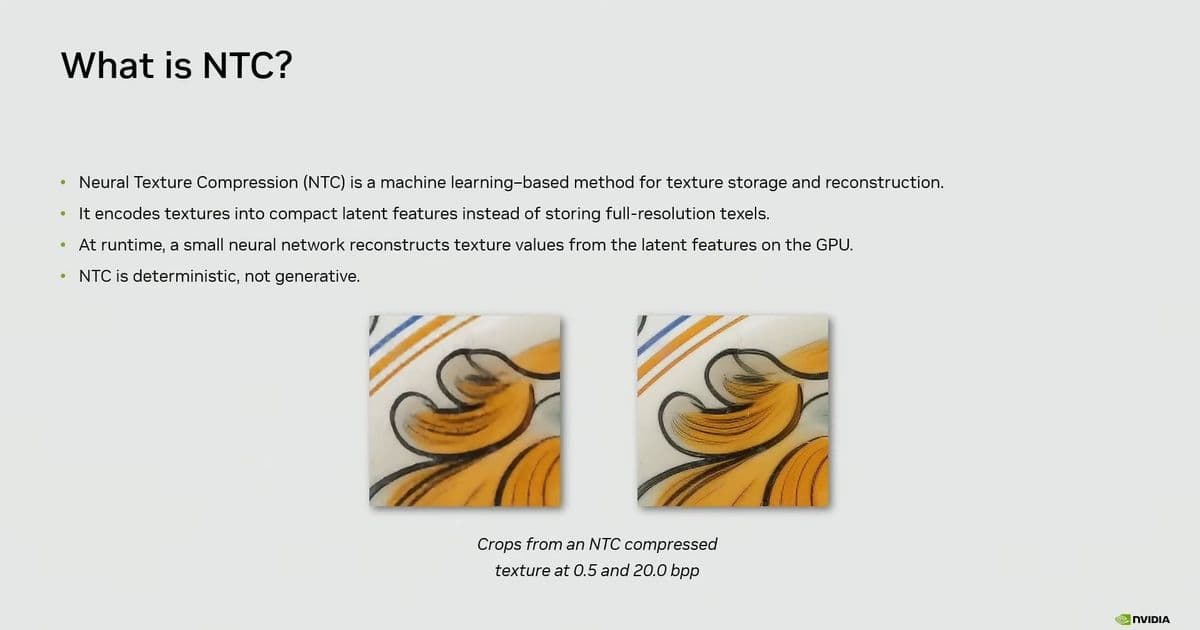
Nvidia's Neural Texture Compression technology dramatically reduces gaming GPU memory requirements by up to 85% without sacrificing visual fidelity, using neural networks to decompress textures more efficiently than traditional methods.
Nvidia has unveiled a groundbreaking technology called Neural Texture Compression (NTC) that promises to revolutionize how games manage GPU memory usage. During a recent GTC talk, the company demonstrated how this AI-driven approach can reduce VRAM consumption by up to 85% while maintaining identical visual quality to traditional compression methods.
The Growing VRAM Challenge
As games become increasingly complex and photorealistic, the industry has faced mounting pressure to optimize resource usage. VRAM consumption has risen sharply over recent years, creating bottlenecks for both developers and gamers. Traditional block-based compression techniques, while effective, have reached their practical limits in terms of efficiency gains.
How Neural Texture Compression Works
Unlike conventional compression methods, NTC leverages small neural networks to unpack textures in real-time during gameplay. This approach offers several advantages:
- Dramatically reduced texture sizes for more manageable game installations
- Significantly lower VRAM usage during runtime
- Enhanced final render quality with up to 4x higher effective resolution
In a compelling demonstration, Nvidia showcased a Tuscan Villa Scene that consumed 6.5 GB of VRAM using standard block compression. When switched to NTC, the same scene required only 970 MB of VRAM, with no visible difference in image quality.
Impressive Compression Ratios
The technology's effectiveness is further illustrated by another demo featuring a flight helmet with 272 MB of uncompressed textures. Traditional block compression reduced this to 98 MB, but NTC achieved an astonishing reduction to just 11.37 MB - approximately 24 times smaller than the original texture data.
Neural Materials: The Next Evolution
Building on this foundation, Nvidia also introduced Neural Materials, which applies similar neural network principles to material texture data processing. Traditional rendering pipelines require multiple texture maps stacked together, with the GPU calculating complex light interactions across each layer simultaneously.
Neural Materials simplifies this process by having the neural network already understand how light will interact with materials based on its training data. This eliminates the need for computationally expensive BRDF (Bidirectional Reflectance Distribution Function) calculations during rendering.
The results are impressive: up to 7.7x faster render times at 1080p resolution without any loss in image quality.
Hardware Efficiency
One of NTC's key advantages is its efficient use of existing GPU hardware. The technology utilizes matrix acceleration engines - specialized hardware blocks found in modern GPUs. Nvidia refers to these as Tensor Cores, while Intel calls them XMX engines and AMD labels them AI accelerators.
This hardware integration means that implementing NTC doesn't impact base GPU performance, as these engines are specifically designed for AI and neural network operations. This is the same hardware that powers upscaling technologies like DLSS, FSR, and XeSS.
Beyond Traditional AI Applications
While the term "neural network" might evoke concerns about generative AI or "AI slop," NTC represents a fundamentally different application. The neural networks are trained exclusively on the specific texture sets they'll need to reference during game development, eliminating any possibility of hallucination or unpredictable outputs.
This targeted training approach ensures that NTC enhances rather than replaces traditional game development workflows, providing a practical solution to a real technical challenge.
Industry Standardization and Adoption
Importantly, this technology isn't exclusive to Nvidia. Microsoft has standardized the concept as "Cooperative Vectors" in DirectX, making it accessible to all GPU manufacturers. Intel has already demonstrated its own implementation with noticeably improved texture quality compared to block compression.
AMD discussed the technology in 2024, suggesting broad industry support for this approach. However, as of now, no games support either Cooperative Vectors or Nvidia's Neural Texture Compression specifically.
The Future of Game Development
Given the industry's trajectory toward more complex, visually demanding games, the adoption of NTC and similar technologies appears inevitable. Texture data typically consumes the most VRAM in any game, making efficient compression techniques crucial for future development.
This innovation represents one of the more tasteful implementations of AI in gaming, addressing a genuine technical limitation rather than forcing AI into applications where it doesn't belong. As games continue to push hardware boundaries, technologies like Neural Texture Compression will become essential tools in the developer's arsenal.
While widespread adoption may take time, the potential benefits for both developers and gamers are substantial. Reduced VRAM requirements could enable higher-quality textures on existing hardware, lower system requirements for new games, and more efficient use of available memory resources.
The gaming industry's embrace of NTC could mark a significant shift in how we approach graphics optimization, moving from traditional compression algorithms to intelligent, learning-based solutions that adapt to specific content requirements.
Comments
Please log in or register to join the discussion