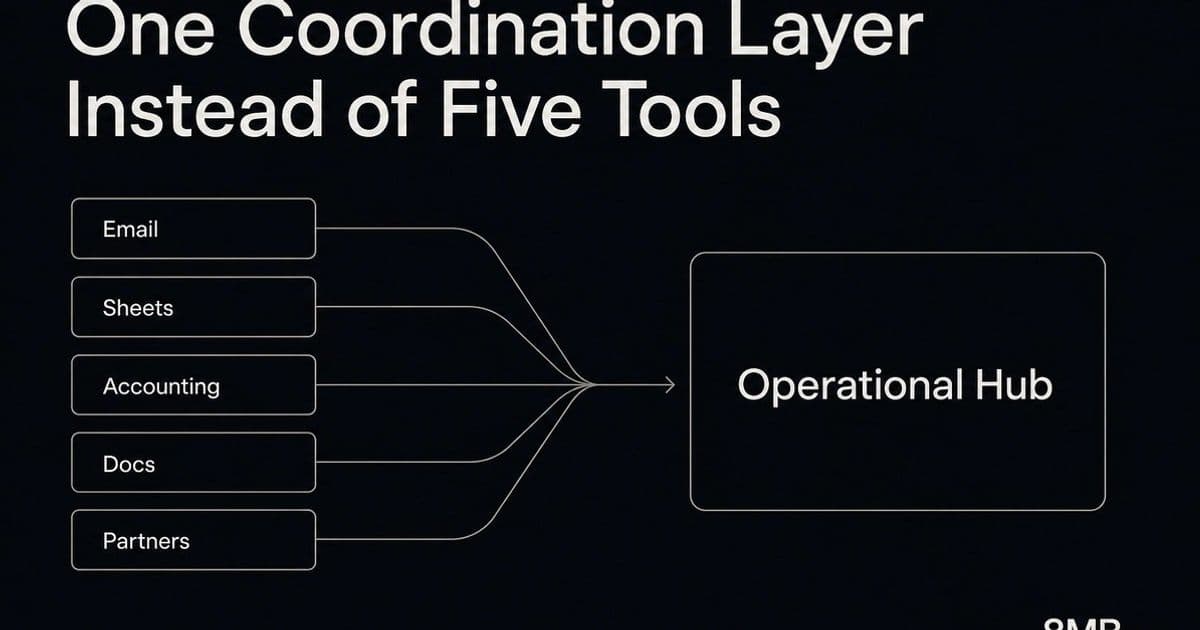
A midsize service firm stopped juggling emails, spreadsheets, accounting software and partner portals by building a single web app that became the operational source of truth. The article explains the coordination tax, why adding more tools rarely helps, and four architectural patterns that make a coordination layer reliable.
One Coordination Layer Replaces Five Tools
The problem: multiple truths, constant friction
On a Tuesday a delivery date is confirmed in an email thread. By Thursday the spreadsheet still shows the previous week’s date. Finance issues an invoice based on that stale sheet. A partner uploads a signed contract to their portal, but nobody links it to the case the rest of the team is tracking. By Friday the status meeting spends forty minutes reconstructing what should have been obvious on Monday.
No one was careless. Everyone was working on the same operational story, but each person saw a different version of it. This hidden cost is what we call the coordination tax – the recurring effort spent aligning parallel records instead of moving work forward.
Why adding another tool usually fails
When the pain becomes visible, the instinct is to buy another product: a CRM module, a project board, a workflow app. In practice that often creates a sixth truth rather than a hub. The reasons are systematic:
- Updates still happen elsewhere – if people continue to write dates in email, the new tool becomes a reporting layer, not the source of truth.
- Off‑the‑shelf models don’t match domain concepts – service companies work with cases, hand‑offs, partner artifacts, and billing triggers. Generic entities force awkward workarounds.
- Integrations copy data without ownership – a row sync reduces typing but does not answer who should own a field when two sources disagree.
- Behavior beats UI – a tool fails when the official record is harder to update than the inbox. Trust in the record is earned by making the write path frictionless.
The solution: a single coordination layer
Instead of piling on dashboards, we built one web application that became the operational hub. It stores a durable record for each case, explicit relationships to documents, invoices and partner inputs, and permissions that mirror real responsibility. External systems (accounting, storage, partner APIs) are integrated at the edges – they consume or emit events against the hub but never maintain their own copy of case status.
Stack snapshot (for the curious)
- Backend – PHP with Symfony and Sonata Admin (chosen for maintainability by a small team).
- Database – MongoDB Atlas for flexible document modeling and built‑in replication.
- Integrations – webhook listeners and periodic jobs that translate external events into hub updates.
The technology is not the lesson; the architecture is.
Four patterns that make a coordination layer stick
1. Operational record as the unit of truth
Every piece of work gets a permanent entity in the hub: a case with identity, status, owners and an immutable audit trail. All other systems import or export data against that entity. The design implication is to avoid “task”‑only models; instead model the long‑lived case that spans multiple actors and billing cycles.
2. Explicit relationships, not implied links
Relationships such as case ↔ document, case ↔ invoice, case ↔ partner submission are first‑class foreign‑key‑like references. This enables:
- Validation rules (e.g., no invoice without a confirmed delivery date).
- One‑click navigation from a case screen to all attached artifacts.
- Auditable history of when a file was linked.
A small graph of well‑named entity types replaces a sprawling spreadsheet with dozens of nullable columns.
3. Permissions that mirror responsibility
Roles are defined by who should be allowed to change which part of a case:
- Internal staff can edit status and attach files.
- Partners have scoped write access only to their submission fields.
- Clients receive read‑only views of progress.
If the write path is harder than sending an email, the hub will never be used. Therefore permissions are built early and kept simple.
4. Edge‑only integrations
Accounting, document storage, partner portals, and notification channels sit at the perimeter. They listen for events like case.updated or push events like partner.file.uploaded. The hub remains the single source of operational truth; external systems provide domain‑specific capabilities (ledger rules, file versioning) without duplicating status.
Key design steps:
- Define idempotent sync rules.
- Decide conflict resolution policy (hub wins for operational fields, external system wins for its domain data).
- Use message queues or webhook retries to guarantee delivery.
Before and after
| Aspect | Before | After |
|---|---|---|
| Truth source | Email, sheets, folders, partner portals | Single hub with shared records |
| Status reconstruction | Meetings spent recreating the picture | Immediate view of current state |
| Handoffs | Implicit, easy to lose | Explicit, traceable links |
| Context location | Scattered across inboxes | Attached to the case entity |
| Dependency on individuals | High – knowledge lives in heads | Low – new team members can follow the case instantly |
Measured impact
- 30‑50 % reduction in time spent on status clarification and follow‑ups.
- Noticeable drop in billing errors caused by outdated dates.
- Faster decision cycles because information no longer required a validation round.
- Reduced reliance on any single person’s mailbox for context.
The biggest win is qualitative: meetings now focus on decisions, not on rebuilding reality.
When this approach makes sense (and when it does not)
Fits well when:
- Work spans multiple internal roles and external partners.
- Existing tools are already fragmented and cause frequent double‑checking.
- The organization is willing to shift where updates happen, not just add reporting layers.
Probably not worth it when:
- A single owner handles the entire process end‑to‑end.
- A clear, enforced system of record already exists and coordination overhead is negligible.
- Leadership insists on a tool purchase without committing to process change.
Closing thoughts
If your week looks like the opening story – dates locked in email, status in spreadsheets, invoices on stale data, partner files in limbo – the bottleneck is structural, not effort. A deliberately built coordination layer provides a single, current representation of work while allowing specialist systems to do what they do best at the edges.
The case study with full metrics is available in English (link) and Polish (link).
Feel free to reach out via the case‑study page for a quick conversation about whether a coordination layer fits your organization. No exhaustive specification is needed – a short description of where work breaks and what gets double‑checked is often enough to start.
Written by the delivery team at 8mb, a senior‑led engineering studio focused on reliable back‑ends, integrations and maintainable operational software.
Comments
Please log in or register to join the discussion