
OpenAI is rolling out sponsored content in ChatGPT for logged-in U.S. adults on free and Go plans, marking a significant shift from its subscription-only model. The company promises strict privacy controls and no influence on AI responses, but the move highlights the financial pressures of scaling AI and the evolving landscape of AI monetization.
OpenAI is fundamentally changing its business model. Starting in the coming weeks, the company will begin showing sponsored content within ChatGPT for logged-in adult users in the United States who are on the free or ChatGPT Go tiers. This marks a major departure from the company's previous stance, which had relied almost exclusively on subscription revenue.
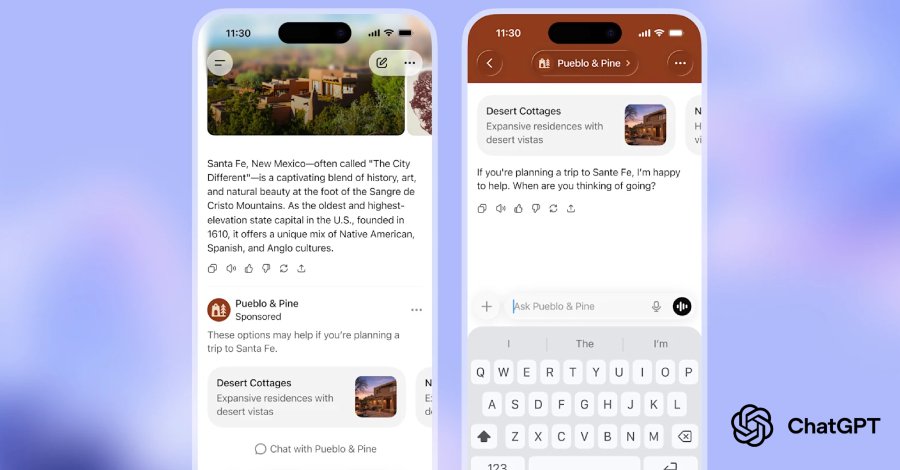
The ads will appear at the bottom of a user's conversation, clearly labeled as sponsored content. According to OpenAI's announcement, the initial test will show ads "when there's a relevant sponsored product or service based on your current conversation." The company emphasized that ads will not be shown in accounts for users under 18, nor will they appear near sensitive topics like health, mental health, or politics.
A Strategic Pivot from "Last Resort"
This move represents a significant softening of OpenAI's position on advertising. As recently as May 2024, CEO Sam Altman characterized ads as "like a last resort for us for a business model" and described "ads plus AI" as "sort of uniquely unsettling." In a recent post on X, Altman acknowledged the shift, stating, "It is clear to us that a lot of people want to use a lot of AI and don't want to pay, so we are hopeful a business model like this can work."
The financial reality is stark. Training and operating large language models like GPT-4 is extraordinarily expensive, with costs running into billions of dollars. While ChatGPT boasts an impressive 800 million weekly active users as of early October 2025, the vast majority are on free tiers. Advertising offers a path to monetize this massive user base without requiring a subscription, potentially making advanced AI more accessible to the masses.
Privacy Promises and User Control
OpenAI is attempting to navigate the inherent tension between personalized advertising and user privacy. The company explicitly stated that "your data and conversations are protected and never sold to advertisers." Instead, the ads will be served based on the context of the current conversation, not on a user's broader chat history or personal profile data.
Users will have several controls:
- Ability to see why a specific ad was shown
- Option to dismiss ads and provide feedback
- Ability to turn off personalization entirely
This approach is designed to address the "uniquely unsettling" feeling Altman previously described. By keeping the ad targeting confined to the immediate conversation context and preventing advertisers from accessing user data, OpenAI aims to maintain the integrity of the AI's responses while generating revenue.
The Technical and Ethical Implications
The implementation raises several technical and ethical questions. How does OpenAI determine "relevance" between a conversation and a sponsored product? What algorithms will match conversation topics to ads without analyzing the full content of private chats? The company has not detailed the exact data collection methods, which leaves room for scrutiny.
From a technical perspective, this requires sophisticated natural language processing to identify conversation topics in real-time, match them to an ad inventory, and serve the content without disrupting the user experience. The system must also enforce strict boundaries around sensitive topics and age verification.

Industry Context and Precedent
This move aligns with a broader trend in the tech industry. Major platforms like Google, Meta, and Microsoft have long used advertising to support free services. However, integrating ads into an AI chat interface is relatively new territory. The challenge is maintaining the conversational, assistant-like feel of ChatGPT while introducing commercial content.
OpenAI's approach differs from traditional search advertising. Instead of placing ads alongside search results, they're embedding them within a conversational flow. This could be less intrusive than banner ads but risks breaking the natural dialogue if not implemented carefully.
What This Means for Users and the Industry
For users on free tiers, this means continued access to ChatGPT without a subscription fee, but with the introduction of sponsored content. For the industry, it signals that even the most well-funded AI companies are grappling with sustainable business models.
The success of this experiment will be closely watched. If it proves effective without alienating users or compromising privacy, it could become a standard model for AI services. If it fails, it may push companies toward other revenue streams or force a reevaluation of how AI is monetized.
OpenAI's commitment to keeping ads out of Plus, Pro, Business, and Enterprise tiers suggests they view this as a solution for the mass market, while maintaining a premium, ad-free experience for paying customers.

Looking Ahead
As the test rolls out, key questions remain: How will users respond to ads in their AI conversations? What will the ad inventory look like? How will OpenAI measure success beyond revenue? The company's ability to balance monetization with its mission to make AGI benefits accessible will be critical.
For now, OpenAI is taking a cautious, controlled approach—testing in a limited market, with clear boundaries and user controls. The outcome will likely influence not just OpenAI's future, but the entire landscape of AI service monetization.
Related Resources:
Comments
Please log in or register to join the discussion