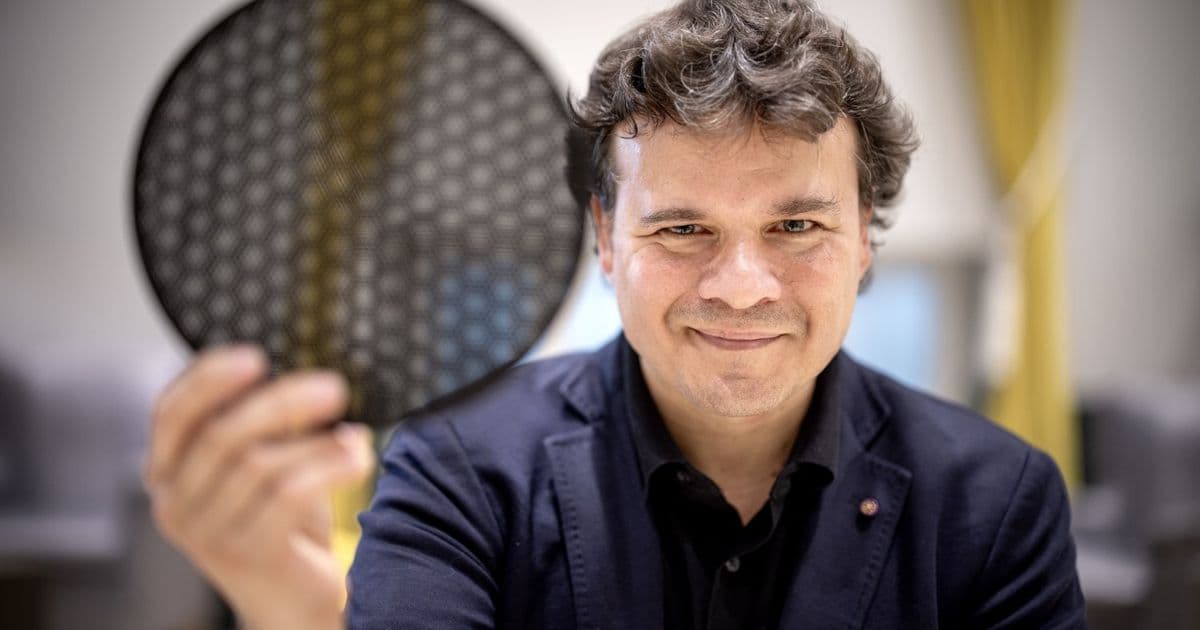
MIT physicist Pablo Jarillo-Herrero shares the 400,000-euro BBVA Foundation Frontiers of Knowledge Award with Allan MacDonald for their pioneering work on twisting graphene layers to unlock superconductivity and other exotic quantum states, a discovery that has opened a new field of 'twistronics' with potential applications in energy transmission and quantum computing.
The BBVA Foundation has awarded its 2025 Frontiers of Knowledge Award in Basic Sciences to MIT physicist Pablo Jarillo-Herrero and Allan MacDonald of the University of Texas at Austin for their groundbreaking work on "magic-angle" graphene. The 400,000-euro prize recognizes their combined theoretical and experimental achievements in demonstrating that rotating two-dimensional materials like graphene can fundamentally transform their electronic properties, creating new states of matter such as superconductivity.
From Theoretical Prediction to Experimental Breakthrough
The story begins in 2011, when theoretical physicist Allan MacDonald published a model predicting that when two sheets of graphene—a single layer of carbon atoms arranged in a honeycomb lattice—are twisted at a specific angle of approximately 1.1 degrees, the interaction between electrons would produce entirely new emergent properties. This theoretical insight remained largely academic for several years until Pablo Jarillo-Herrero's experimental group at MIT achieved the critical verification.
In 2018, Jarillo-Herrero's team successfully fabricated twisted bilayer graphene and observed the predicted phenomena. Their experimental confirmation demonstrated that at this "magic angle," the material exhibited superconducting behavior—conducting electricity with zero resistance—at temperatures far higher than conventional superconductors. This discovery validated MacDonald's theoretical framework and opened an entirely new research direction in condensed matter physics.
The Technical Challenge of Precision Stacking
The experimental realization proved far more challenging than the theory suggested. Jarillo-Herrero's group spent years developing techniques to precisely control the rotational alignment between graphene layers. The process involves mechanically exfoliating graphene flakes and then stacking them with atomic-scale precision—a task that requires both sophisticated equipment and considerable patience.
"It was uncharted territory, beyond the reach of the physics of the past, so was bound to produce some interesting results," Jarillo-Herrero explained. The breakthrough came when his team devised a method to reduce the twist angle systematically until reaching the critical 1.1-degree threshold. At this precise alignment, the graphene layers create a moiré pattern—a superlattice structure that modifies the electronic band structure, allowing electrons to interact in ways that produce superconducting and magnetic states.
The technique, while conceptually straightforward, proved exceptionally difficult to implement reliably. "It was a big surprise, because the technique we used, though conceptually straightforward, was hard to pull off in the lab," Jarillo-Herrero noted. The success required overcoming numerous technical hurdles, from controlling the twist angle to ensuring clean interfaces between layers.
The Emergence of Twistronics
The combined work of MacDonald and Jarillo-Herrero has given birth to an entirely new field now known as "twistronics"—the study of how twisting two-dimensional materials can control their electronic properties. This approach represents a fundamental shift in materials science: instead of discovering new materials with desired properties, researchers can now engineer existing materials by simply rotating them.
The implications extend far beyond graphene. The same principle applies to other two-dimensional materials, including transition metal dichalcogenides and other van der Waals materials. Researchers are now exploring twisted heterostructures combining different materials, potentially creating devices with tailored electronic, optical, and magnetic properties.
Real-World Applications and Industrial Impact
The BBVA Foundation's award committee specifically highlighted the potential industrial impact of this research. Superconductivity, in particular, could revolutionize energy transmission. Conventional superconductors require extremely low temperatures (near absolute zero) to function, making them impractical for widespread use. Magic-angle graphene exhibits superconductivity at temperatures approaching 200 Kelvin (-73°C), which, while still requiring cooling, represents a significant improvement over traditional superconductors.
More sustainable electricity transmission with virtually no energy loss could transform power grids, reducing the estimated 5-10% of electricity lost during transmission globally. This would have substantial environmental and economic benefits. Beyond transmission, the unique properties of twisted graphene could enable new types of transistors, sensors, and quantum computing components.
Broader Scientific Significance
The work exemplifies a growing trend in condensed matter physics toward "materials by design." Rather than relying on serendipitous discovery, researchers can now engineer materials with specific properties by controlling their structure at the atomic level. The moiré superlattices created by twisting layers represent a new degree of freedom in materials engineering, alongside traditional parameters like composition and crystal structure.
The discovery also highlights the importance of bridging theory and experiment. MacDonald's 2011 theoretical prediction might have remained obscure without Jarillo-Herrero's experimental verification. Conversely, the experimental results would have lacked theoretical context without MacDonald's framework. This synergy between theoretical and experimental physics has accelerated progress in the field.
Ongoing Research and Future Directions
Since the initial 2018 discovery, research in twistronics has exploded. The Jarillo-Herrero group continues to explore the fundamental physics of magic-angle graphene, investigating phenomena such as correlated insulating states, magnetism, and the interplay between different quantum phases. They have also extended their work to trilayer graphene and other twisted heterostructures.
The Materials Research Laboratory at MIT, where Jarillo-Herrero is affiliated, has become a hub for this research, attracting scientists from around the world. The field has generated hundreds of publications and numerous research groups dedicated to exploring twisted van der Waals materials.
The Award and Its Context
The BBVA Foundation Frontiers of Knowledge Awards, established in 2008, recognize world-class research across eight categories. The foundation has a history of recognizing MIT researchers, with over a dozen faculty members receiving awards since 2009. The awards aim to celebrate and promote knowledge as a global public good, supporting scientific research and cultural creation.
For Jarillo-Herrero, this award represents recognition of work that began with a simple question: what happens when you twist two sheets of graphene? The answer has transformed our understanding of quantum materials and opened new possibilities for controlling matter at the atomic scale. As MacDonald noted, "The community would never have been so interested in my subject, if there hadn't been an experimental program that realized that original vision." The award acknowledges both the theoretical insight and the experimental mastery required to bring this vision to life.
The research continues to evolve, with each new discovery revealing more about the rich physics of twisted quantum materials. What began as a curiosity-driven experiment has become a cornerstone of modern condensed matter physics, demonstrating that sometimes the most profound discoveries come from looking at familiar materials in new ways—literally, by twisting them.
Comments
Please log in or register to join the discussion