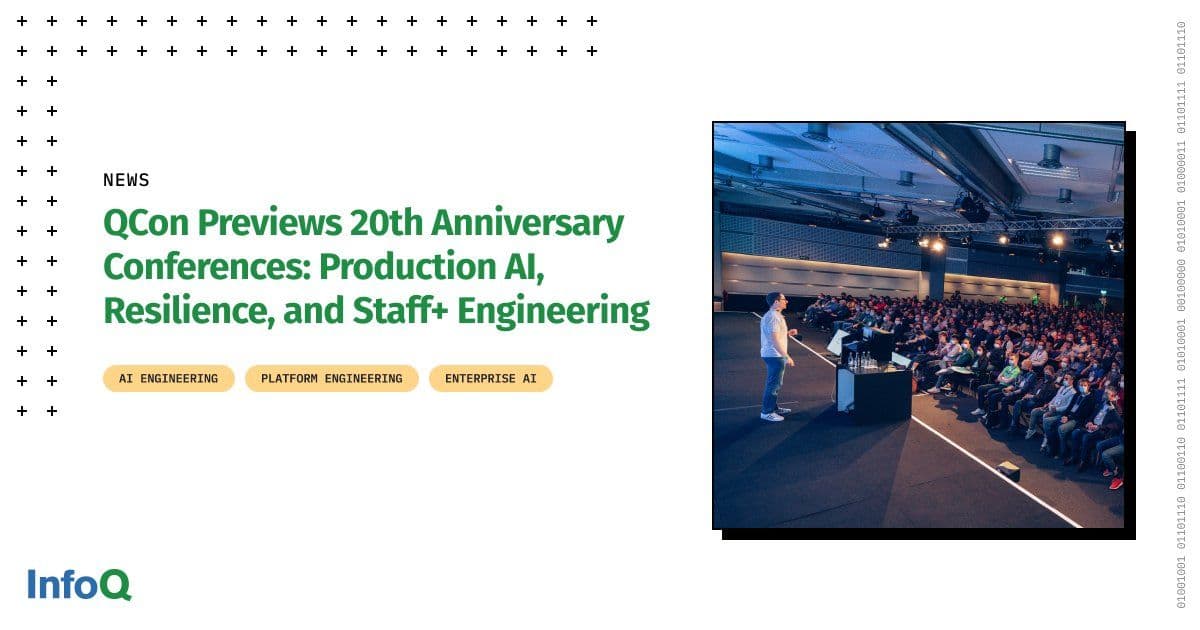
QCon's 2026 conferences focus on moving AI from experimentation to production, building resilient systems, and developing Staff+ engineering skills, with tracks curated by senior engineers who share real-world failures and successes.
As QCon marks its 20th anniversary in 2026, the conference series is doubling down on what has made it distinctive: sessions curated by senior engineers sharing hard-won lessons from production systems. The upcoming QCon London (March 16–19) and QCon San Francisco (November 16–20) events reflect the industry's current inflection points—moving AI from experimental prototypes to reliable production systems, building architectures that survive inevitable failures, and developing the leadership skills needed at Staff+ levels.
From Chatbots to Agentic Systems: The AI Production Challenge
The 2026 programs signal a clear shift from AI experimentation to production deployment. Senior engineers are now grappling with the realities of integrating large language models into critical business paths, where non-determinism, observability gaps, and security concerns can no longer be treated as edge cases.
Hien Luu, Sr. Engineering Manager at Zoox, is hosting the London track on AI Engineering, which moves beyond the hype cycle to address the rigorous testing and validation required when probabilistic models handle production traffic. This represents a maturation of the AI conversation—from "can we build this?" to "how do we make this reliable enough for customers to depend on?"
The focus on "agentic systems" reflects the industry's evolution beyond simple chatbot interfaces. These systems integrate models, tools, and workflows in ways that demand new approaches to testing, monitoring, and incident response. The non-deterministic nature of AI outputs means traditional testing methodologies often fall short, requiring engineers to develop new patterns for validation and error handling.
Architecting for Survivability, Not Just Uptime
As distributed systems grow increasingly complex, QCon's 2026 agenda prioritizes "survivability" over simple uptime metrics. The Architecting for Resilience tracks examine patterns like cellular isolation and fault containment—approaches designed to limit the "blast radius" of inevitable failures rather than attempting to prevent them entirely.
This philosophy represents a pragmatic shift in how senior engineers think about system design. Instead of pursuing the impossible goal of perfect reliability, the focus is on building systems that can fail gracefully and recover quickly. The cellular isolation pattern, for instance, segments services into independent cells that can operate autonomously when other parts of the system fail.
One long-time attendee captured the conference's unique value proposition: "QCon is where you hear what failed, not just what worked. That kind of judgment is what separates senior developers from Staff-level engineers." This emphasis on failure analysis—understanding not just how systems break but why they break—remains central to QCon's identity after two decades.
The Human Side: Staff+ Engineering and Platform ROI
Technical decisions don't happen in a vacuum, and QCon's 2026 tracks acknowledge the expanded scope of senior roles. The Staff+ Engineering track, hosted by Shawna Martell, Principal Engineer at Imprint, focuses on "durable skills" such as technical judgment, trade-off analysis, and influence without authority. These capabilities remain relevant regardless of the technology stack and represent the core competencies that distinguish Staff+ engineers from their peers.
The Platform Engineering ROI discussions have similarly evolved. Rather than celebrating adoption metrics, conversations now center on measurable outcomes like developer throughput and operational costs. This shift reflects the maturation of platform engineering from a cost center to a strategic investment that requires justification through concrete business impact.
What This Means for Engineering Organizations
The 2026 events feature over 75 peer-selected speakers in London and 60+ in San Francisco, offering engineering organizations the opportunity to align entire architectural groups around emerging patterns. For teams of 10 or more, additional savings are available, making it feasible to send cross-functional groups that can share learnings and implement changes collaboratively.
The conference's continued focus on production realities—what actually works and what fails—provides a counterbalance to the hype cycles that often dominate technology discussions. By maintaining its editorial stance of curating sessions based on real-world experience rather than theoretical possibilities, QCon offers senior engineers the practical insights needed to navigate the complex decisions facing their organizations.
As AI systems move from prototypes to production, as architectures must survive increasingly complex failure modes, and as engineering leadership requires new skills and perspectives, QCon's 20th anniversary events position themselves as essential gatherings for engineers who need to make these compounding decisions with confidence.
Comments
Please log in or register to join the discussion