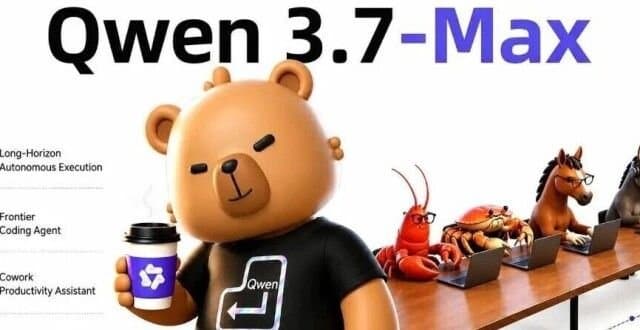
A critical examination of Alibaba's Qwen 3.7 Max model and its claimed 35-hour autonomous task capability, assessing the technical significance and practical implications.
Alibaba's recent announcement about Qwen 3.7 Max's 35-hour autonomous task run has generated considerable attention in the AI community. The claim of maintaining performance through 1,158 consecutive tool calls without degradation represents a significant assertion about long-horizon task execution in large language models.
The claim centers on Qwen 3.7 Max's ability to perform extended autonomous operations, specifically completing kernel-level optimizations over 35 continuous hours. This capability addresses a persistent challenge in LLM development: maintaining performance during complex, multi-step workflows that traditionally require human intervention or task restarts.
What makes this potentially noteworthy is the distinction between benchmark performance and sustained task execution. As highlighted by X user @FakeMaidenMaker, the significant aspect isn't merely surpassing benchmark scores, but demonstrating reliability during extended operational periods. This distinction matters because real-world applications often require models to maintain focus and coherence over extended timeframes—a capability that has eluded many current LLM implementations.
The technical significance of 1,158 tool calls over 35 hours requires careful examination. On average, this represents approximately 33 tool calls per hour, or one every 1.8 seconds. While impressive for sustained operation, the actual complexity and computational intensity of these tool calls remain unclear. The model's performance metrics during this extended run, including any degradation in response quality or accuracy, would provide important context for evaluating the claim's validity.
From a practical standpoint, the ability to handle extended reasoning chains represents a significant advancement for enterprise applications. Complex tasks such as code debugging, research synthesis, and multi-agent orchestration often require maintaining context and coherence across hours of operation. If Qwen 3.7 Max can reliably perform these tasks without human oversight, it could substantially reduce operational costs and increase productivity in professional settings.
The accessibility claims—success with moderate hardware specifications and quantization options for consumer-grade GPUs—suggest Alibaba is positioning Qwen 3.7 Max for broader adoption than many competing models. This approach aligns with industry trends toward making powerful AI tools more widely available, though actual performance on consumer hardware will need independent verification.
Several questions remain unanswered regarding the testing methodology:
- What specific tasks were performed during the 35-hour run?
- What metrics were used to evaluate performance consistency?
- How was the environment configured to prevent external interruptions?
- What safeguards were in place to ensure task completion without human intervention?
The availability via Alibaba Cloud's API with quantization options suggests a practical deployment strategy. However, the model's performance in real-world scenarios—particularly with tasks requiring nuanced understanding or creative problem solving—remains to be seen.
Compared to other LLMs in the global race, Qwen 3.7 Max's claimed long-horizon execution capability could represent a significant differentiator. Models like GPT-4, Claude 3, and Gemini have demonstrated strong performance on individual tasks, but sustained autonomous operation over extended periods remains an open challenge across the industry.
For developers and enterprises considering adoption, several factors warrant attention:
- The actual performance consistency across different task types
- Resource requirements for production deployments
- Integration capabilities with existing workflows
- Cost implications of extended API usage
- Safety measures for autonomous operation
As with any significant advancement in AI, independent validation will be crucial. The claims about Qwen 3.7 Max's capabilities represent an important development if substantiated, but practical implementation will require thorough testing in diverse scenarios.
The model's availability through Alibaba Cloud and reported accessibility on moderate hardware suggest opportunities for community evaluation. As developers begin testing the model's capabilities in real-world scenarios, a clearer picture of its actual strengths and limitations will emerge.
In conclusion, while the claims about Qwen 3.7 Max's sustained performance are intriguing, they require careful scrutiny and independent verification. If the model can reliably perform extended autonomous tasks as claimed, it would represent a meaningful advancement in LLM capabilities and potentially reshape expectations for what AI systems can accomplish without human oversight.
Comments
Please log in or register to join the discussion