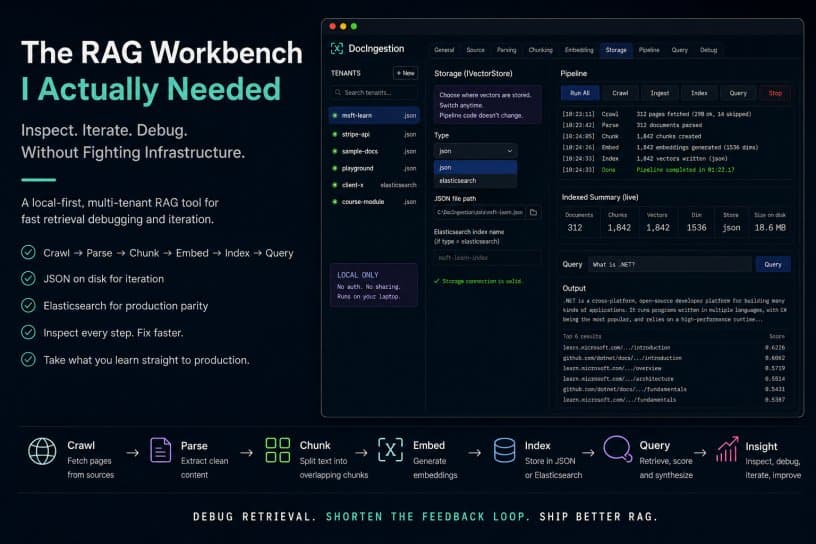
Jamie Maguire’s DocIngestion tool shows that a simple JSON‑backed vector store can dramatically shorten the retrieval‑debugging loop for Retrieval‑Augmented Generation projects, letting teams iterate on crawling, parsing and chunking locally before committing to production‑grade stores like Elasticsearch.
What changed
Most RAG tutorials hand you a fixed pipeline – crawl, chunk, embed, store, query – and immediately push you into a managed vector database. Jamie Maguire’s DocIngestion flips that model. By exposing a single IVectorStore abstraction with two concrete implementations (JSON on‑disk for development, Elasticsearch for production) the tool removes the infrastructure bottleneck that slows retrieval debugging.
Provider comparison
| Feature | JSON file (local) | Elasticsearch (cloud/on‑prem) |
|---|---|---|
| Setup time | Zero – just drop a file in a folder | Requires cluster provisioning, auth, networking |
| Cost | Free (disk space only) | Pay‑as‑you‑go or license fees |
| Scalability | Limited to a few thousand chunks; all data in memory | Handles millions of vectors with sharding and replication |
| Performance | Sufficient for < 5k chunks; latency in milliseconds | Sub‑second queries at scale, optimized indexing |
| Operational overhead | None – no infra, no upgrades | Monitoring, backups, scaling policies |
| Migration path | Simple config switch ("type": "elasticsearch") – same pipeline code |
Same as production deployment |
Why the JSON option matters
- Speed of iteration – Changing a selector, fixing a parser, or adjusting chunk overlap becomes a two‑minute edit followed by an instant re‑run. No need to wait for a cloud service to spin up or for IAM policies to propagate.
- Visibility – The JSON file can be opened in any editor, allowing developers to eyeball chunk counts, duplicate URLs, or malformed text directly.
- Cost containment – Early prototypes rarely need more than a few thousand vectors; paying for a managed store at that stage adds unnecessary expense.
Business impact
Faster time‑to‑value
By collapsing the ingest‑inspect‑query loop into a local workflow, teams can validate that the right chunks are being indexed within hours instead of days. This translates into quicker proof‑of‑concept deliveries and earlier stakeholder buy‑in.
Reduced technical debt
Because the same IVectorStore interface is used in production, the codebase does not need a separate “dev” and “prod” pipeline. When the project is ready to scale, switching to Elasticsearch is a single configuration change – no rewrite, no data migration script, no risk of regression.
Lower operational risk
Running a full vector database during early development exposes teams to networking glitches, permission errors, and version mismatches that are unrelated to retrieval quality. Removing that layer lets engineers focus on the true source of retrieval failures: data quality, chunking strategy, and embedding choice.
Example workflow
- Crawl a documentation site with the built‑in crawler.
- Parse & chunk using configurable rules (e.g., markdown headings, code block detection).
- Store the resulting vectors in
JsonFileVectorStore. - Inspect the UI – it lists each chunk, its source URL, and cosine similarity scores for a test query.
- Iterate – tweak the parser, re‑run the ingest, and see the impact instantly.
- Promote – once the top‑k retrieval scores meet the acceptance criteria, change the store config to Elasticsearch and redeploy the same pipeline.
Practical tips for adopting a local‑first RAG workbench
- Start with a small slice of your knowledge base (1‑2 k pages) to keep the JSON file manageable.
- Version‑control the JSON alongside your parser code; this gives you a historical view of how chunking decisions evolve.
- Automate similarity checks – write a small script that runs a set of representative queries after each ingest and flags any drop in top‑k scores.
- Plan the migration early – define the Elasticsearch index mapping (vector field type, metadata fields) while you are still in the JSON phase so the switch is truly just a config change.
- Monitor memory usage – the JSON store loads everything into RAM; watch the process footprint as chunk counts grow beyond a few thousand.
The bigger lesson
Most RAG failures are not caused by the vector database itself but by the data that feeds it. A workbench that surfaces chunk counts, duplicate URLs, and retrieval scores without the overhead of a full‑scale store gives teams the feedback they need to fix those data problems early. When the data is clean, the choice of storage becomes a secondary concern.
If you are interested in a deeper dive or need help tailoring a similar workbench to your organization’s document repositories, feel free to schedule a call via the author’s Calendly link.
Comments
Please log in or register to join the discussion