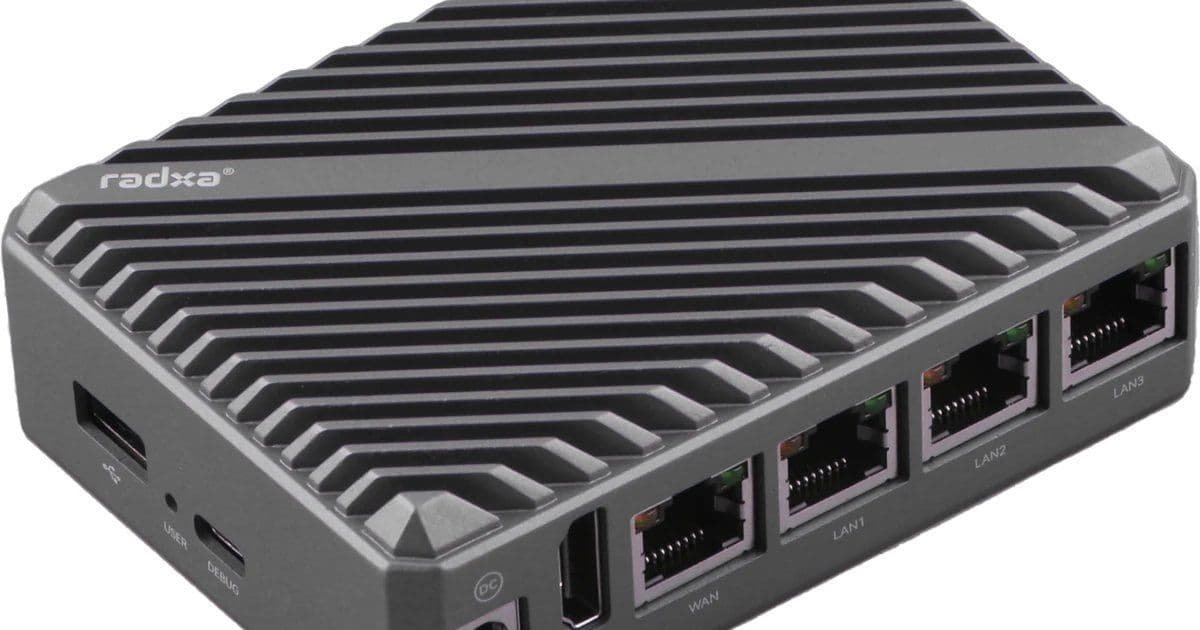
Radxa launches two compact, passively cooled PCs packing four Gigabit Ethernet ports, NVMe storage, and Rockchip silicon starting at just $35. The higher-end E54C model offers 32GB RAM and a 5 TOPS NPU for edge AI tasks, but makes a surprising tradeoff by omitting a GPU entirely despite including HDMI output.
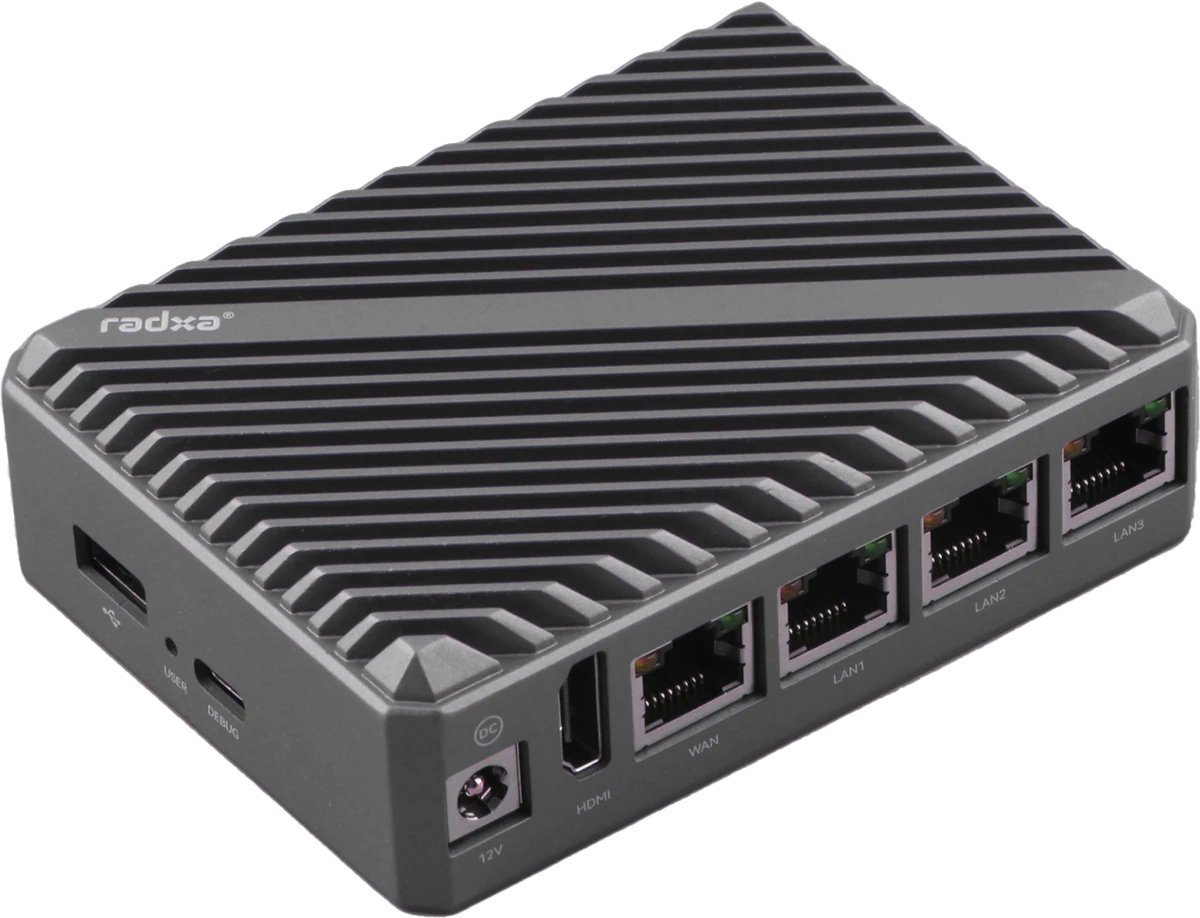
Radxa has unveiled two compelling fanless systems designed for networking and edge computing: the E24C ($35) and the E54C ($55). Both models feature robust aluminum enclosures for passive cooling (with optional active fan support), four configurable Gigabit Ethernet ports handled by a dedicated RTL8367RB switch chip, and versatile storage via M.2 2280 slots for NVMe SSDs, eMMC modules, and microSD cards. This combination makes them prime candidates for DIY routers, firewalls, network gateways, or lightweight edge servers.
The core distinction lies in their processors and capabilities:
| Feature | Radxa E54C | Radxa E24C |
|---|---|---|
| Processor | Rockchip RK3582 (6-core) | Rockchip RK3528A (4-core) |
| CPU Cores | 2x Cortex-A76 @ 2.2GHz + 4x Cortex-A55 @ 1.8GHz | 4x Cortex-A53 @ 2.0GHz |
| NPU | 5 TOPS @ INT8 | None |
| GPU | None | Mali-450 |
| Max RAM | 32GB LPDDR4 | 8GB LPDDR4-2133 |
| Max eMMC | 128GB | 32GB |
| USB Ports | 1x USB 3.0 Type-C, 1x USB 3.0 Type-A, 2x USB 2.0 Type-A | 1x USB 2.0 Type-C, 3x USB 3.0 Type-A |
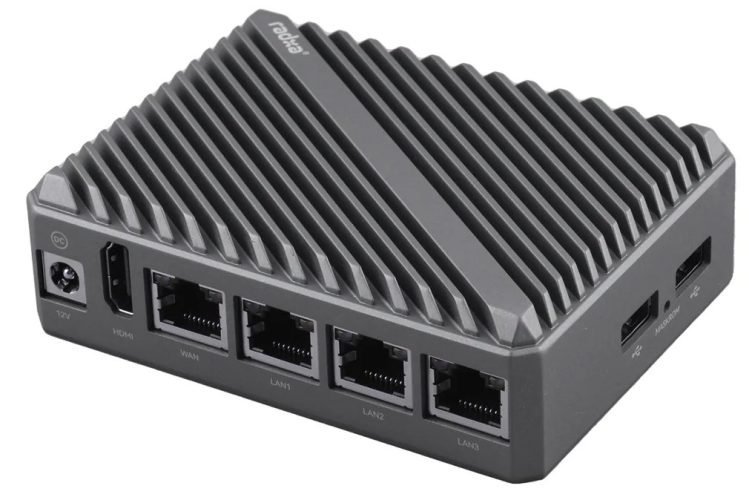 Radxa E54C showing I/O panel and compact form factor
The E54C's hexa-core RK3582 offers significantly higher CPU performance and includes a capable NPU, enabling hardware-accelerated machine learning tasks at the edge—ideal for applications like local inference or network traffic analysis. However, its lack of a dedicated GPU is notable, especially given the presence of an HDMI 2.1 port. This means any graphical output relies solely on software rendering, limiting its suitability for media playback or visualization-heavy interfaces. For headless networking or pure compute tasks, this trade-off makes sense, prioritizing raw processing and AI over graphics.
Conversely, the budget E24C includes a Mali-450 GPU but lacks an NPU and uses a simpler quad-core Cortex-A53 CPU. Both devices support popular Linux distributions like Debian and OpenWrt, leveraging their multiple NICs for flexible network segmentation. The inclusion of M.2 NVMe support is a significant advantage over many competing SBCs, allowing for high-speed local storage crucial for logging, caching, or database operations in network applications.
Starting at $55 for the NPU-equipped E54C with 2GB RAM (scaling to $130 for 32GB), Radxa delivers remarkable density and capability for network appliance builders and tinkerers. While the GPU omission on the higher-end model is unconventional, it underscores a focused design philosophy: maximum network throughput and AI readiness in a silent, compact footprint. These devices exemplify the ongoing trend of powerful, specialized ARM hardware democratizing advanced networking and edge compute infrastructure.
Source: Liliputing
Comments
Please log in or register to join the discussion