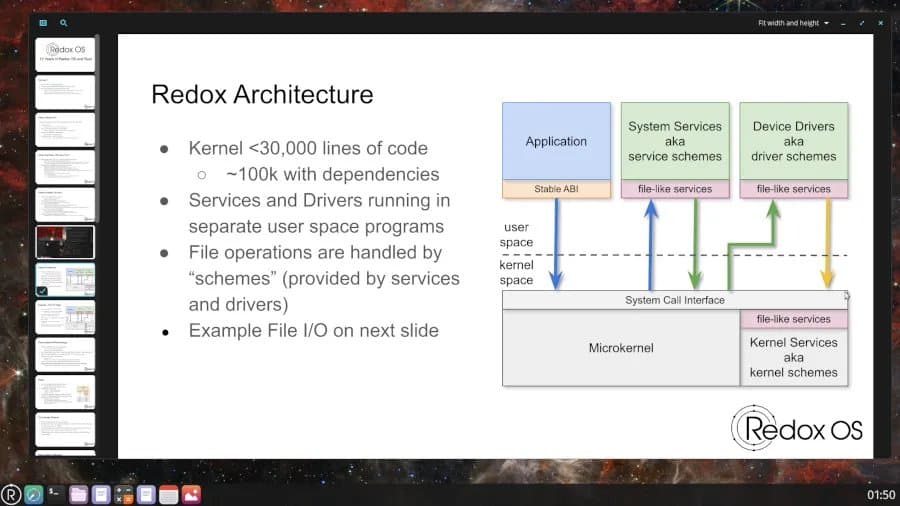
The Rust-based Redox OS has implemented a strict policy prohibiting contributions made with large language models, emphasizing human craftsmanship in their microkernel operating system development while advancing graphics support and package management.
Redox OS, the ambitious Rust-based microkernel operating system, has taken a definitive stance on AI-generated code by implementing a strict policy that forbids contributions created using large language models. The announcement came as part of their March 2026 development status update, where the project detailed numerous technical improvements alongside this controversial policy decision.
The new AI policy states clearly that Redox OS "does not accept contributions generated by LLMs" and notably adds that "The policy is not open for discussion." This hardline approach stands in stark contrast to many open-source projects that have embraced AI assistance tools, reflecting Redox OS's commitment to maintaining human oversight and craftsmanship in their systems programming efforts.
Technical Advancements Continue Despite Policy Stance
While the AI policy has garnered significant attention, Redox OS developers have been making substantial progress across multiple technical fronts during March 2026:
Graphics and Display Server Progress
The project achieved a notable milestone with the libcosmic demo now running successfully on Redox OS. This development is part of their broader initiative to enhance graphics capabilities and support for the COSMIC compositor. The team has also made progress on DRM API implementation and GPU memory mapping functionality, laying groundwork for improved graphics driver support in the future.
Performance Optimizations
Redox OS implemented a new Deficit Weighted Round Robin Scheduler as their CPU scheduler, aiming to deliver better performance characteristics across various workloads. This scheduler change represents a significant architectural decision that could impact the operating system's responsiveness and efficiency.
System Reliability Improvements
The kernel now features enhanced deadlock detection capabilities, addressing one of the critical challenges in operating system development. This improvement should help developers identify and resolve potential concurrency issues more effectively during the development process.
Package Management Enhancements
One of the most practical improvements involves LZMA2 support for pkgar packages, which promises to reduce package sizes by approximately 3-5x. This compression advancement will significantly benefit users with limited storage or bandwidth constraints while maintaining the system's package management efficiency.
Software Stack Updates
Redox OS updated several key packages including CPython, PHP, Nano, and Vim to utilize ncursesw with Unicode support. This change ensures better internationalization support and modern terminal capabilities across the system's software ecosystem.
The AI Policy Debate in Open Source
The decision to ban LLM-generated contributions reflects growing concerns within certain segments of the developer community about the quality, security implications, and licensing complications of AI-generated code. Redox OS's approach is particularly noteworthy given that Rust, the language in which Redox is written, has become popular among AI-assisted development tools.
Critics of AI-generated code in systems programming argue that the subtle bugs and security vulnerabilities introduced by automated tools can be especially problematic in low-level code where manual memory management and precise control over hardware interactions are essential. The Redox team appears to share these concerns, prioritizing human expertise over automated assistance for their microkernel implementation.
Community Response and Project Trajectory
The policy announcement has sparked discussion within the Redox OS community and the broader open-source ecosystem. While some developers applaud the commitment to human-crafted code, others question whether such a rigid stance might limit the project's ability to attract contributors who have become accustomed to AI assistance tools.
Despite the controversy surrounding the AI policy, Redox OS continues to demonstrate steady progress toward its goal of creating a fully Rust-based operating system with modern capabilities. The combination of graphics improvements, performance optimizations, and practical enhancements like better package compression suggests the project remains focused on delivering a competitive alternative to traditional Unix-like systems.
The complete March 2026 status update and additional technical details are available on the Redox-OS.org blog.
Comments
Please log in or register to join the discussion