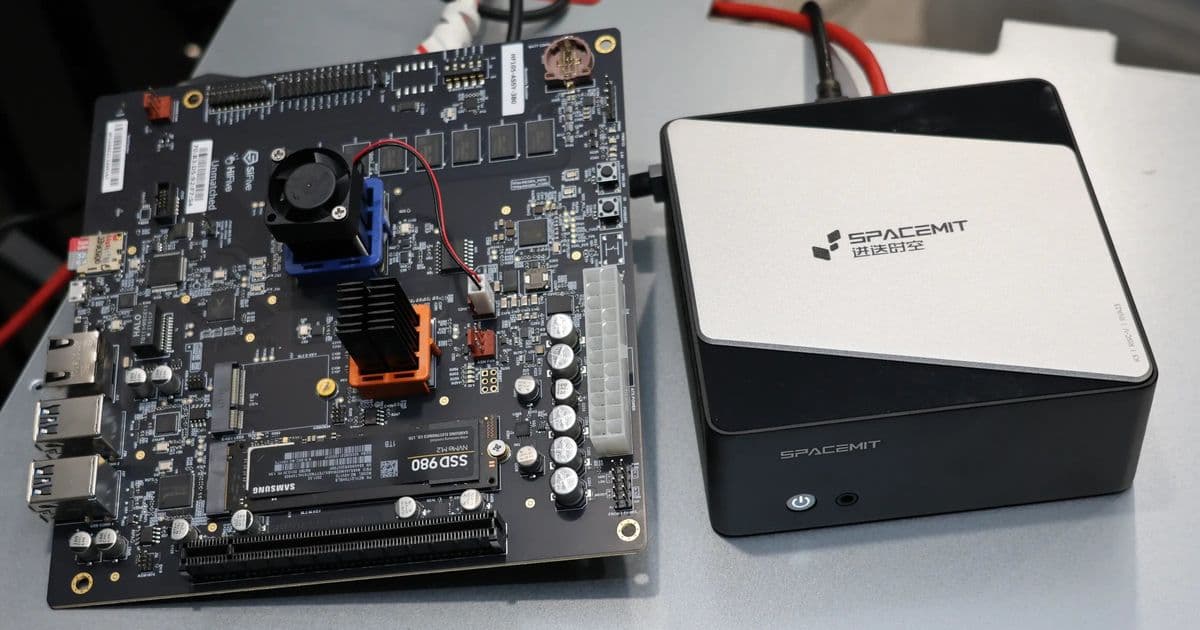
Five years separate the SiFive HiFive Unmatched and the SpacemiT K3, and Phoronix's longitudinal benchmarks show an 8x leap in RISC-V CPU performance. Here's what changed at the silicon level, what the new RVA23 SoC brings to a homelab rack, and where RISC-V still trails ARM and x86.
Michael Larabel over at Phoronix just published one of the more useful RISC-V data points I've seen in a while: a head-to-head between the 2021-era SiFive HiFive Unmatched and the brand-new SpacemiT K3 RVA23 SoC. The headline number is an 8x performance jump across five years. For anyone who has tried to run real workloads on a RISC-V board, that figure is worth unpacking, because the architecture has spent most of its life being interesting rather than fast.
I run a small homelab and I measure everything that draws power in my rack, so I care less about the marketing slide and more about what these chips actually do per watt, per dollar, and per PCIe lane. This comparison is a clean before-and-after on both counts.
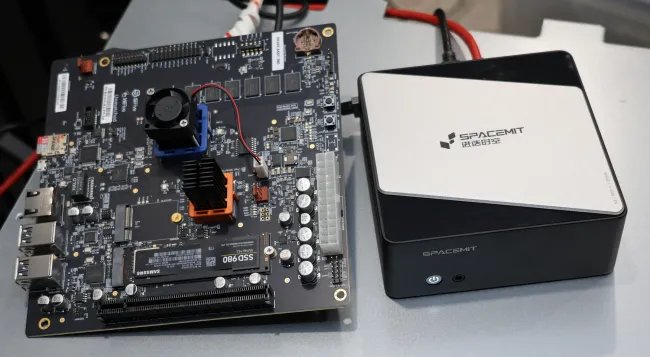
The two boards
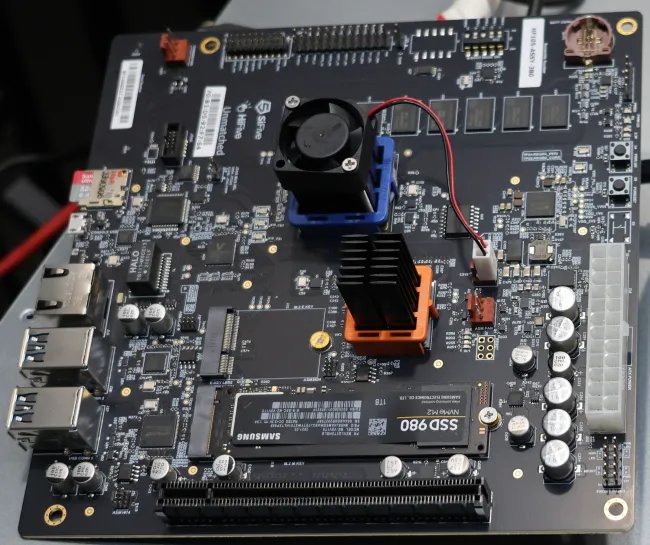
The HiFive Unmatched was, for its moment, the best RISC-V hardware you could buy. SiFive announced it in 2020 and started shipping in May 2021. At its heart sat the FU740 SoC: four U74-MC application cores plus a single S7 core, paired with 16GB of DDR4. The board itself was a proper mini-ITX layout, which is what made it appealing to builders. You got a PCIe x16 mechanical slot wired for Gen3 x8, an NVMe port, a micro-SD slot, and Gigabit Ethernet. In 2021 that was a genuinely usable workstation skeleton, even if the CPU underneath was closer to a Cortex-A55 in throughput.
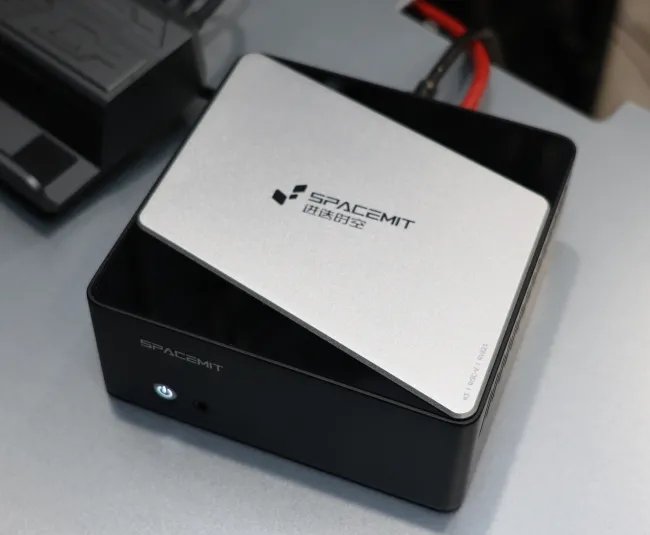
The SpacemiT K3 is a different class of part. It packs eight X100 RISC-V cores alongside eight ultra-wide A100 cores, and crucially it is the first-to-market RVA23 SoC. The Pico-ITX board wraps that silicon in 10GbE networking, UFS storage, dual M.2 slots, USB Type-C with power delivery, and 16GB or 32GB of LPDDR5-6400. The memory subsystem alone is a generational shift: DDR4 on a narrow bus versus LPDDR5 at 6400 MT/s feeds a much hungrier core complex.
Why RVA23 is the real story
The core count and clocks matter, but the architectural profile is what makes the 8x number believable. RVA23 is the profile that finally mandates the vector extension (RVV 1.0), hypervisor support, and a long list of bit-manipulation and scalar crypto extensions as baseline. The HiFive Unmatched predates all of that. Its FU740 cores are scalar machines with no production vector unit, so anything that vectorizes well on modern hardware simply runs as a serial loop on the Unmatched.
That is why the gap widens dramatically on certain workloads. General integer code might show a 3x to 4x improvement from clocks, cache, and core count. Throw something at it that the compiler can auto-vectorize, or a library with hand-tuned RVV kernels, and the spread opens toward that 8x figure. The flip side is a compatibility wall: the K3 runs SpacemiT's Ubuntu-derived Bianbu 4.0 on Linux 6.18, while the Unmatched is stuck on Ubuntu 24.04 LTS because newer images now assume RVA23 features it does not have. The platform moved on and left the old board behind.
| Spec | HiFive Unmatched (2021) | SpacemiT K3 (2026) |
|---|---|---|
| Cores | 4x U74-MC + 1x S7 | 8x X100 + 8x A100 |
| Profile | Pre-profile scalar | RVA23 |
| Vector | None | RVV 1.0 |
| Memory | 16GB DDR4 | 16/32GB LPDDR5-6400 |
| Network | 1GbE | 10GbE |
| Storage | NVMe + micro-SD | Dual M.2 + UFS |
| Form factor | Mini-ITX | Pico-ITX |
Putting it in context
Larabel framed this against his earlier ARM server piece, where Ampere's original eMAG to NVIDIA's new Vera CPU delivered roughly 7x over eight years. RISC-V matching and exceeding that pace over a shorter window is the meaningful part. ARM had a mature ecosystem and a head start; RISC-V is compressing the same curve into five years because it started from so much further back. In the same SpacemiT K3 review the chip was lined up against modern Intel Core Ultra and AMD Ryzen desktops, the Raspberry Pi 5, a Loongson 3B6000, and the SiFive HiFive Premier. The honest read on those numbers is that the K3 lands in Raspberry Pi 5 territory for a lot of tasks, not Ryzen territory. An 8x gain over a five-year-old board is real, and it still leaves RISC-V a generation or more behind mainstream x86 desktop silicon on raw single-thread.
Build recommendations
If you bought a HiFive Unmatched in 2021 to have a native RISC-V build and CI box, the K3 is the upgrade that finally makes that role pleasant. The dual M.2 slots and 10GbE mean you can treat it as a small NAS-adjacent build node rather than a curiosity tethered to a micro-SD card. The LPDDR5 bandwidth is what makes compilation and vectorized test suites tolerable instead of an overnight affair.
For anyone new to RISC-V, the practical advice is the same as it has been: buy in for native development, toolchain work, or porting, not for raw throughput per dollar. A Ryzen mini PC still wins decisively on performance and on software maturity. What the K3 buys you is a board where RVA23 is the floor, so the code you write and test today targets the profile that the next several years of RISC-V hardware will share. That forward compatibility is worth more to a homelab than any single benchmark.
The full six pages of benchmark data are up on Phoronix, and they are worth reading in detail before you spec a board, because the per-workload variance here is enormous. The 8x average hides both 3x integer results and much larger vectorized wins, and which of those you see depends entirely on what you plan to run.
Comments
Please log in or register to join the discussion