A French developer who blogs in English has spent years quietly using language models as copyeditors, and now publishes a per-post disclosure showing exactly which tool touched which article. His position cuts against the reflexive 'AI slop' panic and offers something more useful: a worked example of where the line between assistance and authorship actually sits.
There is a familiar argument circulating through technical communities right now, and it goes roughly like this: language models are flooding the web with low-effort text, so the responsible thing to do is refuse them entirely. The recent debate over Lobsters moving to disallow LLM-generated submissions is one expression of that instinct, and it is an understandable one. Anyone who has scrolled through LinkedIn lately has met the genre being defended against: confident articles studded with emojis and accompanied by uncanny generated imagery, written by people performing expertise in a subject they could not be bothered to learn.
The interesting move in this particular blogger's account is that he agrees with the complaint and still uses the tools every day. He is a native French speaker who writes his blog in both languages, and his thesis is not that the slop critics are wrong but that they have drawn the boundary in the wrong place. The problem was never the model. The problem is the abdication of care. Using an LLM to fabricate authority you do not possess is a different act from using one to fix a verb tense in a sentence you wrote, thought through, and stand behind.
What the disagreement is actually about
Most arguments about AI writing collapse two separate questions into one. The first question is whether a machine produced the ideas. The second is whether a machine touched the prose. Conflating them produces bad conclusions in both directions: it lets generated nonsense pass if it reads cleanly, and it condemns a careful author who used a grammar checker that happens to be a neural network rather than a rule-based one.
His writing process pulls these apart deliberately. He drafts in English, having learned over a decade of blogging that composing in French and translating afterward produced stiff, non-idiomatic results. He keeps the full revision history of at least one article so the stages are inspectable: an original draft written with a thesaurus, a copyedited pass, a French translation, and a human proofread of that translation. The model enters as an editor with a tightly scoped brief, instructed to apply light stylistic edits, avoid passive voice and filler, and write for a technical audience reading English at a B2 level. The ideas, the architecture of the argument, the decision about what is worth saying: those never leave his hands.
The corrections are smaller than you think
What makes the piece persuasive is that he shows the edits rather than asserting they are minor. The examples are almost pedantically small, and that smallness is the point. He had written that scaling a routing database to tens of millions of routes "has been a long time challenge." The model changed it to "long-standing," and he explains the rule he keeps forgetting: long-time describes people, a long-time friend, while long-standing describes situations, a long-standing agreement. Elsewhere he wrote that Akvorado falls back to a route sent by "another equipment," and the correction to "another device" turns on equipment being an uncountable noun, a trap he says he knows about and falls into anyway.
The other examples follow the same pattern. A list of routes is grammatically singular, so "are not stored" becomes "is not stored," and "into" becomes "in" because storage is a state rather than a change of position. The verb "require" needs a noun or an object before a to-infinitive, so "would require to configure all routers" becomes "would require configuring all routers." When he asks for descriptive verbs, the model collapses "has better performance than" into "outperforms." None of this alters what he is claiming about Akvorado, the network flow collector he maintains. It alters whether a reader trips over the sentence on the way to understanding it.
He is honest about the one edit he found genuinely hard to justify, where the model restructured a definition of RIB sharding into a defining relative clause. That admission matters more than the clean examples, because it shows someone evaluating each change rather than accepting the output wholesale. The author's voice can be flattened by an editor, human or machine, and he knows it. His defense is that at this dosage the risk is small and the benefit to the reader is real.
Disclosure as the actual innovation
The genuinely novel contribution here is not the editing workflow, which many people quietly run, but the decision to make it visible. Every page carries a footer disclosing whether and how AI touched the content, graded across three levels: a brain emoji for no AI or near-none such as grammar fixes, sparkles for copyediting, and a robot for generated content like a translation, even when a human edited the result afterward. Hovering over the icon reveals the specific model and what it did.
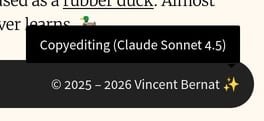
This is a more grown-up answer than either blanket prohibition or silent use. A ban treats all model involvement as equivalent and pushes the honest into the same category as the deceptive, since the careful author and the slop merchant both simply stop disclosing. A graded, per-document label does the opposite. It gives readers the information to judge for themselves and it creates a social incentive to keep model involvement minimal and legible, because the badge is public. He even went back and applied the grammar pass to older articles and recorded the history: French posts translated with DeepL and later an LLM since 2018, English posts copyedited since 2024. A reader who cares can see the whole provenance of the text, year by year.
The non-native writer's case
Underlying all of this is a point that the slop discourse tends to flatten, which is that fluency in English is unevenly distributed and the cost of that unevenness is borne by people who often have the most interesting things to say. He describes French as harder to begin but more systematic, and English as a thicket of irregularities he learns and immediately forgets. He could hire a human editor, but he reasonably declines to pay one for a hobby. The realistic alternatives, then, are not "polished human-edited prose" versus "LLM-edited prose." They are "LLM-edited prose" versus "prose with the grammatical seams showing," and the second outcome quietly penalizes a global pool of technical writers for an accident of birthplace.
He reaches for Stephen King's On Writing to frame it, the idea that good writing means mastering the fundamentals of vocabulary, grammar, and style and then reaching for the right instrument. For a non-native writer, a constrained language model is one more instrument in that third drawer of the toolbox, no more an abdication of craft than a thesaurus or a style guide.
Where this leaves the reader
There is a counter-position worth stating plainly, because the honest framing demands it. Someone could accept every example above and still object that normalizing any model in the writing pipeline erodes the very skills he describes struggling with, and that disclosure, however well intentioned, becomes theater once it is universal and ignored. That argument is not silly, and a sufficiently strict reader will not be moved by a sparkles emoji in a footer.
But the value of this account does not depend on converting that reader. Its value is that it replaces a slogan with a method. It shows what minimal, disclosed, idea-preserving assistance actually looks like at the level of individual sentences, and it lets you decide where your own line sits with real examples in front of you rather than a caricature. Fittingly, he notes that this particular essay was proofread by an unnamed human and translated to French by hand, with no model involved. The point was never that the tools must be used. It was that refusing to think carefully, by hand or by machine, is the only thing actually worth banning.
Comments
Please log in or register to join the discussion