Anthropic's new Fable 5 is a guardrailed sibling of its restricted Mythos model class, free through June 22 for Pro, Max, and Enterprise customers. The catch: it consumes tokens at a rate that can drain a daily allowance in minutes once you push it into high-effort workflows.
Anthropic has started rolling out Claude Fable 5, a model built on the same foundation as Mythos, the company's most capable and most tightly controlled model class. The launch matters because Mythos was never meant for general access. Anthropic restricted it specifically because the same capabilities that help defenders find and patch bugs can help attackers find and exploit them.
The short version: Fable 5 is the version of that powerful model class Anthropic feels comfortable handing to the public, because it now ships with guardrails that redirect dangerous queries elsewhere. It's free for a limited window, it's fast, and it is unusually hungry for tokens.
What Fable 5 actually is
Back in April, Anthropic described Mythos as a state-of-the-art model powerful enough to assist in attacking public and private software. Its own framing was blunt. "The advantage will belong to the side that can get the most out of these tools," the company said when it announced Mythos. "In the short term, this could be attackers, if frontier labs aren't careful about how they release these models. In the long term, we expect it will be defenders who will more efficiently direct resources and use these models to fix bugs before new code ever ships."
That reasoning is why Mythos stayed locked down. A model that can autonomously reason about vulnerabilities in something like Firefox is a defensive asset and an offensive weapon depending on who is holding it. Anthropic chose to limit access to vetted cybersecurity firms and trusted partners rather than ship it broadly.
Fable 5 is the compromise. According to Anthropic, it runs on the same underlying model but applies strict safeguards that block or divert sensitive requests, including offensive cybersecurity, biology, and chemistry prompts. When you hit one of those boundaries, the system routes the query down to Opus 4.8 instead of answering with full Mythos-class capability. The unrestricted variant, Claude Mythos 5, still exists with those safeguards removed, and it remains available only to a highly vetted group such as government cyberdefenders and specific life sciences researchers.
The token problem nobody should ignore
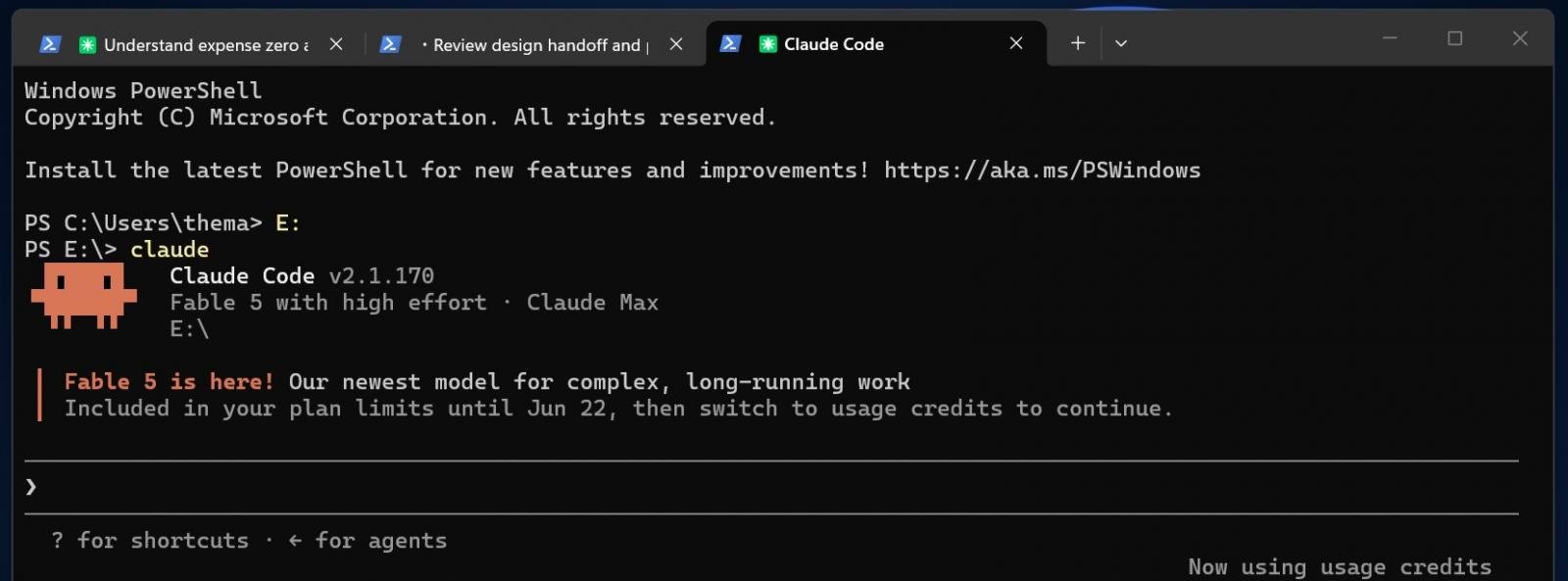
Here is the practical warning for anyone planning to use it. Fable 5 consumes tokens faster than any model Anthropic has shipped. The company is candid that it's expensive to run because it demands a lot of compute, which is why it can't be offered as freely as Opus 4.8.
Through June 22, Fable 5 is available to all Pro, Max, and Enterprise customers. After that window closes, it moves to usage-based pricing. During testing, BleepingComputer watched the model burn roughly one million tokens in eight minutes. In one case, Fable 5 exhausted a $100 Max subscription's entire daily allowance in nine minutes, starting from zero usage.

The spike showed up most dramatically with Workflow, a new execution system that lets Claude split a complex prompt into smaller tasks and spin up parallel subagents to handle them. Combine Workflow with high thinking effort and you can drain a daily quota before you've finished your coffee. Casual back-and-forth chat doesn't trigger this. But even outside of Workflow, Fable 5 reportedly runs through tokens about twice as fast as Opus.
That economics explains Anthropic's caution about unlocking Fable 5 as broadly as Opus and earlier models. The company has a track record of constraining new models at launch and loosening capacity later, so the current limits may ease in the coming weeks.
Practical takeaways
If you're evaluating Fable 5, treat the free window as a sprint, not a free buffet. A few concrete points worth keeping in mind:
- Budget deliberately. With usage-based pricing arriving after June 22, the habits you form now will set your bill later. Reserve Fable 5 for tasks that genuinely benefit from its capability rather than routine queries Opus handles fine.
- Be careful with Workflow plus high effort. That combination is where the token meter runs hottest. If you're on a metered plan, test small before turning subagents loose on a large job.
- Expect redirects on sensitive work. Security researchers and anyone working near offensive tooling, bio, or chem topics should expect the guardrails to hand them off to Opus 4.8. If your work legitimately needs Mythos-class capability for defense, the vetted-partner track is the intended path, not Fable.
- Match the model to the task. For most coding and analysis, Opus 4.8 remains the cost-effective default. Fable 5 earns its keep on problems where its extra reasoning depth measurably changes the outcome.
The release reflects a pattern that's becoming familiar across frontier labs. The most capable models carry dual-use risk, so vendors split them into a guardrailed public tier and a restricted high-trust tier. Fable 5 is Anthropic's attempt to give developers real Mythos-class power while keeping the genuinely dangerous capabilities behind vetting. The token economics are the price of admission, and right now they're steep enough that the free preview is the smart time to learn exactly where this model is worth the spend.
You can follow Anthropic's model announcements and documentation at anthropic.com and find Claude Code details in the official docs.
Comments
Please log in or register to join the discussion