
A deep dive into the promise and pitfalls of integrating Rive animations into a React Native app. The article examines real‑world performance boosts, the hidden developer costs, and practical lessons for teams considering the tool.
Rive in React Native: Performance Gains, Development Friction, and What the Future Holds

Introduction
The annual Spotify Wrapped release spurred a wave of design inspiration across the industry. Its polished animations, data‑rich visuals, and shareability set a high bar for mobile experiences. When the author discovered that the Wrapped UI was built with Rive, a vector animation tool originally designed for the web, curiosity turned into a case study.
The Promise of Rive
Rive offers a declarative animation runtime that can be embedded in native apps via a JavaScript bridge. Its key selling points are:
- GPU‑accelerated rendering – animations run on the compositor thread, reducing JavaScript‑to‑UI frame drops.
- Data‑driven state machines – UI elements can respond to dynamic data without manual re‑rendering.
- Cross‑platform consistency – a single asset works on iOS, Android, and web.
The author’s team expected a plug‑and‑play experience, but the reality proved more nuanced.
Real‑World Implementation
The project began with a modest goal: replace five static SVG‑based UI elements with Rive animations. The timeline was optimistic—just a few days—but the first two weeks revealed a different story.
“Before I started work, I did a quick search to see how other people felt after working with Rive and React Native… these two posts from someone who has been burnt by Rive were what made me think this might not work out.”
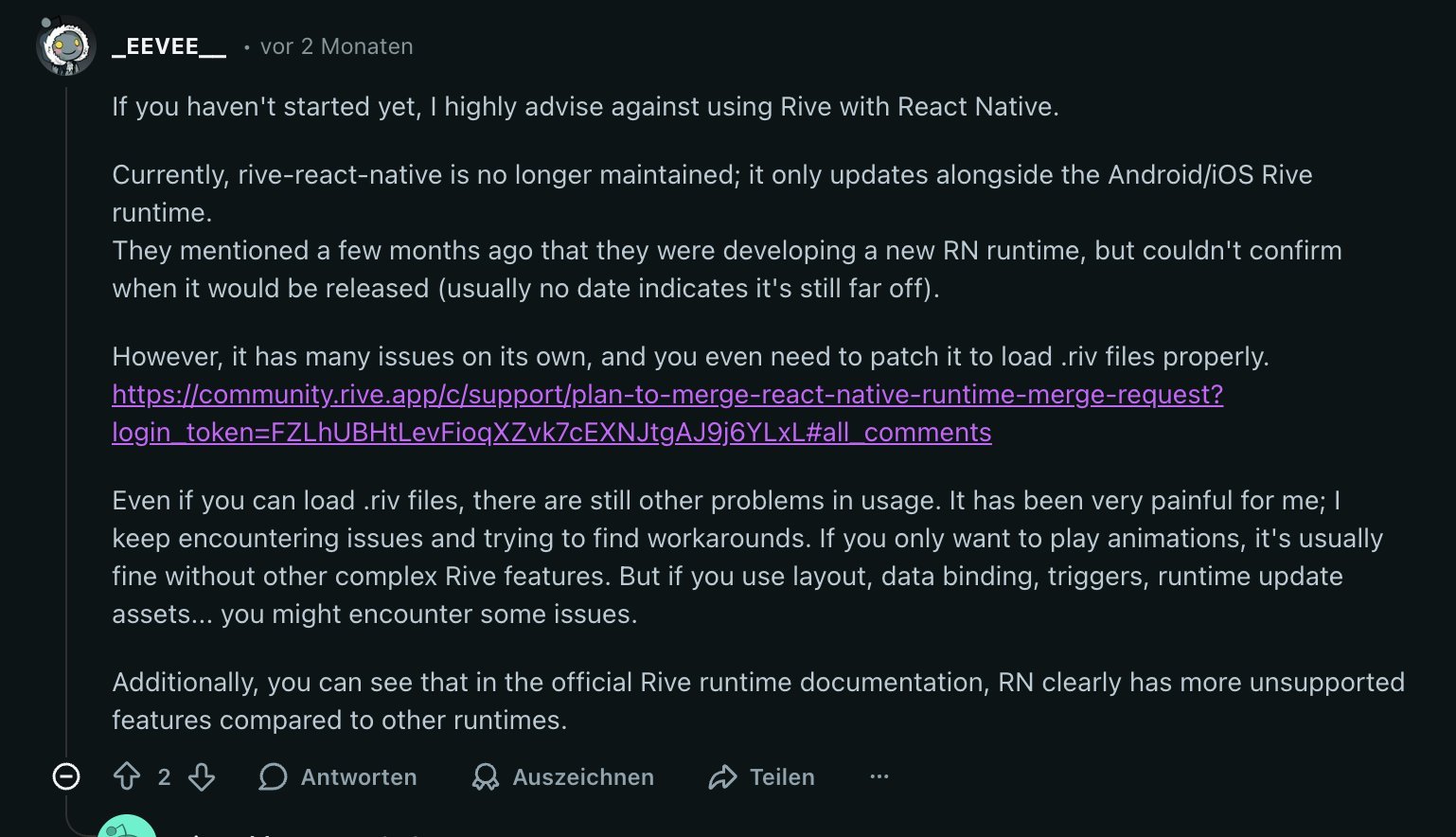
Performance Wins
When compared to a Reanimated‑based fallback and a pure JS implementation, Rive delivered measurable frame‑rate improvements:
- No frames dropped on older Android devices such as the Samsung A53.
- Consistent layout – Rive’s internal layout engine eliminated the need for manual positioning of SVG elements.
- Reduced JavaScript overhead – state changes were handled natively, freeing the JS thread for business logic.
The author noted that a previously problematic semicircle color transition—triggered by three breakpoints—no longer caused a UI freeze.
Development Pain Points
Despite the performance gains, the integration pipeline was riddled with friction:
- Animation authoring dependency – Every visual tweak required a round‑trip to an external freelancer. In‑team designers struggled with Rive’s interface, leading to bottlenecks.
- Arcane API – Basic changes such as color swaps or padding adjustments took hours to implement. The library’s hooks were unreliable, forcing the use of manual refs.
- State management complexity – Animations needed to start in an active or inactive state, a requirement that proved difficult to satisfy reliably.
“The hooks provided by the rive library almost never work and forced me to rely on magic with my own ref attached to the rive component.”
Janky Behaviors
Several animations exhibited erratic behavior that ultimately led to their removal:
- Like‑button animation – Failed to maintain state consistency, prompting a custom Reanimated solution.
- Toast replacement – Designed to display Rate Game Score gains, it was perceived as out of place by the product owner and replaced with a simpler, animated toast.
Common issues included:
- Random disappearance or delayed appearance.
- Mandatory absolute positioning and minimum height constraints.
- No reliable initialization callback, leading to the use of arbitrary timeouts.
- Crashes on Android when invoking the
fireStatetrigger.
“Our crashlytics reported an android startup crash that I haven't been able to reproduce so far.”
Future Directions
The author anticipates improvements with the upcoming Rive React Native 0.1.1 release, which introduces Nitro modules. Early testing suggests a smoother developer experience and better DX, but the performance gains remain a compelling argument.
From a strategic standpoint, the team has adopted a more conservative animation philosophy:
- Start simple – Implement minimal, well‑tested animations that can be shipped quickly.
- Avoid over‑engineering – Complex state machines often add more maintenance overhead than value.
- Triple estimates – When Rive is mandated, project timelines should be adjusted accordingly.
Takeaway
Rive delivers tangible performance benefits for React Native apps, especially on older Android hardware. However, the tool’s current maturity level introduces significant developer friction. Teams should weigh the performance upside against the cost of external animation authorship and the learning curve of the Rive API.
In practice, a modest animation—such as a fade‑in or simple color transition—can often achieve the same user‑experience goals with far less overhead.
Source: https://justanotherheroriding.github.io/portfolio/writing/rive-react-native
Comments
Please log in or register to join the discussion