
Rockstar Games confirms data breach affecting 78.6 million records after ShinyHunters gang leaks analytics data stolen through compromised Anodot tokens. The incident highlights third-party integration risks as attackers target Snowflake environments.
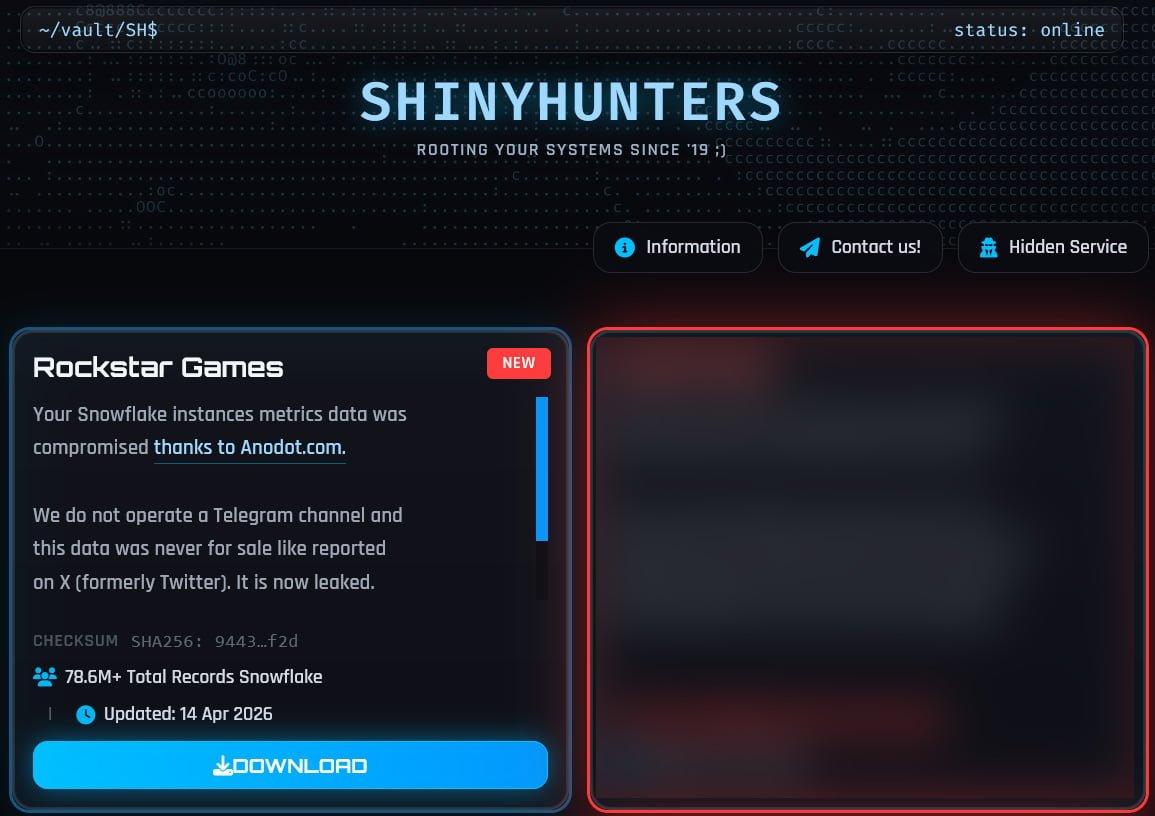
Rockstar Games has confirmed a data breach affecting more than 78.6 million records after the ShinyHunters extortion gang leaked stolen analytics data on its dark web leak site. The breach stems from a recent security incident at Anodot, a data anomaly detection company whose compromised authentication tokens gave attackers access to customer data stored in connected Snowflake environments.
Breach Details Emerge
The threat actors claim they accessed Rockstar's Snowflake instances through tokens stolen during the Anodot breach. According to their leak site listing, the stolen data includes internal analytics used to monitor Rockstar's online services and support tickets.
BleepingComputer obtained a file list from the attackers showing references to fraud detection systems and anti-cheat model testing. The datasets allegedly contain in-game revenue and purchase metrics, player behavior tracking, and game economy data for Grand Theft Auto Online and Red Dead Online. Customer support analytics for Rockstar's Zendesk instance were also reportedly compromised.
Rockstar Games acknowledged the breach in a statement to Kotaku, confirming that "a limited amount of non-material company information was accessed in connection with a third-party data breach." The company emphasized that "this incident has no impact on our organization or our players."
Third-Party Integration Risks
The Rockstar breach is part of a larger campaign targeting companies that use Anodot's services. As first reported by BleepingComputer, attackers stole authentication tokens from Anodot and used them to access customer data stored in connected Snowflake, S3, and Amazon Kinesis instances.
Snowflake confirmed to BleepingComputer that it detected unusual activity affecting a small number of customer accounts tied to the third-party integration. The company responded by locking down affected accounts and notifying customers. Snowflake later confirmed that Anodot was the third-party integration company involved.
The ShinyHunters group told BleepingComputer it was behind the attacks and claimed to have stolen data from dozens of companies using the compromised tokens.
Historical Context
This marks the second major breach for Rockstar Games in recent years. In 2022, a hacker associated with the Lapsus$ extortion group leaked Grand Theft Auto 6 gameplay videos and source code, causing significant disruption to the company's development timeline.
Industry Impact
The breach highlights the growing risks associated with third-party integrations and the interconnected nature of modern cloud services. Companies increasingly rely on multiple SaaS providers and cloud platforms, creating complex attack surfaces that can be exploited when any single component is compromised.
For Rockstar Games, the incident raises questions about data retention policies and the scope of analytics collected from players. While the company claims the breach has no material impact, the exposure of player behavior data and game economy metrics could have competitive implications if analyzed by rivals.
Security Recommendations
Organizations using third-party integrations should implement the following security measures:
- Token Rotation: Regularly rotate authentication tokens and API keys, especially after any security incident at a vendor
- Network Segmentation: Isolate critical data stores and limit third-party access to only necessary datasets
- Monitoring: Implement continuous monitoring for unusual access patterns or data exfiltration attempts
- Vendor Assessment: Conduct regular security assessments of third-party providers and their security practices
- Data Minimization: Limit the collection and retention of sensitive analytics data to reduce breach impact
Broader Implications
The Rockstar Games breach demonstrates how attackers are increasingly targeting the supply chain rather than individual organizations. By compromising a single integration point, threat actors can potentially access data from multiple high-profile companies simultaneously.
This attack pattern has become increasingly common as organizations migrate to cloud services and rely on interconnected SaaS ecosystems. The incident serves as a reminder that security is only as strong as the weakest link in the chain of trust between integrated services.
The exposure of game analytics data, while not containing direct player personal information, still represents a significant breach of corporate confidentiality. Game developers invest heavily in understanding player behavior and optimizing game economies, making this type of data particularly valuable to competitors.
As cloud services continue to evolve and integrate more deeply, organizations must adopt a holistic approach to security that considers not just their own infrastructure but also the security practices of every vendor and integration point in their ecosystem.
Comments
Please log in or register to join the discussion