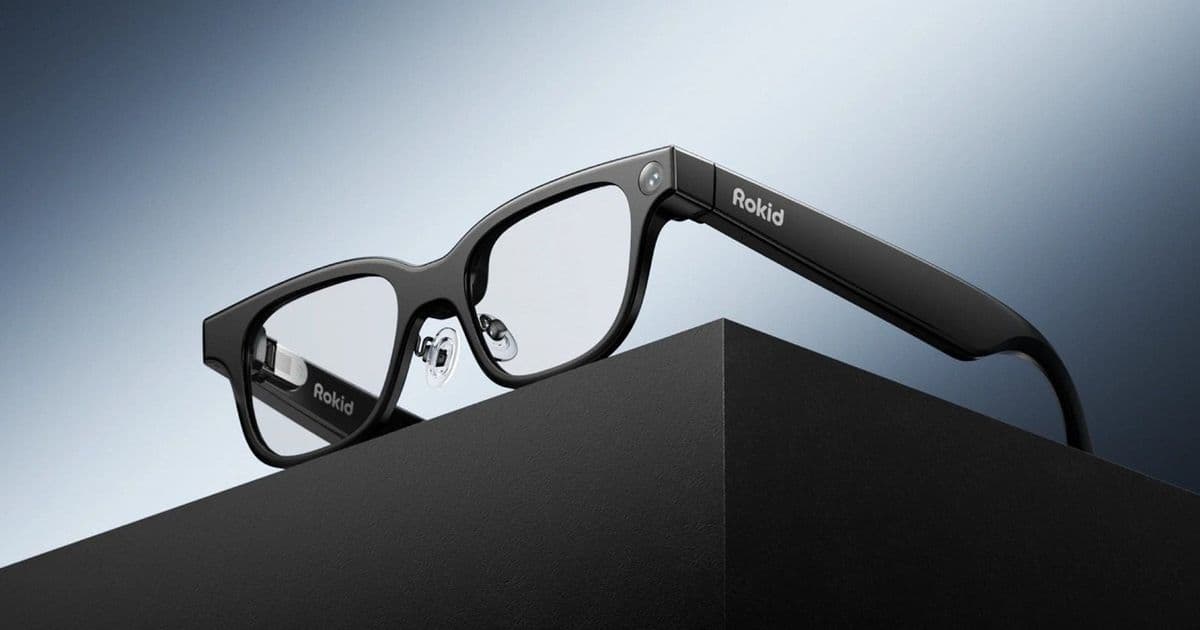
Rokid's new AI Glasses Style launch globally at $299, offering a screenless, prescription-first alternative to Meta's Ray-Bans with open AI ecosystem support and 12-hour battery life.
Rokid is taking its screenless AI Glasses Style worldwide this month, betting that consumers want AI-powered eyewear without the weight and complexity of a built-in display. After debuting at CES 2026, the lightweight glasses are now available for global online orders starting at $299, positioning them as a practical alternative to Meta's Ray-Ban smart glasses.

What's New: A Screenless Prescription-First Approach
The AI Glasses Style represent a deliberate departure from Rokid's earlier AR-focused products. Instead of micro-displays or HUDs, these glasses rely entirely on voice, audio, and a 12 MP Sony camera sensor for interaction. At 38.5 grams, they're lighter than most camera-equipped smart glasses from competitors like Meta, which often weigh 40-45 grams.
The camera captures 4K video in continuous clips up to 10 minutes, and Rokid claims the dual-chip architecture delivers up to 12 hours of typical use. That's notably longer than Meta's Ray-Ban Stories, which typically manage 4-6 hours before needing a recharge.
What sets Style apart is Rokid's "prescription-first" design philosophy. The frames support full prescription lenses up to ±15.00D, and buyers can upload their optical prescription directly to Rokid's platform for custom lens cutting. The company offers standard frames starting at $299, while bundles with prescription photochromic lenses (which darken in sunlight) run around $398. Even at that price, Rokid undercuts comparable Meta Ray-Ban setups, which can exceed $450 with prescription lenses.
How It Compares: Open Ecosystem vs. Walled Garden
Rokid's biggest strategic move is its "open AI ecosystem" approach. Rather than locking users into a single assistant, Style can connect to multiple AI models and services simultaneously. The glasses support:
- ChatGPT and GPT-based assistants for general queries and tasks
- DeepSeek and Qwen for alternative LLM capabilities
- Google Maps integration for turn-by-turn navigation prompts
- Microsoft's translation stack for real-time translation across dozens of languages
Voice commands triggered by "Hey Rokid" activate features like live transcription, meeting summarization, object recognition, and navigation. All audio feedback comes through open-ear speakers, maintaining situational awareness while keeping the experience screen-free.
This stands in direct contrast to Meta's approach, which tightly integrates Ray-Ban glasses with Meta's own AI assistant and ecosystem. While Meta's system offers seamless integration within its walled garden, Rokid's open strategy gives users flexibility to choose their preferred AI services and avoid vendor lock-in.
The trade-off is clear: Style lacks Meta's branded fashion partnership with Ray-Ban, which carries cultural cachet and retail presence. It also doesn't include a charging case, which Meta provides. However, Rokid's lighter frame, longer battery life, broader AI model support, and lower price point create a compelling value proposition for users who prioritize function over fashion partnerships.
Who It's For: Practical Buyers vs. Early Adopters
The AI Glasses Style target a specific segment: users who need prescription eyewear and want AI capabilities without committing to a display-based AR system. This includes:
Professionals who need transcription and translation: The 12-hour battery life and continuous recording support make these viable for full workdays, international travel, or meetings. The open-ear audio ensures you can take calls or receive translations without isolating yourself from your environment.
Prescription glasses wearers seeking all-in-one solutions: Rather than carrying regular glasses plus separate AI devices, Style consolidates vision correction and AI assistance. The prescription-first design means the AI features feel like an addition to essential eyewear, not a separate gadget.
Budget-conscious tech users: At $299, these cost less than most premium sunglasses with camera add-ons, and the $398 prescription bundle still undercuts Meta's equivalent by $50-100. For users who want AI assistance without investing in full AR headsets like Apple's Vision Pro, this represents a lower-risk entry point.
Users wary of ecosystem lock-in: If you prefer using ChatGPT over Meta's assistant, or need Google Maps integration rather than Meta's navigation, Style's open architecture accommodates those preferences.
However, Style isn't for everyone. Users who want the fashion prestige of Ray-Ban branding will prefer Meta's offering. Those who need a charging case for on-the-go power will find Meta's ecosystem more convenient. And if you're looking for AR displays or heads-up notifications, these won't satisfy that need—Rokid has other products for that.
Technical Architecture: Dual-Chip Efficiency
Rokid's dual-chip design separates low-power voice processing and sensor management from heavier AI computation. This architecture is similar to what we see in high-end smartwatches, where a dedicated low-power core handles always-on tasks while a main processor activates only for intensive work.
The approach explains the 12-hour battery life. Voice detection and basic sensor polling consume minimal power, while the main AI chip only activates when you trigger a command or start recording. This is crucial for screenless glasses, since they can't rely on display power management to conserve energy.
The 12 MP Sony sensor is likely the IMX681 or similar variant used in other compact camera devices. It supports 4K video at 30fps, and the 10-minute clip limit is probably a thermal constraint rather than a battery limitation. Continuous 4K recording generates significant heat in a small frame, so limiting clips prevents overheating.
Market Impact: Pressure on Meta's Segment
Style's global launch at $299 puts immediate pressure on Meta's Ray-Ban smart glasses, which start at $299 but quickly climb with prescription lenses and accessories. Rokid's lighter weight, longer battery, and open AI ecosystem directly address common complaints about Meta's offering.
More importantly, Rokid's strategy could influence the broader smart glasses market. If consumers embrace screenless AI glasses as a distinct category separate from AR displays, we may see more manufacturers follow this path. It represents a pragmatic middle ground between basic camera sunglasses and expensive AR headsets.
The open AI ecosystem approach also challenges the prevailing walled-garden strategy in consumer tech. If Style succeeds, it could pressure companies like Meta and Apple to open their hardware to third-party AI services, similar to how Android's openness pressured iOS to adopt more flexible features.
Availability and Pricing
The AI Glasses Style are available globally through Rokid's official website and select online retailers including Amazon. The base model at $299 includes standard frames and non-prescription lenses. Prescription bundles with photochromic lenses start at $398. Global shipping is open now, with most regions receiving orders within 7-14 business days.
For users interested in exploring Rokid's broader ecosystem, the company offers additional details at Global.Rokid.com and technical specifications on their product page.
The glasses represent a calculated bet that many consumers want AI assistance integrated into their daily vision correction, not as a separate device or a flashy AR display. For Rokid, it's a move to differentiate from both the AR crowd and the fashion-first smart glasses segment. For consumers, it's another option in an increasingly crowded market—one that prioritizes practicality and openness over brand prestige.
Comments
Please log in or register to join the discussion