While history remembers Ronald G. Wayne as the Apple co-founder who sold his 10% stake after just two weeks, his 91-year life story encompasses far more than that brief moment in computing history.
In the pantheon of tech history, certain names become synonymous with revolution. Steve Jobs. Steve Wozniak. And Ronald G. Wayne, the man who signed the original Apple partnership agreement but walked away before the company truly took flight. While Wayne's two weeks at Apple have been endlessly retold, the other 91 years of his life represent a fascinating journey through multiple industries, passions, and innovations that deserve equal attention.
The Beginning: Beyond the Apple Contract
Wayne's story with Apple begins not with computers, but with slot machines. In the mid-1970s, Wayne worked alongside Steve Jobs at Atari, where his background in electronic gaming devices made him a natural fit. It was this connection that eventually led to the formation of Apple Computer Company in 1976.
"He walked up to me one day and said, 'I can get my paws on $50,000; let's go into the slot machine business,'" Wayne recalled. "And I told him that would be the quickest way I could think of to lose $50,000."
Jobs persisted, eventually introducing Wayne to Wozniak, and the three formed a partnership. Wayne received 10% of the company, intended as a tie-breaker in disagreements between Jobs and Wozniak. His most visible contribution was the company's first logo: a complex illustration of Isaac Newton under an apple tree, with an apple about to fall on his head.
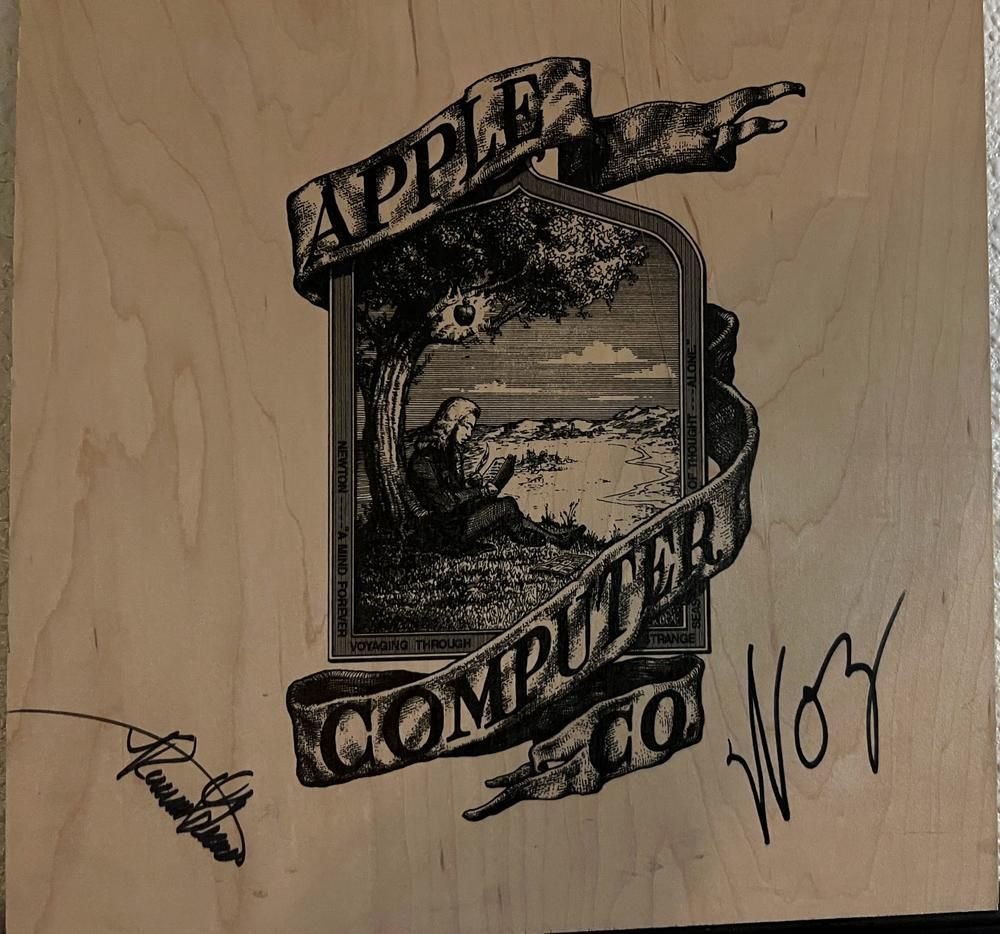
"It was done in a Gothic design. It was not a modern logo by any stretch of the imagination," Wayne explained. "But it reflected a sense of whimsy around the work the company was doing, something I picked up from co-founder Steve Wozniak."
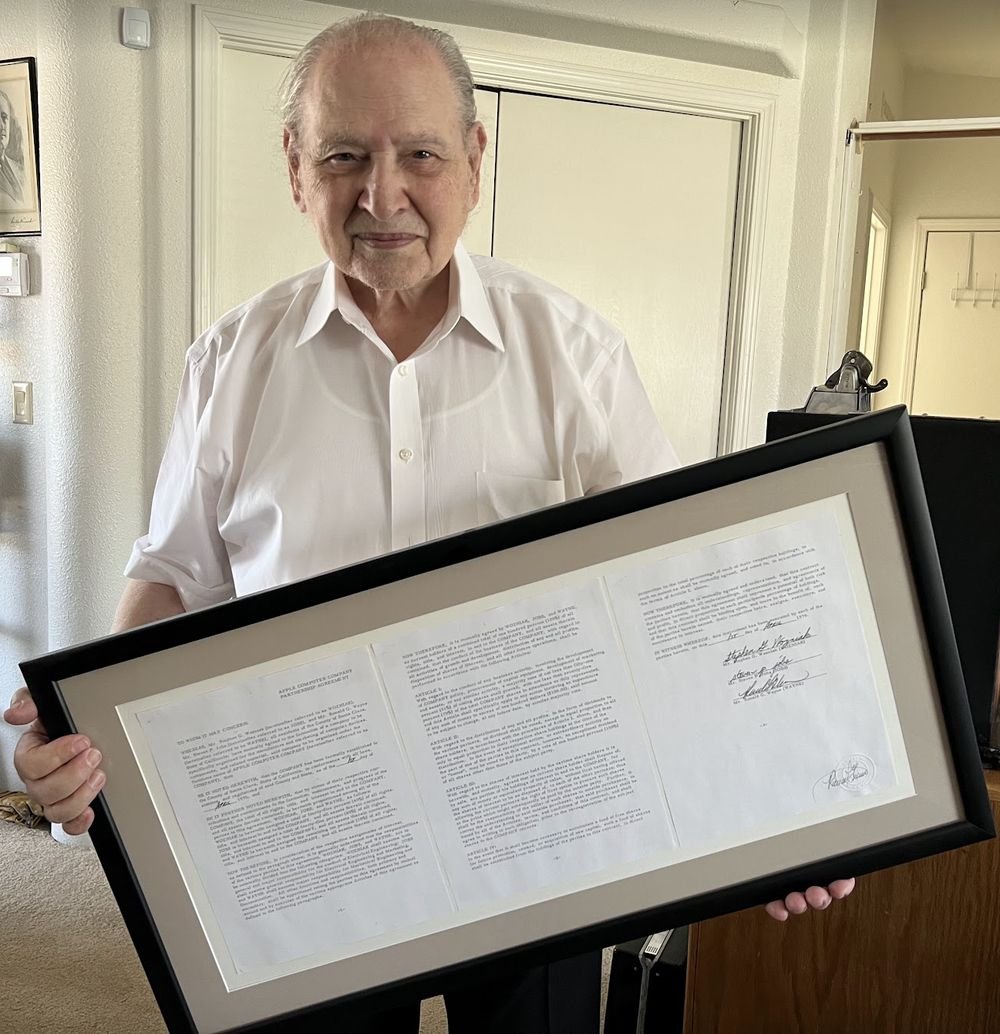
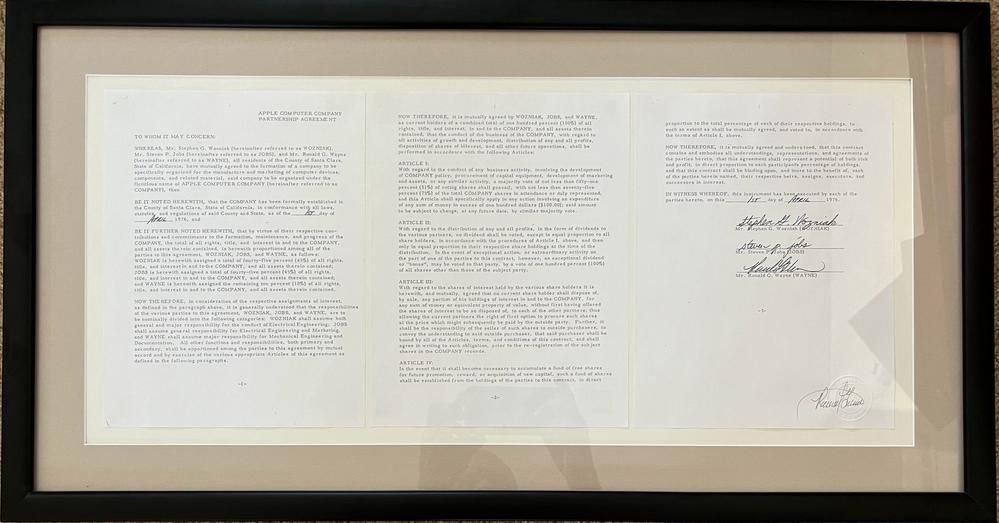
Within two weeks, however, Wayne's concerns about potential liability led him to sell his back to Jobs and Wozniak for $800. The document he typed up on his own typewriter would later sell at auction for $2.5 million, a testament to how history has remembered those crucial early days.
A Diverse Career: The Man Beyond Apple
What followed Wayne's departure from Apple was a career as varied and interesting as his Apple logo was detailed. His talents spanned multiple fields, each representing a different facet of his polymathic nature.
At Lawrence Livermore National Laboratory, Wayne transitioned from design draftsman to establishing the facility's first model shop. His intricate scale models, including one of a mirror fusion reactor project, showcased his exceptional attention to detail and craftsmanship.

"My manager walks over and says, 'Mr. Wayne, we've been looking at your resume, and you say you're a compulsive model builder,'" Wayne recalled. "I responded affirmatively. They said, 'Well, you're no longer a design draftsman; you're going to establish the laboratory's first model shop.'"
Before Apple, Wayne had already made significant contributions to gaming technology. He helped develop some of the earliest electronic slot machines, achieving the distinction of creating the first certified gaming commission-approved wholly electronic slot machine that appeared in Las Vegas.
"I finally came up with a design that worked, and as a result, I wound up with the first certified gaming commission certified wholly electronic slot machine that wound up on the streets of Las Vegas," Wayne said.
His technical expertise extended to Atari, where his organizational skills transformed the company's chaotic parts department into a well-documented system that later proved valuable when Warner Communications acquired the company for $27 million.
"For the next three months, I designed a complete purchase parts documentation system that wound up a 400-page manual and organized everything in the parts department," Wayne explained. "Apparently they were quite happy with that because I had sort of an aura in the place for the next three years that I was there."
A Life of Learning and Creation
Wayne's post-Apple life was defined by curiosity and exploration. Without formal degrees, he pursued knowledge across multiple domains, becoming an author, philatelist, and expert on monetary systems.
His fascination with stamp collecting began in childhood when he discovered line-engraved intaglio printing, where images are composed of tiny lines. This interest led him to open "Wayne's Philatelics," a stamp business he described as "moderately successful." By 2016, his personal collection had grown to over one million stamps.
Wayne's monetary philosophy, shaped by his reading of Adam Smith, centers on his belief that the world's departure from the gold standard in 1968 set economies on a dangerous path.
"I understood immediately, in 1968, that we were in trouble not only in The United States but worldwide because they took the whole world off of the gold standard," Wayne explained. "Which meant that every country in the world was running on what's called fiat money. Instead of money backed by gold and silver, which had been the case for 2,400 years very successfully, now the world was running on Monopoly money."
This perspective contrasted with that of his former partner Steve Jobs, who Wayne recalled bought $250,000 in gold but sold it for a modest profit when it reached $400,000, "learning absolutely nothing." Wayne himself accumulated silver coins in anticipation of their eventual disappearance from circulation.
Legacy and Influence
Despite his brief tenure at Apple, Wayne's influence extends beyond what history commonly acknowledges. He played a crucial role in convincing Wozniak to assign his chip designs to the company rather than retaining personal ownership.
"It took me about 25 minutes to get Woz to understand that in a company, it's the company that is the driving force. The company is the owner of all the concepts that come up for use by the company," Wayne explained. "It was at that moment in time where Woz turned around and said, 'Okay, I agree to proprietorship.'"
Wayne also contributed to the early design concepts of the Apple II, envisioning an integrated system with keyboard, computer, and monitor as one unit.
"I had the keyboard integral to the enclosure for the circuit board and on top of this you put a monitor," he recalled. "So you had monitor, computer, and keyboard all as one integral unit that got rid of all that interconnection wiring."
Even Jobs recognized Wayne's value, attempting to recruit him back to Apple multiple times. Wayne consistently declined, remaining committed to his diverse interests and projects.
In recent years, Wayne has gained a new kind of recognition, appearing in a Bud Light commercial parodying his Apple founder status. The 91-year-old continues to collaborate with business partner Charles Stigger on new ventures, maintaining the same curiosity and energy that has defined his remarkable life.
"The whole world was to me a sandbox with all the toys I could play with," Wayne reflected. "I mean, I did so many different things because diversification was my hobby."
As Apple celebrates its 50th anniversary, the story of Ronald G. Wayne reminds us that history often simplifies complex narratives into convenient soundbites. While his two weeks at Apple secured his place in tech history, they represent merely a fraction of a life rich with achievement, creativity, and intellectual exploration.
Comments
Please log in or register to join the discussion