
The first Rust release of 2026 introduces a targeted improvement for developers writing low-level code, allowing conditional compilation of individual assembly statements within a single block, while also updating the musl libc for better static linking reliability.
The Rust programming language has launched its first feature release of 2026 with version 1.93, bringing a targeted enhancement for developers working close to the metal. The update focuses on refining inline assembly handling and improving the reliability of statically linked binaries for Linux targets.
A Surgical Improvement for Assembly Code
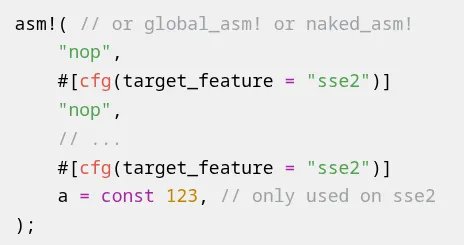
The most significant language-level change in Rust 1.93 addresses a long-standing limitation in the asm! macro. Previously, Rust's cfg attributes—which allow for conditional compilation based on target features—could only be applied to entire asm! blocks. This meant developers writing hand-tuned assembly for different CPU architectures or instruction sets had to duplicate entire blocks of code, even when only a single instruction differed.
With Rust 1.93, cfg attributes can now be applied to individual statements within an asm! block. This enables developers to conditionally compile specific assembly instructions based on target features without repeating the surrounding code. For example, a developer could write a single asm! block containing both x86 and ARM-specific instructions, with each statement guarded by the appropriate #[cfg(target_arch = "x86_64")] or #[cfg(target_arch = "aarch64")] attribute.
This refinement is particularly valuable for performance-critical code paths in areas like cryptography, graphics rendering, or operating system development, where developers often need to write architecture-specific optimizations. The change reduces code duplication, improves maintainability, and makes it easier to write portable low-level code that adapts to different hardware capabilities.
musl libc Update for Static Linking
Beyond the assembly improvements, Rust 1.93 updates the musl libc from version 1.2.3 to 1.2.5 for all *-linux-musl targets. This update was primarily motivated by improvements to musl's DNS resolver and various bug fixes.
The enhanced DNS resolver is particularly important for Rust programs that use static linking with musl. Static linking with musl creates self-contained binaries that don't depend on system libraries, which is valuable for deployment in containerized environments or on systems with minimal installations. However, the previous musl version had known issues with DNS resolution that could cause networking problems in certain scenarios.
With musl 1.2.5, Rust programs compiled for *-linux-musl targets should have more reliable networking behavior, especially in environments where DNS resolution is critical. This update benefits applications that need to make network requests during startup or operation, such as microservices, CLI tools that fetch remote data, or systems that perform health checks over the network.
Context and Impact
These changes reflect Rust's ongoing maturation as a systems programming language. The inline assembly improvement shows the language is continuing to refine its low-level capabilities, making it more competitive with C and C++ for performance-critical applications. Meanwhile, the musl update demonstrates the language's commitment to supporting diverse deployment scenarios, from embedded systems to cloud infrastructure.
Developers who have been waiting for more flexible assembly handling can now experiment with the new cfg attribute placement. The Rust documentation provides detailed examples of the new syntax, which maintains backward compatibility—existing asm! blocks continue to work as before.
For teams using musl-based static linking, the libc update should be mostly transparent, though testing in staging environments is recommended to verify that DNS-dependent functionality works as expected.
The full list of changes in Rust 1.93 is available on the official Rust blog and the detailed release notes. Developers interested in the technical details of the inline assembly changes can refer to the RFC that proposed this feature and the updated reference documentation.
The Rust team continues to balance language improvements with stability, ensuring that each release provides tangible benefits while maintaining the language's reliability guarantees. Rust 1.93 exemplifies this approach with focused enhancements that solve specific pain points for developers working at different levels of the software stack.
Comments
Please log in or register to join the discussion