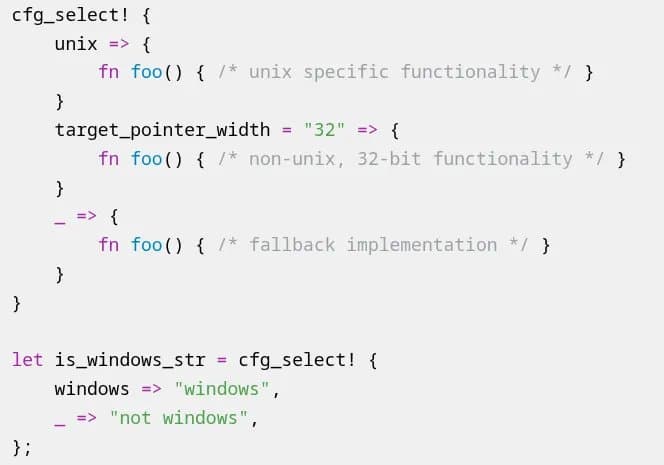
Rust 1.95 brings the new cfg_select! macro for compile-time configuration, if-let guards in match expressions, and API stabilization, with the Linux kernel already preparing for the update.
The Rust programming language has reached another milestone with the release of version 1.95, bringing several notable improvements that enhance both developer experience and system-level programming capabilities. The update, announced today by the Rust team, introduces features that streamline conditional compilation and pattern matching while continuing the language's commitment to stability and performance.
At the heart of this release is the new cfg_select! macro, which effectively replaces the functionality previously provided by the popular cfg-if crate. This macro serves as a compile-time match expression for configuration attributes, allowing developers to write more concise and readable conditional compilation code. Where previously you might have written multiple nested cfg_if! macros or complex conditional compilation blocks, cfg_select! provides a cleaner syntax that's now part of the standard library.
Consider the practical impact: developers working on cross-platform libraries or applications that need to handle different target architectures, operating systems, or feature flags can now express these conditions more elegantly. The macro evaluates configuration predicates at compile time, selecting the appropriate code branch without runtime overhead. This is particularly valuable for systems programming, embedded development, and performance-critical applications where conditional compilation is frequently used to optimize for specific platforms.
Another significant addition in Rust 1.95 is the stabilization of if-let guards within match expressions. This enhancement allows developers to add additional conditions to match arms, providing more expressive pattern matching capabilities. For example, you can now write patterns like Some(x) if x > 10 => ..., combining pattern matching with arbitrary boolean conditions. This feature has been long-awaited by the Rust community and brings the language's pattern matching capabilities closer to those found in functional programming languages like Haskell and ML.
The release also includes stabilization of several APIs that were previously in the nightly channel. While the specific APIs weren't detailed in the initial announcement, this pattern of stabilizing experimental features demonstrates Rust's careful approach to evolving the language. Features spend time in the nightly channel, allowing the community to test and provide feedback before they become part of the stable release.
Perhaps most tellingly, the Linux kernel development community has already begun preparations for Rust 1.95. The kernel's embrace of Rust has been one of the most significant developments in systems programming over the past few years, with Rust modules being integrated alongside traditional C code. The kernel's readiness for this new Rust version underscores the language's growing importance in systems-level development and its acceptance in even the most conservative software projects.
For developers looking to upgrade, the transition to Rust 1.95 should be straightforward. The Rust team maintains strong compatibility guarantees, and the new features are additive rather than breaking existing code. However, developers using the cfg-if crate will want to migrate to the standard library's cfg_select! macro to reduce dependencies and align with idiomatic Rust practices.
The broader implications of these changes extend beyond mere syntax improvements. The stabilization of cfg_select! and if-let guards reflects Rust's maturation as a language. What were once community-driven solutions (like cfg-if) are becoming part of the language's core, and pattern matching capabilities are expanding to support more sophisticated code organization patterns. These improvements make Rust even more attractive for complex systems programming tasks, from operating systems and game engines to web assembly modules and embedded controllers.
As Rust continues to evolve, each release brings the language closer to its goal of being the premier choice for systems programming that requires both performance and memory safety. The 1.95 release, while not revolutionary, represents the steady, thoughtful progress that has characterized Rust's development since its inception. For the millions of developers who rely on Rust for everything from command-line tools to critical infrastructure, these incremental improvements compound over time to create a more powerful and expressive programming environment.
The Rust 1.95 release is available now through the standard update channels, and the full changelog with detailed explanations of all changes can be found in the official Rust blog post on Rust-Lang.org.
Comments
Please log in or register to join the discussion