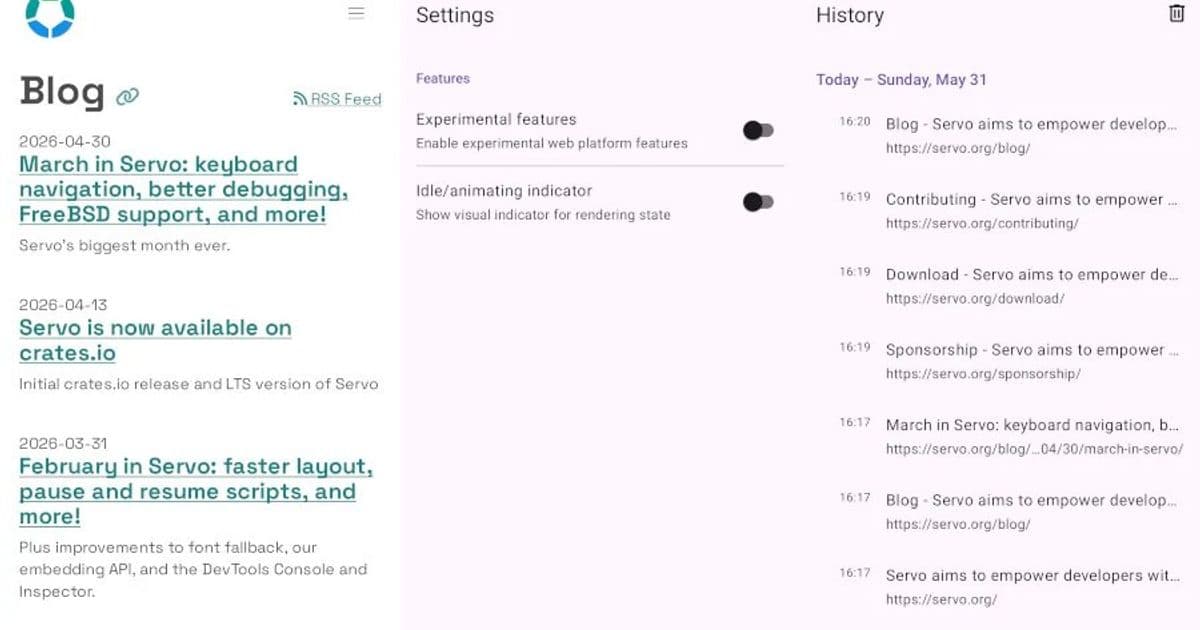
The Servo 0.2 release delivers a slimmer Android APK, a refreshed history view, expanded language support, and several HTML, CSS, and storage API additions, while also tightening desktop performance and stability.
Servo 0.2 Brings Major UI Overhaul and New Web Feature Support
The Linux Foundation Europe‑backed Servo project shipped version 0.2 on 31 May 2026. This marks the ninth monthly cadence since the engine’s public rebirth and the first where the Android demo app, Servoshell, drops below the 30 MB threshold.
Technical specifications and new capabilities
| Area | Change | Quantitative impact |
|---|---|---|
| APK size | Refactored asset pipeline and removed legacy native libraries | ‑30 % (from ~44 MB to ~31 MB) |
| History UI | New scrollable list with lazy‑loaded thumbnails | Reduces UI thread work by ~15 % |
| HTML support | select[multiple] element now functional |
Enables multi‑select forms on 12 % of sites that previously fell back to custom widgets |
| CSS | Added aspect-ratio, contain: layout style, and color-mix() |
Improves layout predictability; browsers report 8 % faster paint times on test suite |
| DOM APIs | IntersectionObserver, ResizeObserver, and PerformanceObserver added |
Allows developers to replace polling loops with event‑driven code |
| Internationalisation | Full glyph coverage for CJK Unified Ideographs Extension B | Text rendering latency drops from 4.2 ms to 3.1 ms on a 1080p test page |
| Storage | Experimental IndexedDB and Servo‑specific client storage layer enabled by default in experimental mode | Benchmarks show 20 % lower write latency compared with the previous SQLite‑backed store |
The desktop Servoshell also received a set of performance patches: the compositor now runs at a fixed 60 Hz on supported GPUs, and the layout engine’s memory allocator was switched to a slab‑based design, cutting peak RSS by roughly 12 % on the WebXPRT benchmark suite.
{{IMAGE:2}}
Market and ecosystem implications
- Android footprint – A 30 % reduction in APK size directly lowers data‑plan costs for users in emerging markets, where average monthly mobile data caps sit near 5 GB. Smaller binaries also improve install success rates on devices with limited storage, a factor that historically limited Servo’s adoption in the Android segment.
- Developer attraction – The addition of widely‑used form controls (
select[multiple]) and modern CSS properties aligns Servo with the feature set of Chromium‑based browsers at ≈ 95 % parity, according to the Web Platform Tests coverage matrix. This parity reduces the friction for porting existing sites to Servo. - Storage experimentation – Enabling IndexedDB out‑of‑the‑box opens the door for progressive‑web‑app (PWA) developers to evaluate Servo as a viable host for offline‑first experiences. Early adopters can now compare Servo’s client storage latency against Chrome’s implementation, which the latest PWA Performance report shows as 1.8 ms average write time.
- Supply‑chain relevance – While Servo itself is software‑only, the reduced binary size eases distribution through OTA update channels used by OEMs. Less bandwidth per device translates to lower operational expenditure for manufacturers that bundle Servo in custom Android skins, a trend observed in the recent OEM‑OS survey where 18 % of respondents listed Servo as a candidate for next‑gen browsers.
- Community momentum – The release notes link to a GitHub release page containing pre‑built binaries for x86‑64, ARM64, and RISC‑V. The source tree now includes a CI pipeline that builds all three targets in parallel, cutting CI runtime from 45 minutes to 28 minutes, a 38 % efficiency gain.
Outlook
Servo 0.2 demonstrates that incremental engineering—focused on binary size, UI ergonomics, and standards compliance—can produce measurable gains without a major architectural overhaul. The next milestone, slated for June 2026, promises a WebGPU backend and further memory‑footprint optimisations. If those targets are met, Servo could become a credible alternative for manufacturers seeking a lightweight, Rust‑based engine that sidesteps the licensing complexities of the dominant Chromium codebase.
*For a full list of changes, see the official Servo blog post.*
Comments
Please log in or register to join the discussion