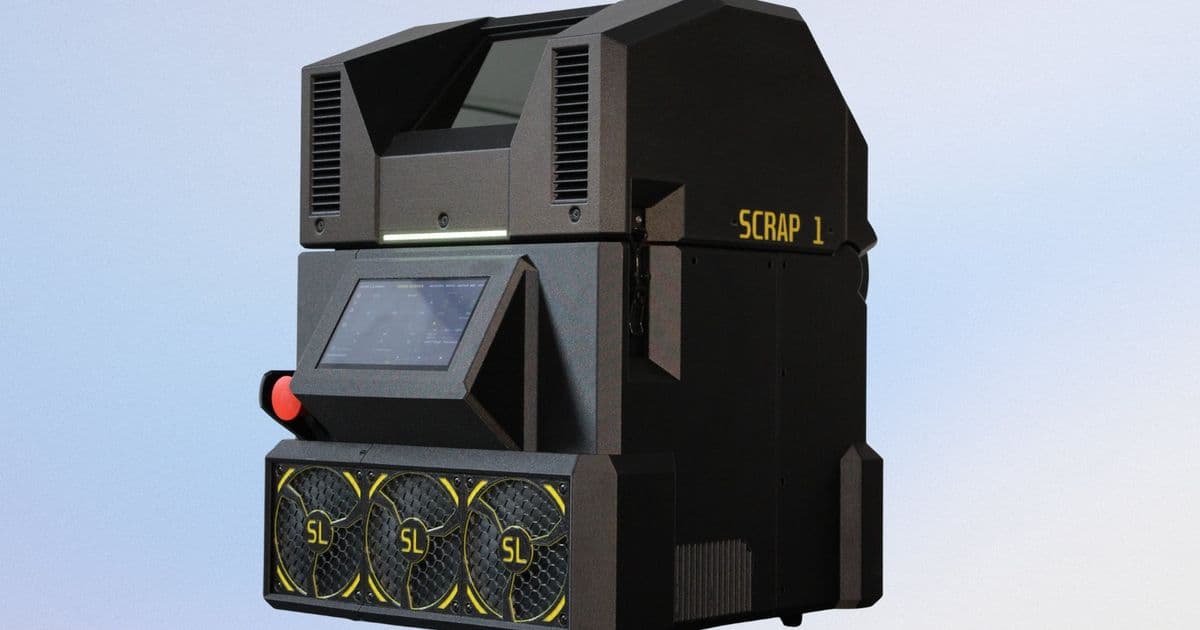
Colorado-based startup Scrap Labs has introduced the Scrap 1, a compact laser powder-bed fusion metal 3D printer priced at $9,600 for kits, aiming to democratize industrial-level metal additive manufacturing for small businesses, research labs, and individual builders.
Scrap Labs, a Colorado-based additive manufacturing startup, has unveiled the Scrap 1—a compact laser powder-bed fusion metal 3D printer—at the Rocky Mountain RepRap Festival in Loveland, Colorado. This new device represents a significant step toward making advanced metal additive manufacturing accessible to smaller operations, educational institutions, and individual creators who have traditionally been priced out of this technology.
Metal 3D printing stands as one of the most compelling manufacturing technologies available today, capable of producing fully functional parts with complex internal geometries, intricate lattice structures, and near-full material density that would be impossible or prohibitively expensive to produce through conventional machining methods. Despite these advantages, metal printing has remained largely inaccessible to anyone outside well-funded industrial operations.
The Scrap 1 addresses this accessibility challenge head-on. Traditional entry-level systems from established players like EOS or Trumpf typically cost well above $200,000 and require three-phase electrical infrastructure, dedicated floor space, and extensive safety systems. Even more affordable options from companies like Xact Metal start around $65,000 while still requiring a proper lab environment.
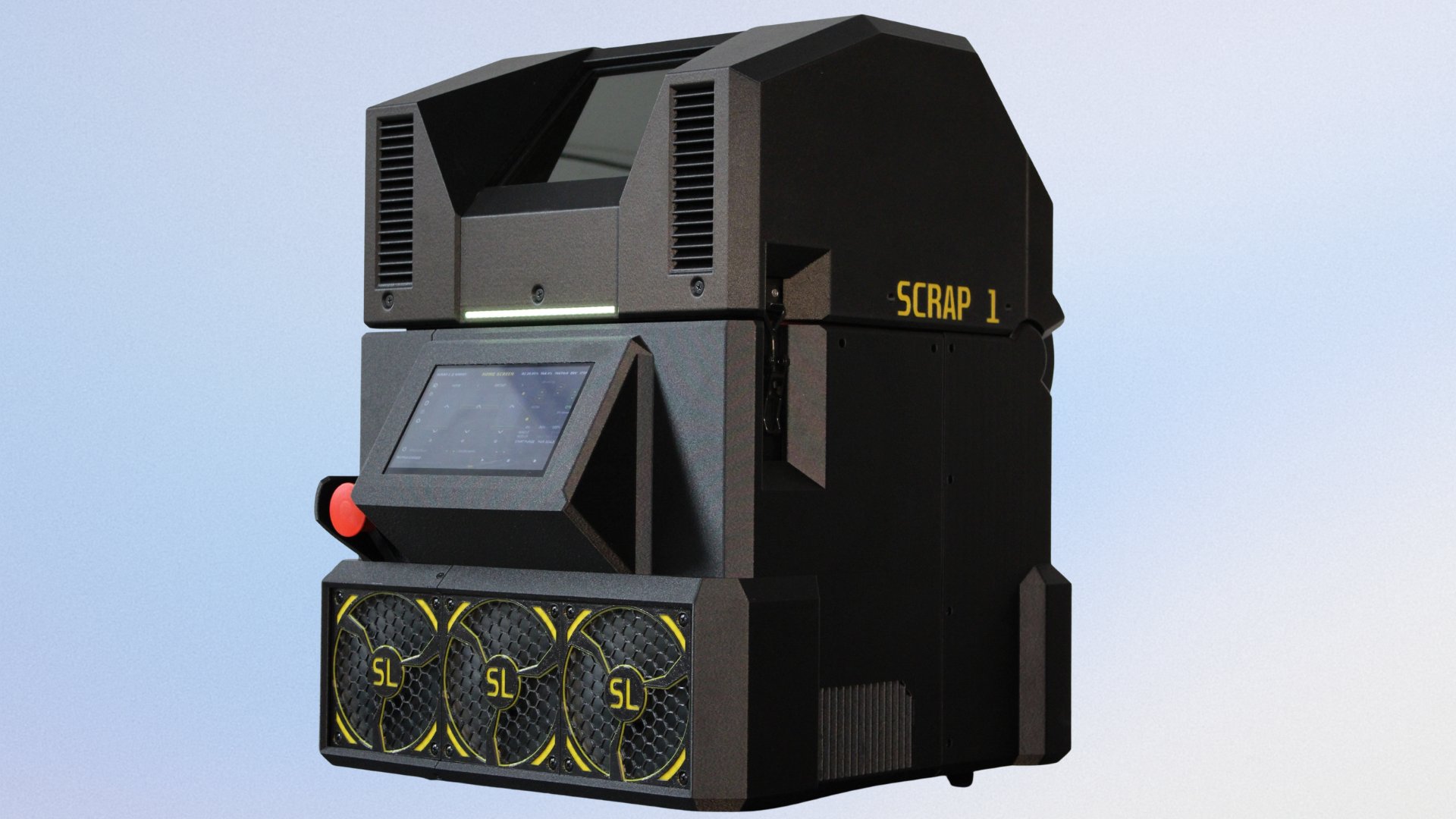
The Scrap 1 brings industrial capability to a workbench-sized package with the following specifications:
- Build Volume: 100×100×100 mm (~4×4×4 in)
- Physical Dimensions: 43W×50D×57H cm (16.9W×19.7D×22.4H in)
- Weight: 30 kg (66 lb)
- AC Input: 100-240V AC, 50-60 Hz, single phase
- Power Consumption: 500W max (250W avg)
- Working Temperature: 10°C to 30°C (50°F to 86°F)
- Laser Spot Size: 135 µm (0.0053 in)
- Layer Thickness: 20-100 µm (0.0008-0.004 in)
The machine employs laser powder bed fusion technology, which works by spreading thin layers of fine metal powder across a build platform and selectively melting them with a high-powered laser, building the complete 3D geometry layer by layer. For cooling, the system combines liquid and air cooling mechanisms, while a HEPA filter handles filtration of metal particles.
Supported materials include stainless steel, tool steel, copper, nickel alloys, and cobalt chrome, covering a wide range of prototyping and production needs. Connectivity options include Ethernet, Wi-Fi, USB, and a web dashboard, with firmware based on Klipper. The printer supports common slicing workflows including ScrapSlicer, PrusaSlicer, and OrcaSlicer, emphasizing open workflows rather than a closed ecosystem.
This accessibility could transform numerous sectors. University labs could produce custom experimental equipment without budget constraints. Vocational schools could provide hands-on experience with cutting-edge manufacturing technology. Automotive repair shops and motorsport garages could produce custom replacement parts on demand. Jewelry makers could create intricate metal designs with precision, while product design studios could rapidly iterate on metal prototypes.
"Our mission is to make advanced metal printing radically more affordable and practical while maintaining genuine industrial capability," said Scrap Labs representatives. "We want builders and makers to prototype, iterate, and deploy high-performance metal parts without requiring a six-figure machine."
As of now, the Scrap 1 is not yet shipping. Pre-orders are open, with kits starting at $9,600 under limited-time founder pricing, rising to $14,200 after April 30, 2026. Fully assembled and tested systems start at $17,990. Shipments are expected to begin in early 2027.
The company has completed its proof-of-concept phase in December 2025 and is currently in Phase 02, onboarding alpha testers and integrating early partners. Phase 3, planned for December 2026, will scale beta testing with broader field feedback. Full production launch is targeted for June 2027, with initial shipments to US customers.

This development comes amid growing interest in additive manufacturing across various industries. Metal 3D printing has seen increased adoption in aerospace, medical, automotive, and tooling applications, where the ability to create complex geometries provides significant advantages over traditional manufacturing methods.
The Scrap 1's introduction could accelerate this trend by removing a major barrier to entry—cost. By reducing the investment required from tens of thousands to under $20,000, the technology becomes accessible to a much broader range of users, potentially fostering innovation in small workshops, educational institutions, and specialized manufacturing operations that couldn't previously justify the expense.
For those interested in learning more about metal 3D printing technologies or the Scrap 1 specifically, the company's website and documentation provide additional technical details. The development also reflects a broader trend in manufacturing technology becoming more democratized, similar to how personal computers brought computing power from corporate data centers to individual desks decades ago.
Comments
Please log in or register to join the discussion