Testing reveals that Alienware 16's Overdrive mode provides minimal performance gains over Performance mode while significantly increasing fan noise, making it unnecessary for most gamers.
When manufacturers equip gaming laptops with extreme performance modes, they're often marketing to enthusiasts who believe maximum performance justifies maximum noise. The Alienware 16 Area-51 follows this pattern with its Overdrive mode, which pushes fans to maximum RPM for theoretical peak performance. But our testing reveals that for most gamers, this extra mode offers diminishing returns at the cost of unbearable noise levels.
The Alienware 16, equipped with a Core Ultra 9 290HX processor and RTX 5080 graphics, features three power profiles: Balanced, Performance, and Overdrive. While most users understand the standard Power Saver, Balanced, and Performance options, gaming laptops often include an additional "Turbo" or "Overdrive" mode that promises maximum performance at the expense of acoustics and potentially thermals.
Our benchmark testing using Time Spy reveals the actual performance differences between these modes. In Overdrive mode, the Alienware 16 achieved a combined score of 21,384, with graphics and physics scores of 22,247 and 17,534 respectively. The noise level at this setting reached 57 dB(A), which is comparable to standing next to a vacuum cleaner in operation.
Switching to Performance mode, the system maintained 97% of the Overdrive performance with a combined score of 20,776 (graphics: 21,478; physics: 17,530). More importantly, the noise level dropped significantly to 49 dB(A), a reduction that makes the laptop noticeably more comfortable during extended gaming sessions.
The Balanced mode offers another slight performance reduction to 20,189 (combined score), representing a 6% drop from Overdrive, but with minimal noise reduction to 48 dB(A). The GPU power consumption follows a similar pattern, drawing 172W in Overdrive mode, 156W in Performance mode, and 151W in Balanced mode.
For most gamers, the Performance mode represents the optimal balance between performance and noise. The 3% performance gain from Overdrive comes at the cost of 8 additional decibels of fan noise, a trade-off that rarely makes sense outside of competitive benchmarking scenarios. The difference between Performance and Balanced modes is even less compelling, with only a 1 dB(A) noise reduction for another 3% performance hit.
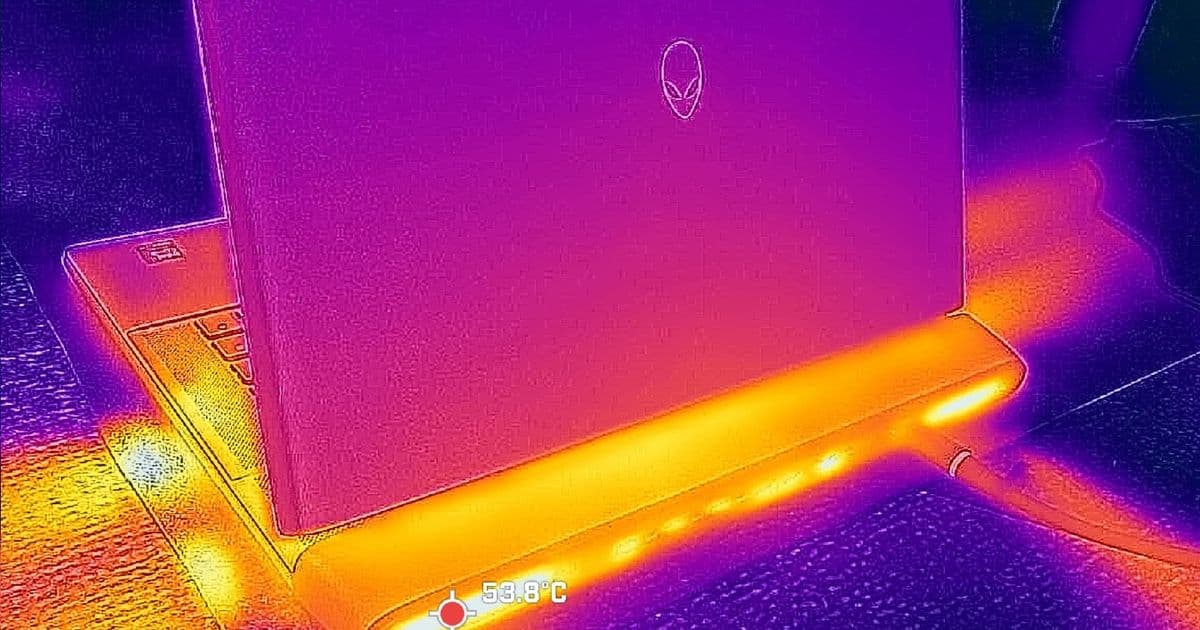
The Alienware 16's thermal management system appears well-designed, as the GPU power consumption differences between modes are relatively modest. This suggests that the Performance mode likely provides adequate cooling for the RTX 5080 without pushing fans to extreme RPMs. The diminishing returns from Overdrive mode highlight how modern gaming laptops have reached a point where the "maximum" settings often provide minimal real-world benefits.
For users who prioritize both gaming performance and a comfortable acoustic environment, the Performance mode offers the best compromise. The Balanced mode might appeal to those who frequently work in quiet environments but still want good gaming performance. Only enthusiasts specifically chasing benchmark records or those playing highly demanding titles at maximum settings might find the Overdrive mode justified, even with its significant noise penalty.
Our full review of the Aliware 16 Area-51 includes additional benchmark comparisons and thermal analysis that further validate these findings. The testing methodology used for this analysis follows industry standards, with noise measurements taken at consistent distances and under controlled conditions to ensure accuracy.
As gaming laptops continue to push performance boundaries, manufacturers should consider providing more nuanced performance profiles that balance performance with user comfort. The Alienware 16's current implementation, while functional, could benefit from additional intermediate settings that offer more granular control between Performance and Overdrive modes.
Comments
Please log in or register to join the discussion