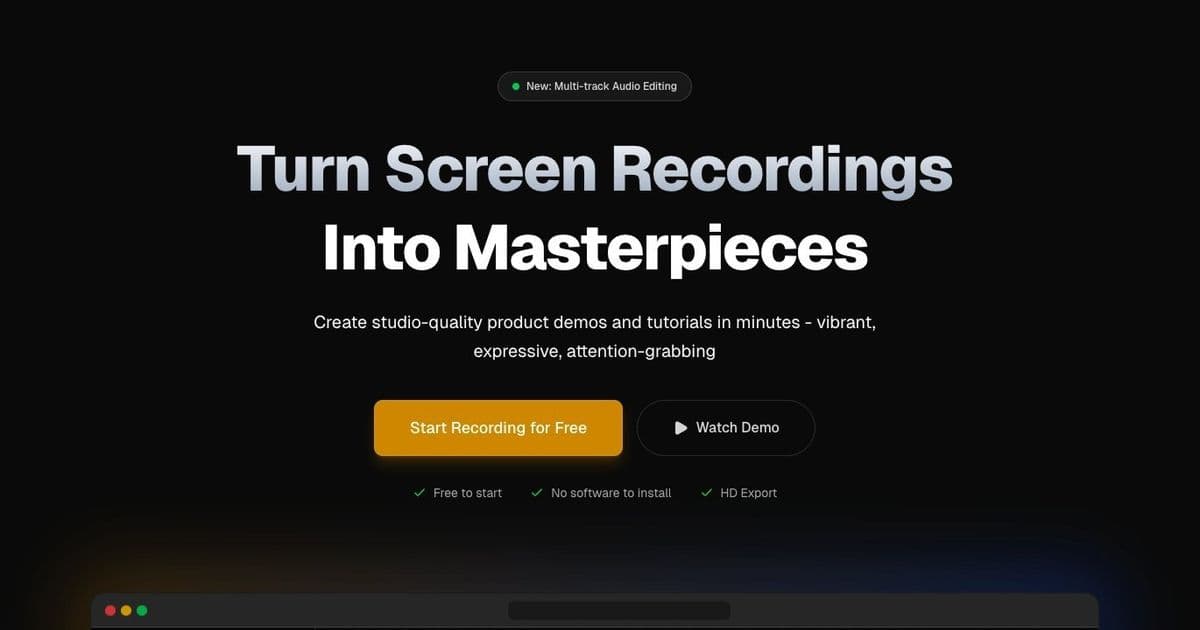
A new browser-based video editing tool promises professional-grade features without local installation, leveraging Web APIs to process recordings entirely on-device and address growing privacy concerns.
In an era dominated by cloud-dependent software, a new browser-based video editing platform is challenging conventional workflows by processing all content locally. Screentell, a tool designed for screen recordings and camera footage, capitalizes on modern Web APIs to offer multi-track editing, cinematic zoom effects, and annotation tools without requiring users to install applications or upload sensitive data.
"We value your privacy - your recordings are processed in your browser memory and never uploaded to our servers."
The platform's core innovation lies in its dual-stream recording engine, which simultaneously captures screen content and camera feeds as separate editable layers. This approach enables post-production adjustments like resizing or hiding camera elements – a significant improvement over traditional recording tools that require perfect takes. Its focus zoom feature uses keyframe interpolation to create smooth, cinematic transitions, while annotation tools include hand-drawn shapes and custom image overlays.
Privacy stands as Screentell's most compelling differentiator. By processing all video rendering in-browser using the MediaRecorder API and Canvas elements, the tool eliminates third-party server access. This approach directly responds to enterprise and individual concerns about data sovereignty, particularly for sensitive recordings like software demos or internal tutorials.
The free tier includes unlimited recordings and basic editing capabilities, with a $5.99/month Pro plan removing watermarks and enabling longer exports. While browser-based video editing isn't new, Screentell's emphasis on local processing and professional features positions it as a viable alternative for developers creating documentation and product demonstrations where data exposure remains critical.
As web technologies continue to mature, tools like Screentell signal a shift toward more privacy-conscious software delivery models – one that prioritizes user control without sacrificing functionality.
Comments
Please log in or register to join the discussion