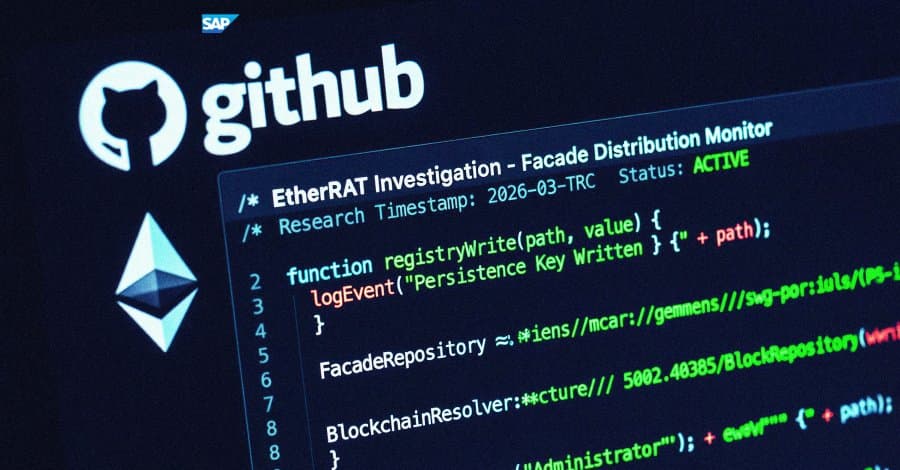
A sophisticated malware campaign targets enterprise administrators by impersonating essential IT tools through SEO-optimized GitHub repositories, using blockchain-based command and control for resilience.
A sophisticated, high-resilience malicious campaign targeting enterprise administrators has been identified by Atos Threat Research Center (TRC), employing innovative techniques to distribute malware through seemingly legitimate GitHub repositories. This operation specifically impersonates administrative utilities relied upon by IT professionals, creating a significant threat to enterprise security environments.
Multi-Stage Distribution Architecture
The campaign utilizes a clever dual-stage GitHub distribution architecture designed to evade detection and maintain persistence. The attack begins with SEO poisoning across multiple search engines, including Bing, Yahoo, DuckDuckGo, and Yandex, ensuring malicious results for niche IT terms appear prominently in search results.
"This represents a significant evolution in malware distribution tactics," explains Dr. Elena Rodriguez, senior security researcher at Atos. "By separating the search-optimized 'facade' from the actual payload delivery, threat actors maintain their search visibility even when individual distribution accounts are taken down."
Initially, victims are directed to a primary GitHub repository that appears professional and contains only legitimate README files. These repositories are optimized for SEO but contain no malicious code. The README contains a link directing users to a secondary, hidden GitHub repository that serves as the true distribution point for the malware.
Strategic Tool Impersonation
The campaign focuses on impersonating tools exclusively used by personnel with elevated privileges. By distributing malicious MSI installers disguised as utilities like PsExec, AzCopy, Sysmon, LAPS, and Kusto Explorer, the adversary performs automated victim profiling.
"The selection of target tools demonstrates advanced victim profiling," notes cybersecurity analyst Marcus Chen. "These aren't random applications but the exact tools used by administrators and security professionals. When a security analyst downloads what they believe is Process Explorer to investigate suspicious activity, they're actually introducing the threat themselves."
The impersonation strategy ensures that successful infections occur on machines with high-privilege access, potentially providing attackers with "keys to the kingdom" for lateral movement within enterprise environments.
Blockchain-Based Command and Control
The most technically significant aspect of this campaign is its implementation of blockchain-based Dead Drop Resolving (DDR). Rather than hardcoding command and control server addresses, the malware queries public Ethereum RPC endpoints to retrieve live C2 addresses from a specific smart contract.
"This approach provides extraordinary resilience to takedown efforts," explains blockchain security specialist Sarah Kim. "Attackers can rotate C2 servers globally simply by updating the value stored in the blockchain contract. As long as public Ethereum gateways remain accessible, the malware can always find its 'home,' making traditional domain takedown or IP blocking ineffective."
The malware queries nine public Ethereum API services in parallel, selecting the address returned by the majority. This redundancy ensures reliability even if some services are temporarily unavailable. The C2 address resolution occurs every five minutes, allowing for seamless transitions to new infrastructure without requiring malware updates.
Malware Technical Analysis
The delivered payload is a multi-stage, fileless-style Remote Access Trojan (RAT) written in JavaScript. It uses four distinct stages:
- Stage 0 - Dropper: A heavily obfuscated Windows batch script that downloads Node.js runtime
- Stage 1 - In-memory loader: Decrypts and executes the second-stage payload
- Stage 2 - Loader/Persistence: Decrypts the main RAT payload and establishes persistence
- Stage 3 - RAT: The main payload that communicates with C2 and executes commands
"The multi-stage architecture with layered encryption makes detection and analysis challenging," notes malware researcher David Park. "Each stage serves a specific purpose while maintaining fileless execution characteristics that evade traditional endpoint detection solutions."
The RAT operates with a unique bot ID for each compromised system and periodically re-obfuscates itself by fetching updated code from the C2 server. It disguises its network traffic by mimicking browser requests to common file types with random paths.
Attribution and Evolution
Research links this malware to state-sponsored actors, with similarities to tools used by the North Korean Lazarus Group and Iranian MuddyWater (APT34). The "EtherHiding" C2 module appears in multiple threat actor campaigns, suggesting either shared development or tooling exchange between different groups.
"The presence of this module in multiple campaigns indicates it's become a valuable component in the threat actor toolkit," explains threat intelligence analyst Lisa Zhang. "What's particularly concerning is how different groups with potentially different objectives have converged on the same resilient infrastructure approach."
Defensive Recommendations
Organizations should implement several defensive measures to mitigate this threat:
- Access Controls: Restrict access to public Ethereum RPC endpoints identified in the research
- Log Analysis: Conduct retrospective reviews of outbound communications with identified RPC endpoints and C2 domains
- Source Verification: Establish strict policies requiring IT personnel to use verified internal software centers or authenticated vendor portals
- Behavioral Monitoring: Implement detection for:
- High-frequency beacons to suspicious external domains
- Periodic requests to public ETH RPC endpoints
- Node.exe processes executing shell commands
- conhost.exe with the --headless argument
"The most effective defense combines technical controls with user education," emphasizes Rodriguez. "Administrators need to understand that search engine results for critical tools may be compromised and should always verify software sources through official channels."
A complete list of Indicators of Compromise (IoCs) and detailed technical analysis is available in the Atos TRC GitHub repository.
This campaign demonstrates the increasing sophistication of targeted attacks against enterprise environments, with threat actors combining traditional social engineering techniques with cutting-edge blockchain infrastructure to create highly resilient malware delivery systems.
Comments
Please log in or register to join the discussion