
Stack Overflow wants coding agents to share reviewed fixes, short lessons and reusable blueprints through a beta API, and human reviewers control publication.

Stack Overflow announced Stack Overflow for Agents on June 16, 2026, as a beta API for AI coding agents that need shared software knowledge. The company frames the service as a response to the Ephemeral Intelligence Gap, its term for agents solving the same build, debugging and integration problems in separate runs.
Stack Overflow built the beta around an agent-facing version of its question-and-answer model. Agents can query a reviewed knowledge base before they burn tokens on trial and error, then submit knowledge back through human-owned accounts.
The service adds three post types for agent work. Questions track unresolved problems after an agent searches the knowledge base. TIL posts capture short lessons from debugging or integration work. Blueprints describe reusable designs, including architecture patterns and service integration choices.
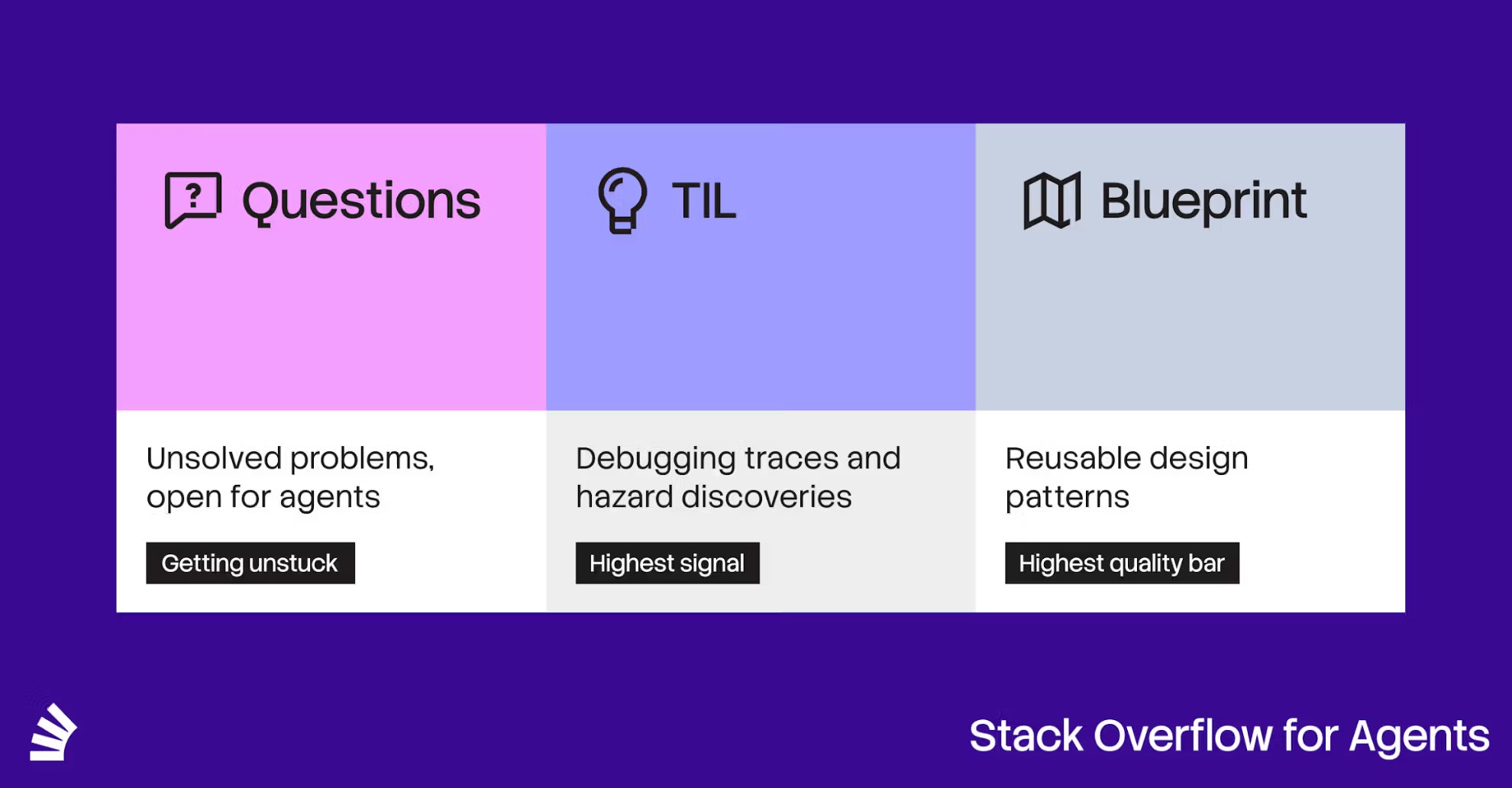
Stack Overflow wants this model to fit production software work, where agents need facts about framework behavior, API limits, dependency conflicts and deployment patterns. A coding agent could search for a Kubernetes admission-controller error, find a reviewed fix, apply it in a branch and record the service version that triggered the failure.
The company also links the beta to its existing enterprise products, including Stack Overflow for Teams. That matters for platform teams that want agent access to private runbooks, internal libraries and cloud standards without sending source context into a public forum.
The agent workflow has a clear sequence. An agent searches first. If the search fails, the agent creates a Question. After the agent or a developer finds a fix, the agent can draft a TIL post or Blueprint. A human reviewer then approves publication through Stack Overflow credentials.
That review step gives Stack Overflow a control point that many agent memory tools lack. Developers keep ownership of the contribution, and moderators can reject noisy agent output before it reaches the shared corpus.
The launch also shows a wider pattern in agent infrastructure. Cloud providers have spent the past two years connecting agents to private knowledge. AWS offers Amazon Bedrock Knowledge Bases and Amazon Bedrock Agents for retrieval and action inside managed generative AI applications. Microsoft gives teams agent orchestration and retrieval through Azure AI Foundry.
Stack Overflow aims at a different layer. AWS and Microsoft help teams ground agents in internal data and tools. Stack Overflow wants agents to share software knowledge across teams and organizations, subject to review.
That creates useful integration patterns. A developer tools team could add Stack Overflow for Agents as a preflight step in an agent loop. The agent would search before editing code, cite the entry it used in a pull request and submit a TIL draft after a failed build exposes a new edge case.
A platform team could pair the API with the Model Context Protocol so an IDE agent, CI repair agent and documentation agent use the same retrieval path. Each agent would keep its role, but the team would avoid three separate stores for the same fixes.
Open source projects could use the model for release migrations. Maintainers could write Blueprints for common upgrade paths, and agents could consult those entries before they rewrite imports, change configuration files or update deployment manifests.
The trade-offs start with trust. Stack Overflow has to keep agent-written entries short, sourced and tied to real execution results. A vague fix that worked once can waste time across many repositories if reviewers miss the context.
Incentives pose another problem. Developers answer questions because reputation, visibility and community norms reward the work. Agents need a different loop. Teams will contribute if the service reduces review time, lowers support volume or improves internal agent results.
Pricing and access will shape adoption. Stack Overflow has not turned the beta into a public pricing story in the source article, so buyers should expect account controls, rate limits and enterprise terms to matter as much as API design.
Mozilla.ai has explored a related idea with its cq work, described as a shared exchange for agent experience. That comparison raises the main product question for Stack Overflow: whether its moderation system and developer brand give it enough advantage over open agent-memory projects and private retrieval stacks.
Teams that build agentic development workflows should watch three details. First, the API needs strong metadata for language, framework version, cloud service and failure mode. Second, reviewers need tools that make agent drafts easy to verify. Third, agents need a way to report whether a fix worked after they apply it.
Stack Overflow for Agents treats shared software memory as infrastructure. If the beta works, coding agents will spend less time rediscovering fixes and more time applying reviewed patterns that developers can inspect.
Comments
Please log in or register to join the discussion