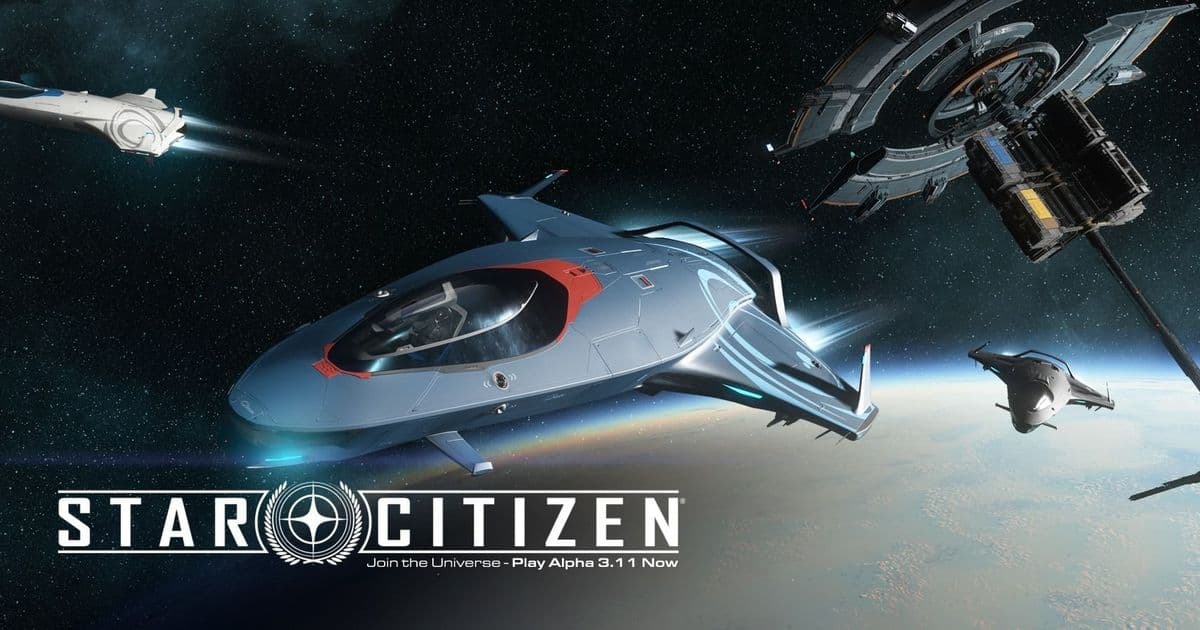
Cloud Imperium's ambitious space simulation project has crossed the $1 billion funding milestone while remaining in early access with no concrete release date, raising questions about development timelines and crowdfunded game sustainability.
Star Citizen has officially crossed the $1 billion funding milestone, 14 years after its initial announcement in October 2012. This crowdfunded behemoth, developed by Cloud Imperium Games, represents one of the most expensive and prolonged development cycles in gaming history, with no official release date in sight despite being playable in an alpha state.
The project began with a Kickstarter campaign but quickly expanded beyond those initial parameters, prompting the studio to establish its own crowdfunding platform. Today, the game exists in a perpetual state of development with over 1,000 employees across multiple studio locations working simultaneously on various aspects of the game.
Technical Evolution and Architecture
The technical scope of Star Citizen has evolved significantly since its inception. The project underwent a fundamental engine switch from CryEngine to Cloud Imperium's proprietary StarEngine, primarily to support 64-bit precision necessary for the game's massive scale. This architectural decision enabled more precise positioning of objects in the game world, crucial for a space simulation spanning vast distances.
One of the most complex technical challenges has been implementing Persistent Entity Streaming (PES), which tracks object locations in real-time across servers. To make this seamless, the developers introduced Server Meshing, a system that stitches multiple servers into one cohesive universe. This architecture dynamically switches players between servers as they traverse planetary boundaries, creating the illusion of a single, persistent universe.
Market Context and Funding Model
To contextualize the $1 billion investment, Grand Theft Auto VI is reportedly the only other game in history to have a comparable budget. Ubisoft's Beyond Good and Evil 2, announced in 2007, predates Star Citizen but remains unreleased. Unlike Star Citizen's crowdfunded approach, Ubisoft has developed that project with private payroll funding.
The crowdfunding model has proven remarkably successful for Star Citizen, with players continuously providing additional funding despite the lack of a release timeline. Recent examples include the "Anvil Odin" ship, priced at $5,000, which cannot yet be flown in-game but was made available for purchase during the DefenseCon event. The studio plans to make this ship playable via future content patches.
Development Timeline and Console Generations
The development of Star Citizen has spanned three console generations. When the project was announced, the PS3 and Xbox 360 were nearing end-of-life, and now the PS5 and Xbox Series X|S are approaching the same stage. By the time the game potentially releases, it may need to be compatible with next-generation consoles like the PS6 and Xbox Helix, raising questions about whether the final product will feel outdated.
Christ Roberts, the project's lead, has hinted at a 2027-2028 release window, suggesting the studio plans to formally launch Star Citizen a year or two after "Squadron 42" is completed. Squadron 42, the single-player cinematic adventure set in the same universe, was announced alongside Star Citizen with a 2014 release window but is now targeting 2026 without a concrete date.
The persistent development cycle has allowed the game to incorporate numerous features and technologies that weren't feasible in 2012. However, this approach has also created a situation where the "finished" product continues to expand as development progresses, potentially pushing the release date further into the future.
Star Citizen stands as a unique case study in crowdfunded game development, demonstrating both the potential and pitfalls of an open development model with virtually unlimited funding and scope. The question remains whether this approach will ultimately deliver on its ambitious promises or become a cautionary tale about feature creep and development timelines.
Comments
Please log in or register to join the discussion