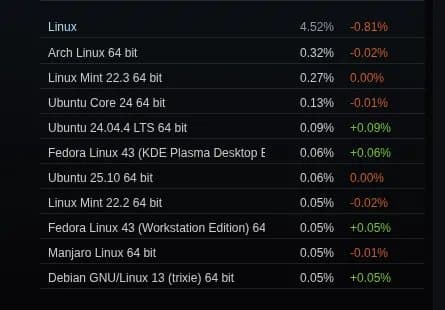
After reaching a historic peak of 5.33% in March, Steam on Linux market share decreased to 4.52% in April 2026, though still representing nearly double the usage from the previous year. The decline comes amid continued growth of the Steam Deck ecosystem and improved Windows game compatibility through Proton.
The Steam Survey results for April 2026 reveal a slight retreat in Linux gaming market share after March's record-breaking performance. Linux gamers accounted for 4.52% of Steam's user base in April, down from the all-time high of 5.33% recorded in March. While this represents a 0.81% decrease month-over-month, the platform continues to show remarkable year-over-year growth.
Looking at the broader trends, Linux gaming has more than doubled its market share over the past year. In April 2025, Linux represented just 2.27% of Steam users, compared to 4.52% in April 2026 - a 99% increase. When looking back two years to April 2024, the Linux share was even lower at 1.9%, demonstrating a sustained upward trajectory despite the recent monthly dip.
Several factors likely contributed to March's exceptional performance and the subsequent normalization in April. The continued success of the Steam Deck, which runs SteamOS (a Linux-based operating system), has been a major driver of Linux gaming adoption. Additionally, Valve's Proton compatibility layer has significantly improved the gaming experience for Windows titles on Linux, reducing the friction for users considering making the switch.
 Steam OS Holo, the specific version of SteamOS that powers the Steam Deck and upcoming Steam Machines, accounts for approximately 23% of Linux gamers on Steam. This substantial portion highlights the impact of dedicated hardware in driving Linux gaming adoption.
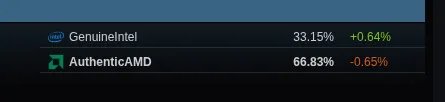
The hardware preferences among Linux gamers also reveal interesting patterns compared to the broader Windows gaming community. Among Linux users, AMD processors maintain a dominant position with 66% market share, while Intel holds 33%. This contrasts sharply with the Windows gaming ecosystem, where Intel commands 55% of the CPU market share. This divergence suggests that Linux gamers may be more inclined to choose AMD hardware, potentially due to better Linux driver support or specific performance characteristics in gaming workloads.
 The Linux gaming community has made significant strides in compatibility and performance. The Proton compatibility layer, which allows Windows games to run on Linux, has seen continuous improvements with each release. Recent versions have shown impressive results in running demanding AAA titles, often with performance comparable to or even exceeding Windows counterparts on the same hardware.
For users looking to build Linux gaming systems, the data suggests several considerations:
CPU preference: AMD processors appear to be favored by the Linux gaming community, likely due to better driver support and gaming performance in Linux environments.
Steam Deck compatibility: Users interested in handheld gaming should consider the Steam Deck, which provides a polished Linux gaming experience out of the box.
Proton compatibility: When selecting games, checking the ProtonDB database can provide insights into how well specific titles run on Linux.
The April results, while slightly down from March's peak, still represent a significant milestone for Linux gaming. The platform has more than doubled its market share over the past year and continues to gain traction among gamers seeking alternatives to Windows.
For those interested in diving deeper into the Steam Survey data, Valve publishes comprehensive statistics on SteamPowered.com, which includes detailed breakdowns of hardware configurations, operating system usage, and other metrics that provide valuable insights into gaming trends.
The sustained growth of Linux gaming, despite the natural fluctuations in monthly data, suggests that the ecosystem is maturing. With continued improvements in compatibility, performance, and hardware support, Linux appears poised to capture an even larger share of the gaming market in the coming years.
Comments
Please log in or register to join the discussion