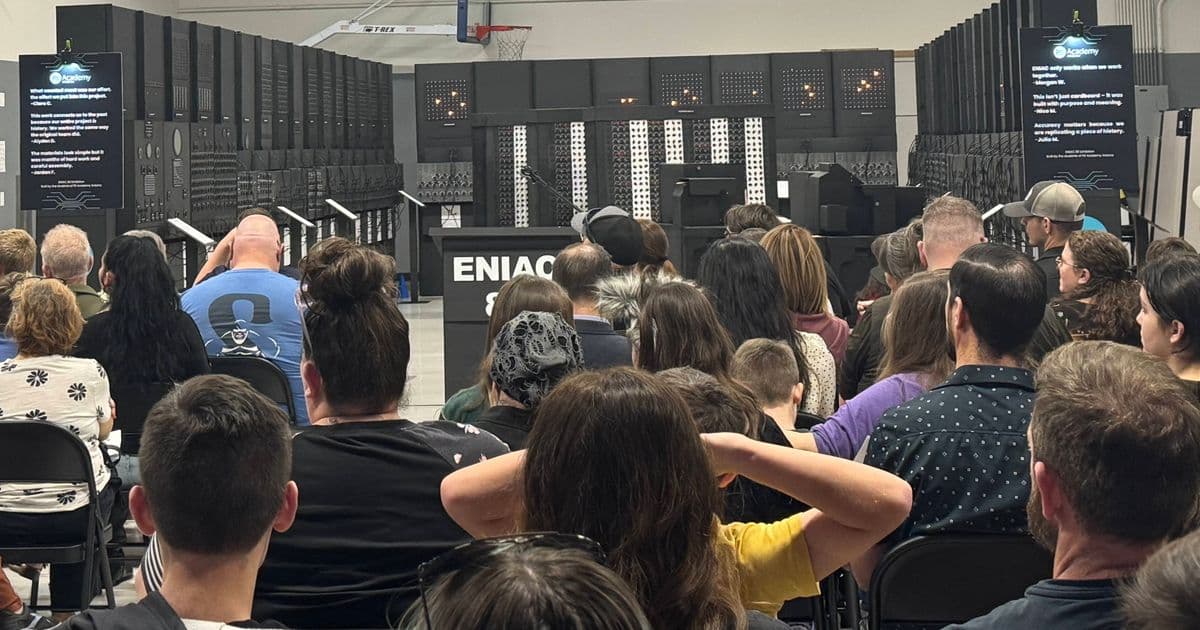
At an Arizona school, students have constructed a 500-square-foot replica of the ENIAC computer using wood, cardboard, and hot glue, marking the 80th anniversary of the original machine's dedication.
Students at PS Academy Arizona have completed an impressive project: a full-scale, historically accurate replica of ENIAC, the world's first general-purpose electronic computer. Built using cardboard, wood, hot glue, and LED lighting, the 500-square-foot structure recreates the machine as it was when first commissioned in 1946, marking 80 years since its dedication at the University of Pennsylvania.
ENIAC (Electronic Numerical Integrator and Computer) represented a monumental leap in computing technology. Conceived during World War II, construction began in 1944 and finished in 1945. The original machine weighed approximately 30 short tons (about 27 metric tons) and contained nearly 18,000 vacuum tubes. While other computing devices existed at the time—including Britain's Colossus—ENIAC's general-purpose, programmable design set it apart from specialized machines like code-breakers. The US Army Ordnance Corps financed the project, and it was formally accepted in 1946. The original machine was eventually dismantled as obsolete, with its components distributed to museums and universities.
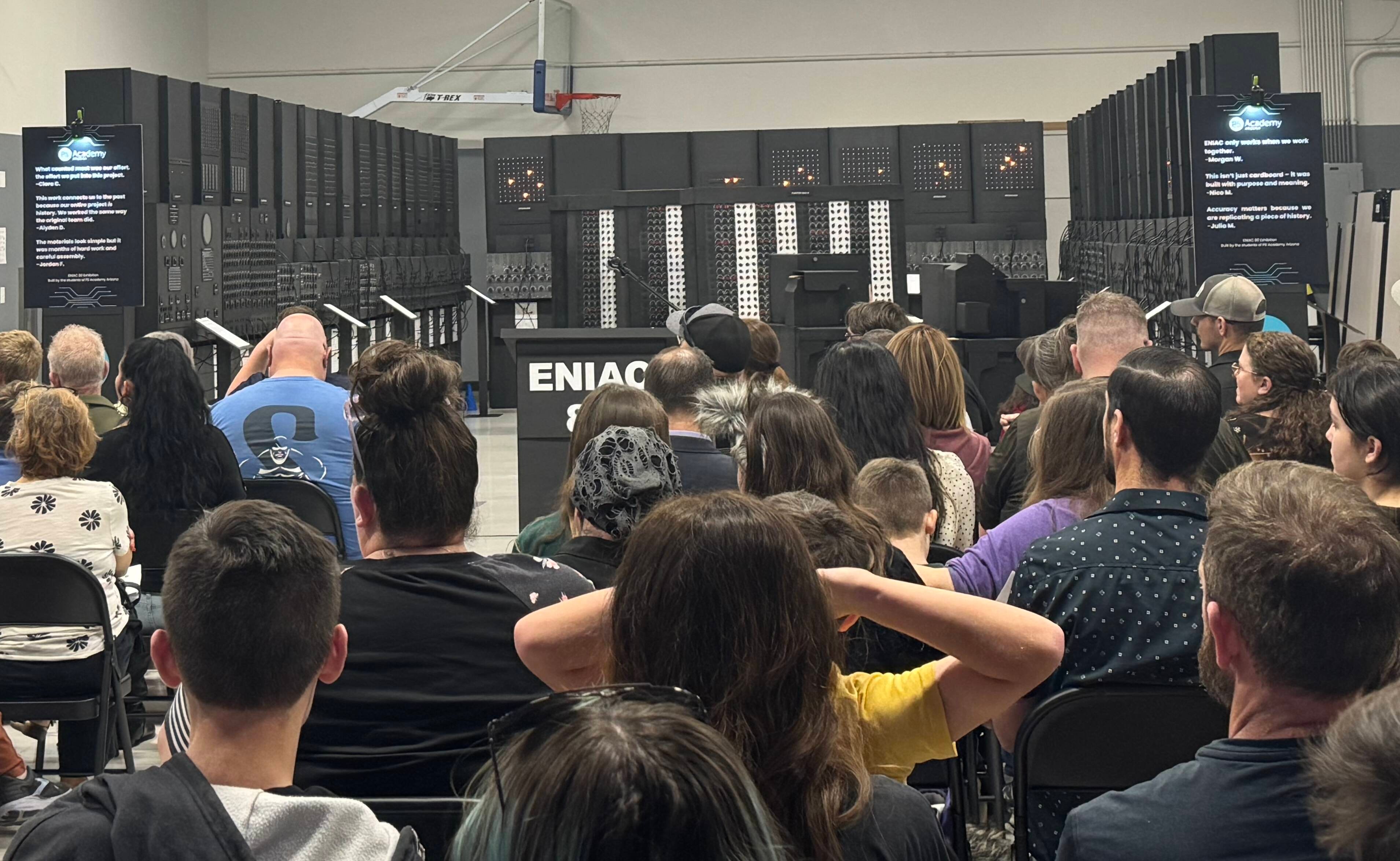
The Arizona replica consists of 45 individual units, each corresponding to ENIAC's major components: accumulators, function tables, initiator, and master programmer. Technology instructor Tom Burick describes it as "a full-scale, historically accurate structural replica," though it is not functional. "All electronic components are visually simulated, not electrically active," he explained. "Vacuum tubes were recreated using paper printed elements that match the size, spacing, and density of the originals."
The project required approximately 80 students to labor for six months, first on design and ensuring accuracy at scale, then on the meticulous work of creating and assembling the elements. "That repetition is historically appropriate," said Burick. "The original ENIAC required the same kind of patient, precise labor, just with soldering irons instead of hot glue."
While several ENIAC simulators exist digitally, this physical approach offers unique educational value. "This project was never intended to recreate a working ENIAC," Burick emphasized. "It was designed to recreate the experience, scale, and structure of ENIAC—so students and the public can understand what early computing really looked like and what it demanded of the people who built and operated it."
The replica helps students grasp the logic and workflow of early computing by understanding how the original ENIAC engineers solved problems. The dense, repetitive, and precise nature of the machine becomes tangible when students can see the spatial relationships between components and trace the cabling paths and plugboard interfaces.
This hands-on project demonstrates how physical modeling can make abstract computing concepts concrete. By working with materials like cardboard and hot glue, students experience the same kind of patient, precise labor required by the original ENIAC builders, providing historical context alongside technical understanding.
The replica stands as a testament to both the engineering achievement of ENIAC and the educational value of hands-on learning in computer science history.
Comments
Please log in or register to join the discussion